
Digital Identity: Personal vs Professional
Recently, I have started to realise that my digital identity can impact both my personal and professional life in the online space and the real world. It is essential to understand what content is suitable for each platform to maintain a good reputation with all my friends, family, followers, and anyone who views my account and content.
It is important to understand how to maintain your digital boundaries. This means the content you share, the audience it reaches, the platforms you use to share content on, and your profile / how you present yourself online. These can all have an impact on your life in both a personal and professional matter.
First, let’s understand the different types of digital identity.
| Personal Digital Identity | Professional Digital Identity | |
|---|---|---|
| Audience | Friends, family, followers, other platform users | Employers, professional contacts, classmates, professors |
| Content Shared | Hobbies, trips, opinions, photos, videos, stories, vlogs | Resume, achievments, portfolio, projects, work history, work strenghts and experiences |
| Purpose | Connect with friends, family & others + share your interests | Connections, networking, share academic achievments, build a reputation |
| Style of Text | Casual, humor, informal | Professional, respectful, formal |
| Example Platforms | Instagream, X (Twitter), TikTok, Reddit | LinkedIn, Indeed, Professional email, academic platforms (Brightspace, MS Teams, Mattermost) |
From the table above, there are clear differences between the usage of personal and professional digital identity. When I reflect on my own digital identity, I can relate to these differences.
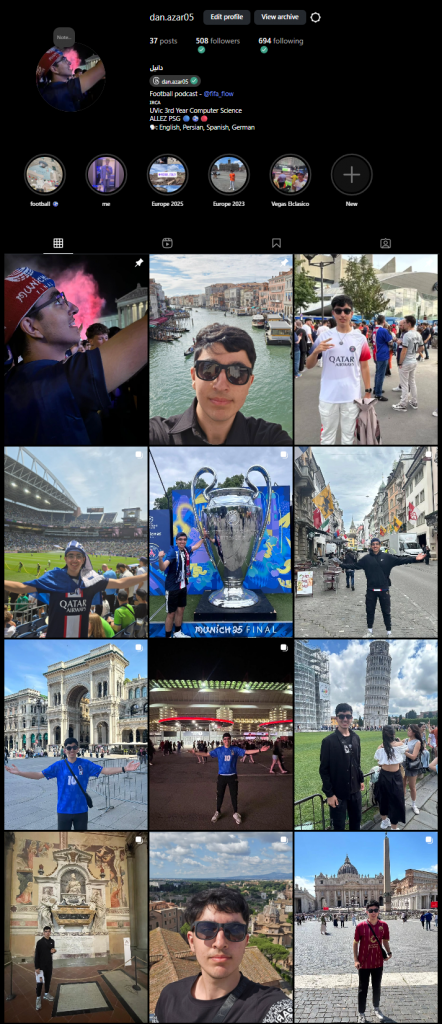
For example, on platforms such as Instagram, I am able to be more casual as I share content related to my hobbies. Some of these include the trips I have been on, photos I have taken during my days out, time with family or friends & posting my hobbies such as football.
On other platforms such as X (formerly known as Twitter), I can share my football opinions and read news about my interests. It’s not to say that these platforms cannot be used for professional matters; however, for my use, it is more of a personal digital space.
As for my professional digital identity, I use platofrms such as LinkedIn and outlook, using my school email. I make sure that the tone of my message is more formal and respectful.
I try managing my boundaries and online presence by making sure I am not posting anything controversial that may ruin my reputation. It is important to know what type of content you are sharing and the audience it is reaching as it may affect you and others. That comes into place for both in my personal and professional online presence. When it comes to my professional accounts, I try to make sure that my profiles are up to date and show the strengths and qualities that I can deliver to other professional networks.
Overall, it is important to understand the difference between personal and professional digital identity. Understanding these has helped me become more aware of my online presence.
Digital Visitor and Resident Map
Over the past week, I learnt the difference between a digital visitor and digital resident as well as reflect on the platforms and applications I use for both my personal and professional use.
Before I get into my usage of social media, lets go over the different ways that we can use it:
| Resident | Visitor | Personal | Professinoal |
|---|---|---|---|
| – Active on the platfoorm daily, – engagine and interacting with the content – posting, commenting and connecting – have an open profile on the platform | – a quick search or reading a post – not logging into the site | – used to connect with friends and familly – share your opinions – used to show and follow your hobbies, interests, and enternainment | – used for work, netwroking, school and career |
As for my Digital Visitor and Resident Map, I was able to reflect on the platforms I use and what I use them for. I found it very interesting to reflect on my usage of social media. Here is what I found out after reflecting:

From the map, you can see that I use platforms such as Instagram and X (Twitter) daily, hence why I placed them towards the resident and personal side of the map. When it comes to a platform such as TikTok and YouTube, although I also use those platforms for entertainment, I also use them as a tool for learning new topics and concepts, either for my interest or for university courses. Applications such as MS Teams, Brightspace, and Mattermost are used for school communication. Platforms such as Outlook and Gmail are also for both my school, professional, and personal use when I sign up for new platforms, connect with others, and plan my calendar. Currently, my map is a mix of both social and personal use, but also for student purposes. However, I can start to notice that I am slowly starting to change direction to a more professional use as a finishing university and start looking for a career in my degree. It’s not to say that I will still not be using other applications such as Instagram and X (Twitter), however, in a few years, this map will for sure look completely different from how it is now.
Theories of Personalized Learning
Everyone has their own style of learning, whether it’s through visual information, hands-on practice, independent learning, or class lectures; learning styles can vary significantly. After understanding what personalized learning is, I realized that it’s not only important to know ‘what’ you’re learning, but also to understand your learning style. Personalized learning focuses on tailoring education to meet each student’s unique needs, interests, and learning styles. There are two theories of personalized learning:
Constructivist Learning
Constructivist learning suggests that, rather than listening to a lecture or reading notes, people learn by actually completing tasks such as problem solving, asking questions, reflecting, teaching others, or even working cooperatively. Students enhance their knowledge of new concepts and topics by using past experiences and information they already know.
Self-Directed Learning
Self-directed learning is essential; you are the teacher and the teaching. You set your plans, topics to learn, how you learn them, when to do them, finding suitable resources, and reflecting on the progress. Instead of relying on the teacher to give you information and a set of instructions, you are more responsible and independent in your learning.
In my own experience, both constructivist and self-directed learning have had an impact on my learning journey.
When it comes to self-directed learning, I feel that there is less pressure on me. I like setting the pace of my learning, the resources I am allowed to use, and choosing the topics that interest me. Although there is more freedom in this style of learning, it requires a lot more responsibility, discipline, and desire to learn. An example for myself would be my interest in learning my ethnic language. Growing up in a Persian family, I was able to learn and listen to the words that they spoke at home; however, since I was raised in an English-speaking country, I never got the chance to learn how to read and write, or, furthermore, enhance my speaking skills in Farsi. Therefore, this past summer, with the idea of self-directed learning, I collected multiple resources from online and in person, set my deadlines, created my assignments, and used my style of learning, via online sources such as social media, translation platforms, and textbooks, to develop my Farsi writing, reading, and speaking.
Both constructivist and self-directed learning have their pros and cons. I like a mix of both styles of learning. Constructivist learning offers engagement with others, group work, hands-on assignments, and times where I can reflect and apply my current and past knowledge to the tasks. On the other hand, I have more freedom when self-directed learning is involved since I can choose how I study, when I learn, and the pace at which I study. A combination of both, what is known as “Learner-Centered Learning”, is what I find the best style of learning.

Privacy, Surveillance, and Digital Footprint Awarness
Whether it’s posting on social media, online websites, or other applications and platforms, almost everything we do online is being tracked and can leave a trace behind. This is what is known as our ‘Digital Footprint’. After reading several articles and listening to videos, given by this course and my own personal interest, I realized how how much a digital footprint I create.
I try to limit the number of platforms I am active on and the time I spend online. The more I interact on social media and applications that I use, the more of my personal information and digital identity are revealed and shared. An example is not allowing full access to most of my mobile applications. This includes limited access to my photos, location, camera, and other privacy settings that I don’t want to be shared. When it comes to my online saftey, I always make sure I am using secure and trusted links, run occasional scans on my devices for any malware or virus, create strong passwords for my accounts which are updated regularly and not common amongst all other online platforms which I use, and finally, updating my computers software for further protection. Recently, I have been going through each application individually to limit the data I allow the app to access, and changing some of my privacy and security settings. I also make sure that before posting online, the content I share is not harmful or misunderstood to ruin my reputation.
It is very important to be aware of what applications and online platforms are collecting your data and how it is being used.
Thanks for reading my blog. Feel free to leave a comment on your suggestions and opinions or if you have any questions you would like to ask.
Make sure to check out some of my other blogs and social media links to stay connected!
Leave a Reply