

We paddle together toward a future where Indigenous languages are not just revitalized, but revered and given great respect. We accept the levels of responsibility we each need to take on to engage with this work. This journey stems from a history of deep resilience and works only through good relationships and reciprocity with all who partake in it. A journey is a forward motion into a good future, and paddling in a canoe works when each person picks up their paddle and sets their mind on a shared destination. We gather in conversation as Indigenous people, language speakers and learners, established and emerging language scholars and educators, mentors, and mentees, and non-Indigenous people, researchers, educators, and graduate students to plan our journey ahead. We look forward together.
Infographics
The following infographics were designed by two artists in collaboration with members of the pē-kiyokētān collective. They are based on artifacts from group discussions held during our first gathering in September 2023 in Saskatoon. The artists incorporated several rounds of feedback from both the infographics team and the larger collective. Select nêhiyawêwin words are included in these graphics, though we hope to expand representation to more languages and landscapes in future iterations.
These infographics are meant to be shared widely, both to reflect the collective work taking place within the pē-kiyokētān collective and to inspire further learning, conversation, and efforts toward Indigenous language revitalization and centering Indigenous languages in language education contexts.
Coming soon! In progress is a curated list of resources for folks who want to learn more about the concepts captured in the infographics.
Series 1: The 5 Rs
This series, designed by Robin Anderson, is built around the 5 Rs shown on the paddles above. These infographics are meant to be taken in together.
“Resilience”

We move toward language revitalization by supporting Indigenous communities’ resilience. Resilience is the capacity to withstand or to recover from difficulties and to thrive in the face of resistance. Through Indigenous resilience, we can see a future where languages are reclaimed, and Nations can be renewed in this reclamation of cultures. This is possible due to deep roots, long memory, and ongoing story. We are grounded and invite others to know our roots so we all may flourish together. We gather in community and create new communities in this ongoing work. We gather in conversation as Indigenous people, language speakers and learners, established and emerging language scholars and educators, mentors, and mentees, and non-Indigenous people researchers, educators, and graduate students to ensure our work is rooted in the knowledge of the deep resilience that continues to ground Indigenous culture, languages, and peoples.
“Reciprocity”

Reciprocity means recognizing that relationships between Indigenous and non-Indigenous peoples must be based on mutual respect, understanding, and collective growth. We share so we can meet shared visions and thrive as individual Nations and collectively. This takes trust, cooperation, and good intentions. As we gather in discussion, we realize that we are entering into an “infinite back and forth” of sharing, learning, and unlearning. Indigenous language revitalization cannot take place within one person working alone, but in community, across Nations, and within all learning spaces and places. It must be reciprocal work and for the good of all peoples. One person in a canoe makes for a slow journey. Many working together can gain momentum and realize a forward path. We gather in conversation as Indigenous people, language speakers and learners, established and emerging language scholars and educators, mentors, and mentees, and non-Indigenous people, researchers, educators, and graduate students to share in this important work.
“Reverence”

Reverence means to regard or treat one another with deep respect. We look to our relationship with nature to help us understand this feeling. We treat earth with dignity and reverence. This also means all our relationships and partnerships should understand and act toward this way of being with nature and one another. We move forward in partnership with others with the understanding that knowledges, languages, and cultures stem from the earth, and are sacred. Spiritual connections guide our relationships and journeys. We hold the relationships up and ask all involved to respect that which comes when you enter deeper conversations and accept the work that we embark upon. We are stewards of the earth, water, and sky. This work deepens our connection and understanding to the world around us. We gather in conversation as Indigenous people, language speakers and learners, established and emerging language scholars and educators, mentors, and mentees, and non-Indigenous people, researchers, educators, and graduate students to be show and hold reverence for the work being done.
“Respect”

Respect is a regard for the feelings, wishes, rights, or traditions of others. In deep respect, we gather together to embark on this journey. We show kindness and compassion to others along the way. We come with good intentions. We hold space for what is to come. We ask that all on this journey participate with openness, responsibility, and diligence. We acknowledge that this is a long journey and takes patience and time. Respect means being open to new ideas. Respect is a way through when there are differences. Respect is the river pushing us forward with an entire network of creatures swimming beneath us. We paddle gently but with determination for a new future. In conversation we find common needs. Respect the relationship with those you’re working with, respect the purpose you are pursuing together, respect other ways of understanding, and respect traditional names of land and places. We gather in conversation as Indigenous people, language speakers and learners, established and emerging language scholars and educators, mentors, and mentees, and non-Indigenous people, researchers, educators, and graduate students, and we have a shared desire for a continued respect of people, process, and land. Our lands are vast and wide, from the ocean, to prairie, to mountain, to sea, we are connected by riverways and honour and respect urban and rural lands where we live, learn, and unlearn.
“Relational”

All my relations. We live in physical, spiritual, and sacred spaces across turtle island, and we live in the knowledge that everything is connected. We are connected to past, present, and future happenings, and to our ancestors through land, language, and culture. We are connected to our local communities in their present states. We connect to the future through new relationships between communities, knowledge keepers, universities, and students of language. We gather in conversation as Indigenous people, language speakers and learners, established and emerging language scholars and educators, mentors and mentees, and non-Indigenous people, researchers, educators, and graduate students, and we see the interconnectedness of ourselves, our ideas, our biases, and our creativity. Pursuing this work together will require deep questioning and reflection from non-Indigenous partners. Questioning colonial understandings of relationships, time, and community. Reflecting on what it means to build personal relationships, non-extractive relationships. Normalizing taking time to build relationships with those we journey beside. Our land is connected from ocean, to prairie, to mountain, and to sea. We are connected by rivers and waterways and all peoples along the way living in rural lands and urban cities, we gather with you and for you to journey together toward Indigenous Language Revitalization. We are all connected. All my relations.
Series 2: Solidarity & Centring Indigenous Knowledges
These three stand-alone graphics, designed by Elise Visentin, can be used with Series 1, as their own series, or each one individually on their own.
“Solidarity”
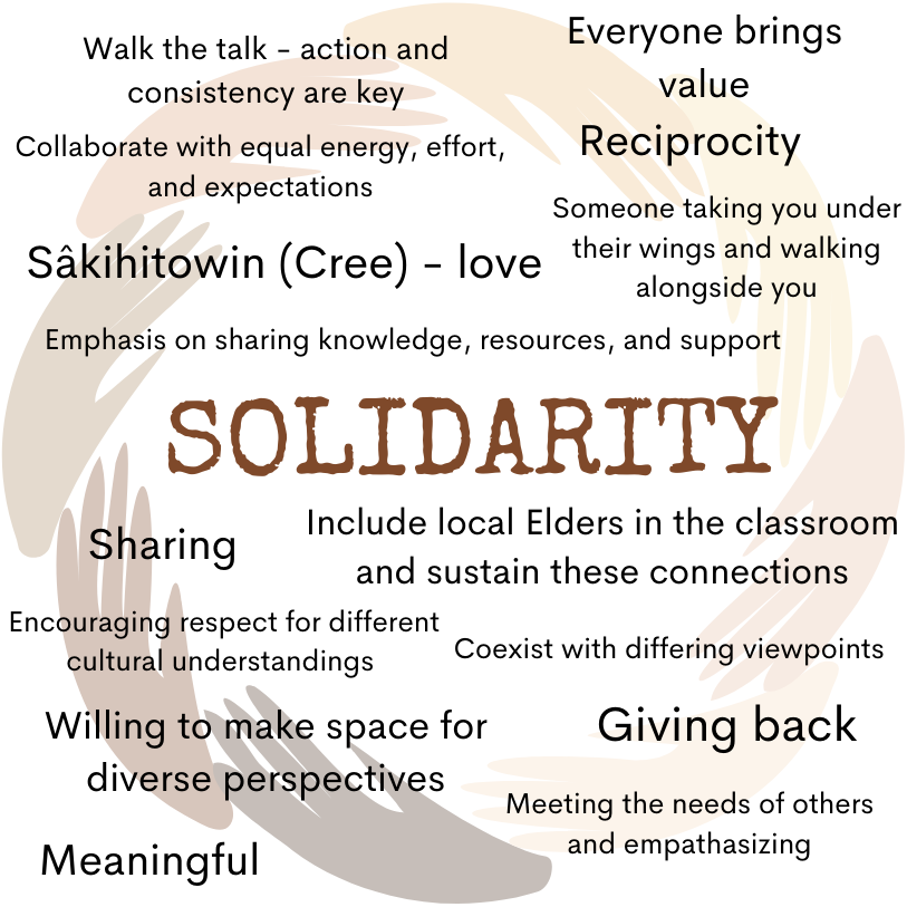
Solidarity between Indigenous and non-Indigenous communities, students, and teachers thrives on the pillars of relationship, reciprocity, and respect. It’s a shared journey of responsibility towards education and knowledge transmission, emphasizing tangible outcomes and mutual contributions. This solidarity is rooted in the art of sharing – exchanging ideas, understanding diverse needs, and building collaboration with equal enthusiasm and expectations. It challenges and reimagines colonial interpretations of relationships and community, creating space for diverse perspectives and honouring different valid ways of understanding. True solidarity is about gracefully stepping aside when necessary, valuing and embracing different viewpoints, and nurturing a community that thrives on mutual support and collective growth.
“Centering Indigenous Knowledges in the Classroom”
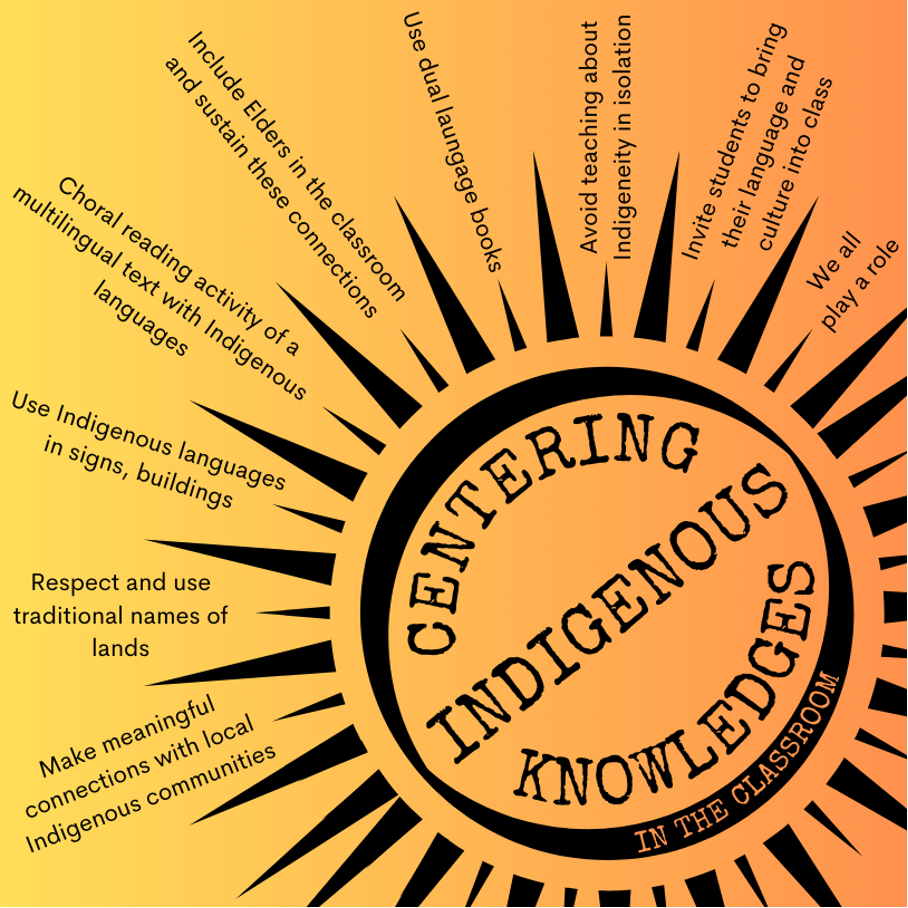
How do we center Indigenous knowledges in the classroom? It starts with actively engaging with Indigenous communities, immersing ourselves in culturally appropriate materials, and honouring the ancestral lands by using their traditional names. Incorporating Indigenous ways of knowing throughout the year gives depth and context to learning, fostering a deeper connection to local knowledges, languages and the land itself. Bringing elders into the classroom not only imparts invaluable wisdom but also cultivates meaningful relationships, creating a learning environment that respects and embraces Indigenous knowledges. This work is essential for fostering inclusive and equitable education that honours and uplifts Indigenous voices and perspectives.
“Centering Indigenous Knowledges in Research”
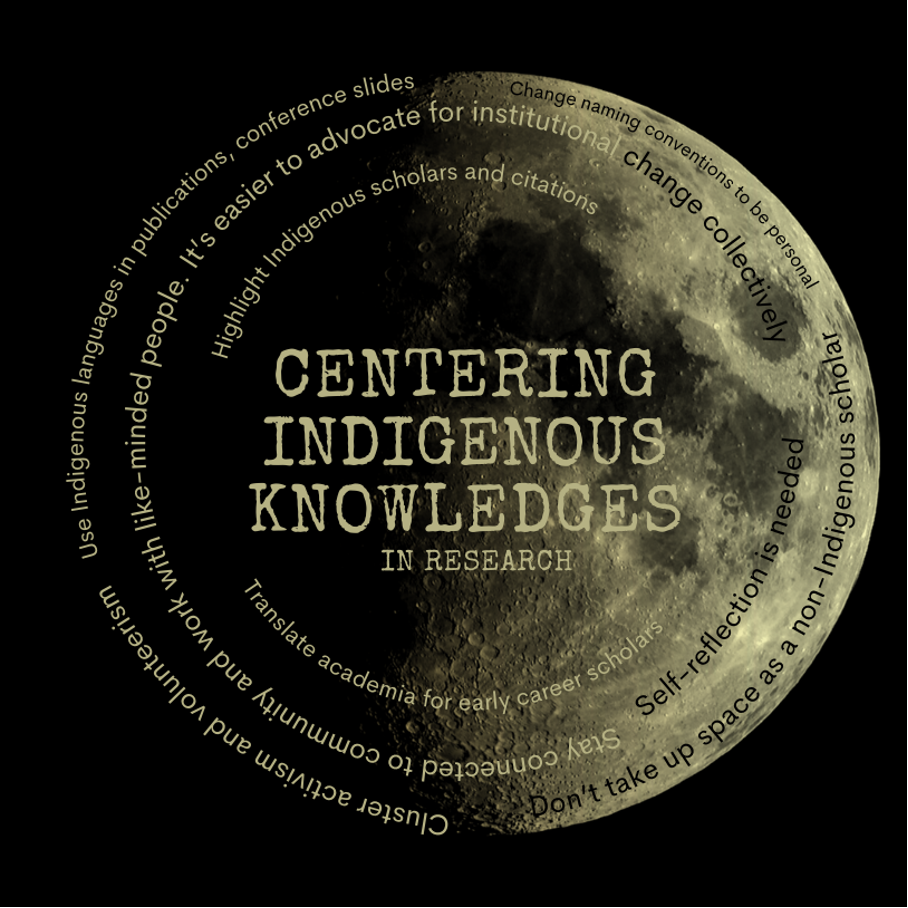
How do we center Indigenous knowledges in research? It begins with strong support from institutions, leadership in higher education, colleagues, and other researchers. We must ensure the visibility of Indigenous languages and perspectives in publications, grant applications, and conference materials. Each of us has a vital role in driving change by translating academic language, decolonizing citation conventions, and engaging in critical self-reflection. This includes examining our biases, being mindful not to dominate discussions as non-Indigenous scholars, and actively learning from Indigenous scholars. Together, we can cultivate a research environment that honours, respects, and integrates Indigenous knowledges authentically.
How to Cite
pē-kiyokētān with Cunningham, C., Meunier, L., Anderson, R., Visentin, E., Accurso, K, & Wernicke, M. (2025). Gathering toward Indigenous language revitalization [Infographics series]. https://onlineacademiccommunity.uvic.ca/pe_kiyoketan/