




Publications
Journal Articles, Books, & Book Chapters
In press/2026
Wu, C. & Lou, N. M. (2026). Optimizing AI-mediated wellness interventions’ design, engagement, and adaptation: Introducing the AI-DEA framework for mental health support and psychological change. Journal of Psychology and AI, 2(1), 2726432.
Lou, N. M. & Justus, B. (in press). Game-mediated intercultural communication: Exploring the socio-psychological mechanisms of collaborative play. Journal of Intercultural Communication Research.
Mede, N. G., Cologna, V., Berger, S., Besley, J., Brick, C., Joubert, M……Lou, N. M., …… TISP Consortium. (in press). Public communication about science in 68 countries: Global evidence on how people encounter and engage with information about science. Science Communication.
Yao, Y., Rong, M., & Lou, N. M. (2026). Can GenAI deliver growth-oriented feedback? Evidence for enhancing learners’ growth mindset and adaptive motivation in second language writing. Journal of Second Language Writing, 73, 101340
Li, J., Costigan, C. L., & Lou, N. M. (in press). A profile of triadic acculturation gaps in Chinese Canadian immigrant families. Journal of Family Psychology.
Unruh, N. U., & Lou, N. M. (2026). The diversity business: Narratives of international student recruitment in Canadian universities. Journal of International Students, 16(14), 229–250.
King, R. B., Lou, N. M., & Barger, M. (2026). Expanding growth mindset research to fulfill its promise in education: International perspectives. Social Psychology of Education, 29, 62.
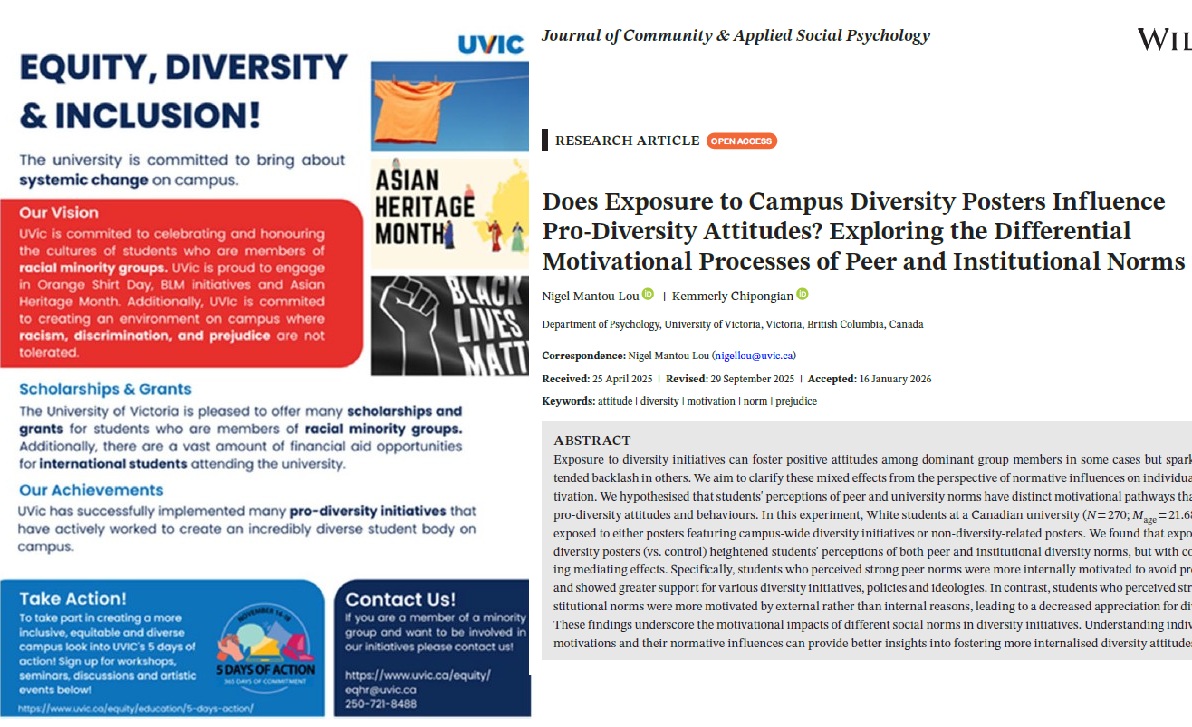
Lou, N. M. & Chipongian, K. (2026). Does exposure to campus diversity initiatives influence White students’ pro-diversity attitudes and behaviors? Exploring the differential motivational processes of peer and university norms. Journal of Community & Applied Social Psychology, 36(2), e70227.
Miske, O., Abatayo, A. L., Daley, M., Dirzo, M., Fox, N., Haber, N., ……, Lou, N. M., ……., Zupan, Z., Nosek, B. A., & Errington, T. M. (2026). Investigating the reproducibility of the social and behavioural sciences. Nature, 652, 135–142.
Aczel, B., Szaszi, B., Clelland, H., Kovacs, M., Schulz-Kümpel, H., Holzmeister, F……., Lou, N. M., …… Nosek, B. (2026). Investigating the analytical robustness of the social and behavioural sciences. Nature, 652, 135–142.
2025
Leis, A., Haukås, Å., Lou, N. M., & Nakamura, S. (2025). Mindsets in Language Education. Multilingual Matters.
Lou, N. M. (2025). Sustaining growth requires contextual support: The Mindset × Ecological System approach to motivation. Studies in Second Language Learning and Teaching,15(2), 401–426.
Lou, N. M., Chaffee, K. E., & Noels, K. A. (2025). Beyond aptitudes and experiences: The unique role of mindsets in emotions in language classrooms. Learning and Individual Differences, 120, 102688.
Lou, N. M., Justus, B., & Schopper, I. (2025). Intersectional stereotypes of race and migration status: The double standards toward Asian international students. International Journal of Social Psychology, 40(2-3), 626–650.
Ivande, K., Schopper, I., & Lou, N. M. (2025). Integrated approach to group discrimination and protective factors in Asian university students: Implications for mental health. International Journal of Intercultural Relations, 105, 102112.
Lou, N. M. (2025). Course design for the psychology of migration: Intradisciplinary and experiential approach. Scholarship of Teaching and Learning in Psychology, 713–719. Preprint Materials
Zarrinabadi, N., & Lou, N. M., & Rezazadeh, M. (2025). Rethinking teaching skills: Growth teaching mindsets predict teachers’ positive emotions and effective management in EFL classrooms. Social Psychology of Education, 28, 157.
Khajavy, G. H., & Lou, N. M. (2025). Applying latent profile analysis in foreign language anxiety research: Uncovering hidden groups. Studies in Second Language Learning and Teaching, 15(4), 797–829.
Peters, H., Ahn, T., Gong, R., Lou, N. M., & Harley, J. M. (2025). Anti-harassment policies across Canadian and international medical programs: Strengths, areas for improvement, and a need for standardization. Canadian Medical Education Journal, 16(3), 56–66.
Haghiri-Vijeh, R., Huel, C., Maimets, I. K., Montague, J., Clark, N., Lou, N. M., & Lee, E. O. J. (2025). Strategies to support the mental health and well-being of migrant LGBTQIA+ college and university students: A scoping review protocol. JBI Evidence Synthesis, 10, 11124.
Mede, N. G., Cologna, V., Berger, S., Besley, J., Brick, C. Joubert. M., ……Lou, N.M., ……Zwaan., R. (2025). Perceptions of science, science communication, and climate change attitudes in 68 countries – the TISP dataset. Scientific Data, 12,114.
Cologna, V., Mede, N. G., Berger, S., Besley, J., Maibach, E., ……Lou, N.M., ……Zwaan., R. (2025). Trust in scientists and their role in society: A global assessment in 68 countries. Nature Human Behaviour, 9, 713–730.
Cologna, V., Meiler, S., Kropf C. M., Luthi, S., Mede, N., ….. & TISP Consortium. (2025). Extreme weather event attribution predicts climate policy support across the world. Nature Climate Change, 15, 725–735.
Van Drom, A., & Lou, N. M. (2025). Learning how to learn leads to the belief one can learn: The motivational dynamics of metacognition and language mindset. Leis, A., Haukås, Å., Lou, N. M., & Nakamura, S. (Eds). Mindsets in Language Education (pp. 229-247). Multilingual Matters. Preprint
2024
Lou, N. M., Lin, Y., Li, L.M.W. (2024). The environment is somewhat alike for different adaptive motivations: Machine learning reveals optimal motivational contexts involve collective support of parents, teachers, and peers. Contemporary Educational Psychology. Preprint Materials
Jiang, Y., Tian, L., Lou, N. M. (2024). From growth mindsets to positive outcomes in L2 learning: Examining the mechanisms of autonomous motivation and engagement. System, 127, 103519.
Roseler, L., Kaiser, L., Doetsch, C. Klett, N., Krapp, J.,…… Lou, N. M., ……. Zhang, Y. (2024). The replication database: Documenting the replicability of psychological science. Journal of Open Psychology Data.
Lou, N. M. & Noels, K. A. (2024). Striving to reach the “native speaker standard”: A growth belief may mitigate some deleterious effects of social comparison in migrants. International Journal of Intercultural Relations, 101, 101990.
Harley, J. M., Lou, N. M., Ahn. T., & Lau, C. H., Liu, Y. (2024). Improving Queer history knowledge and perspective-taking toward LGBTQ+ people: There’s an App for That. Teaching and Teacher Education, 143, 104545.
Jiang, Y., Yue, S., & Lou, N. M. (2024). Exploring the motivational mechanisms of growth beliefs on perseverance among EFL students: The role of ideal and ought-to L2 selves. International Journal of Applied Linguistics.
Rahimi, M., Hejazi, S. Y., Lou, N. M., & Heidarzadeh (2024). Are teachers with better work-life quality more innovated? The mediating roles of psychological empowerment and teaching mindsets. Acta Psychologica, 247, 104315.
Elahi Shirvan, M., Saeedy Robat, E., Alamer, A., Lou, N. M., & Barabadi, E. (2024).A multilevel meta-analysis of language mindsets and language learning outcomes in second language acquisition research.Educational Psychology Review, 36(1), 1-30.
2023
Lou, N. M., & Li, L.M.W. (2023). Social mobility and motivational payoff: Achievement motivation is more important in students’ performance and well-being in cultures with high vs. low social mobility. Journal of Cross-Cultural Psychology. Preprint
Lou, N. M., & Noels, K. A. (2023). “Your English is good for an immigrant”: Examining mixed effects of mindset messages on perceived linguistic potential of and blame attributions towards ESL migrants. Journal of Language and Social Psychology, 42(3), 300–323.
Grossmann, I., Rotella, A., Hutcherson, C., Sharpinskyi, K., Varnum, M. ……Lou, N. M.,…..Wilkenining,T. (2023). Insights into accuracy of social scientists’ forecasts of societal change. Nature Human Behaviour, 7, 484–501.
Lou, N. M., & Li, L.M.W. (2023). The mindset × societal norm effect across 78 cultures: Growth mindsets are linked to performance weakly and well-being negatively in societies with fixed-mindset norms. British Journal of Educational Psychology, 93(1), 134–152. Preprint
Schaerer, M., du Plessis, C., Nguyen, M. H. B., van Aert, R. C., Tiokhin, L., Lakens, D., … & Gender Audits Forecasting Collaboration. (2023). On the trajectory of discrimination: A meta-analysis and forecasting survey capturing 44 years of field experiments on gender and hiring decisions. Organizational Behavior and Human Decision Processes, 179, 104280.
Sadoughi, M., Hejazi, S. Y. & Lou, N. M. (2023). How do growth mindsets contribute to academic engagement in L2 classes? The mediating and moderating roles of the L2 motivational self system. Social Psychology of Education, 26, 241–261.
Lou, N. M, Noels, K. A., Kurl, S., Zhang, Y. S., & Leslie, H. (2023). COVID discrimination experience: Chinese Canadians’ social identities moderate the effect of personal and group discrimination on well-being. Cultural Diversity & Ethnic Minority Psychology, 29(2), 132–144. Link
Cutumisu, M., & Lou, N. M. (2023). The roles of generic and domain-specific mindsets in learning graphic design. Interactive Learning Environments, 31(3), 1781–1795.
Haldane, C., Lou, N. M., Harley, J. M. (2023). Social-historical accounts of identity processes and resilience: Experiences of older and prominent members of the LGBTQ+ community. Journal of Homosexuality.70(3), 387–426.
Zarrinabadi, N., Lou, N. M., & Darvishnezhad, Z. (2023). To praise or not to praise? Examining the effects of ability vs. effort praise on anxiety and willingness to communicate. Innovation in Language Learning and Teaching, 17(1), 88–101.
2022
Lou, N. M., Noels, K. A. Kurl, S., Zhang, Y. S., & Leslie, H. (2022). Chinese Canadians’ experiences of the dual pandemics of COVID-19 and racism: Relations with identity, negative emotion, and anti-racism incident reporting. Canadian Psychology / Psychologie canadienne, 63(3), 279–297. Preprint Materials Media: UVic News Global News CTV News Victoria News Radio-Canada CHEK News Abbotsford News CBC Radio1 (Jan. 10) National Post Vancouver Sun Toronto Star The Province
Zarrinabadi, N., Lou, N. M., & Ahmadi, A. (2022). Resilience in language classrooms: Exploring individual antecedents and consequences. System, 102892.
Lou, N. M.,& Zarrinabadi, N. (2022). Language mindsets. In Li, S., Hiver, P., & Papi, M. (Eds). The Routledge Handbook of SLA and Individual Differences. Routledge.
Daniels, L. M., Goegan L. D., Tulloch, S., & Lou, N. M., & Noels, K. (2022). School-led mindset messaging: Understanding elementary students’ meaning and emotions. Educational Psychology in Practice, 38(3), 279-296.
Harley, J. M., Montreuil, T. C., Lou, N. M., Feldman, L., Fried, G., Lavoie-Tremblay, M., Bhanji, F., Kennedy, H. (2022). Rethinking how healthcare professionals cope with stress: A process model for COVID-19 and beyond. Health Care Management Review, 47(4), 350-359.
Lou, N. M, Chaffee, K. E., & Noels, K. A. (2022). Growth, fixed and mixed mindsets: Mindset system profiles in foreign language learners and their role in engagement and achievement. Studies in Second Language Acquisition, 44(3), 607-632. Preprint Materials
Zarrinabadi, N., & Lou, N. M. (2022). Editorial: Mindsets in language education: Research innovation and implications for language learning and teaching. Innovation in Language Learning and Teaching, 16(3), 205-207.
Zarrinabadi, N., Karimi, M., Rezazadeh, M., & Lou, N. M. (2022). Why do growth mindsets make you feel better about learning and your selves? The mediating role of adaptability. Innovation in Language Learning and Teaching,16(3), 249-264.
Lou, N. M., Noels, K. A. Zhang, Y. S. D. & Kurl, S. (2022). Ethnic minority, immigrants, and Indigenous peoples’ well-being disparities in Canada during the COVID-19 pandemic: The mediating role of threat perceptions. International Journal of Intercultural Relations, 88, 148-156.
Li, W-Q, Li, L. M.W., & Lou, N. M. (2022). Who moved with you? The companionship of significant others reduces movers’ motivation to make new friends. Asian Journal of Social Psychology, 25(2), 319-335.
Lou, N. M., Montreuil, T. C., Feldman, L., Fried, G., Lavoie-Tremblay, M., Bhanji, F., Kennedy, H., Kaneva, P., & Harley, J.M. (2022). Nurses and physicians’ distress, burnout, and coping strategies during COVID-19: Stress and impact on perceived performance and intentions to quit. Journal of Continuing Education in the Health Professions, 42(1), e44-e52. Media: Global News Montreal Gazette CTV News The Conversation Medical Press
Firat, M., Noels, K. A., & Lou, N. M. (2022).Self-determined motivation in language learning beyond the classroom: Interpersonal, intergroup and intercultural processes. In J. Maynard and Shelton-Strong S. (Eds). Autonomy support beyond the language learning classroom: A self-determination theory perspective. Multilingual Matters. Preprint
Zhang, D., Noels, K., Leslie, H. Y., & Lou, N. M. (2022). “Responsible” or “strange”? Differences in face mask use between Chinese and non-East Asian Canadians during the COVID-19 pandemic. Frontiers in Psychology, 13, 853830.
2021
Lou, N. M. (2021). Acculturation in a postcolonial context: Language, identity, cultural adaptation, and academic achievement of Macao students in Mainland China. International Journal of Intercultural Relations, 85, 213–225. Preprint
Harley, J. M., Lou, N. M., Liu, Y., Cutumisu, M., Daniels, L. M., Leighton, J. P., & Nadon, L. (2021). University students’ negative emotions in a computer-based examination: The roles of trait test-emotion, prior test-taking methods, and gender. Assessment & Evaluation in Higher Education, 46(6), 956–972.
Lou, N. M., Montreuil, T. C., Feldman, L., Fried, G., Lavoie-Tremblay, M., Bhanji, F., Kennedy, H., Kaneva, P., Drouin, S., & Harley, J. M. (in press). Evaluations of healthcare providers’ perceived support from personal, hospital, and system resources: Implications for wellbeing and management in healthcare in Montreal, Quebec during COVID-19. Evaluation & the Health Professions, 44(3),319–322. Media: The Globe and Mail Global News McGill Alumni The Gritty Nurse Podcast
Shirvan, M. E., Lou, N. M., & Taherian, T. (in press). Where do language mindsets come from? An ecological perspective on EFL students’ mindsets about L2 writing. Journal of Psycholinguistic Research, 50, 1065–1086.
Shirvan, M. E., Lou, N. M., Shahnama, M., & Yazdanmehr, E. (2021). Maintaining effort and interest despite challenges during the COVID-19 Pandemic: A process tracing approach to a teacher’s grit during an online L2 course. Journal for the Psychology of Language Learning, 3(2), 45-60.
Zhang, X., Lou, N. M., Noels, K., Daniels, L. (2021). Attributions and mindsets. In T. Gregersen & S. Mercer (Eds.), The Routledge Handbook of Psychology of Language Learning.
Zhang, D., Leslie, H. Y., Sharafaddin-Zadeh, Y., Noels, K., & Lou, N. M. (2021). Public messages about face masks during COVID-19: Perceptions of and impacts on Canadians. Journal of Community Health, 46(5), 903-912. Data & Materials Media: CBC Radio Global News Folio AlbertaPrimeTimes
Liu, Y. S., Hankey, J. Lou, N, M., Chokka, P., & Harley, J. M. (2021). Usability and emotions of mental health assessment tools: Comparing mobile app and paper-and-pencil modalities. Journal of Technology in Human Services, 39 (2), 193-211.
Zarrinabadi, N., Lou, N. M., & Shirzad, M. (2021). Autonomy support predicts language mindsets: Implications for developing communicative competence and willingness to communicate in EFL classroom. Learning and Individual Differences, 101981.
Lou, N. M., & Noels, K. A. (2021). Western and Heritage Cultural Internalizations Predict EFL Students’ Language Motivation and Confidence. International Journal of Bilingual Education and Bilingualism, 25(5), 636-650. Materials
2020
Lou, N. M, & Noels, K. A. (2020). Breaking the vicious cycle of language anxiety: Growth language-mindsets improve lower-competence ESL students’ intercultural interactions. Contemporary Educational Psychology, 61, 101847. Pre-registration Supplementary Materials Post-print
Lou, N. M., & Noels, K. A. (2020). Mindsets matter for linguistic minority students: Growth mindsets foster greater perceived proficiency, especially for newcomers. Modern Language Journal, 104(4), 739-756. Materials Post-print
Lou, N. M., & Noels, K. A. (2020). “Does my teacher believe I can improve?”: Meta-lay theories mediate the effect of teachers’ feedback on ESL students’ mindsets and need satisfaction. Frontiers in Psychology, 11, 1417. Materials
Chaffee, K. E., Lou, N. M, & Noels, K. A. (2020). Does stereotype threat affect men in language domains? Frontiers in Psychology, 11,1302. Pre-print
Lou, N. M., & Noels, K. A. (2020). Mindsets about language learning and support for immigrants’ integration. International Journal of Intercultural Relations, 79, 45–57. Materials Post-print
Cutumisu, M., & Schwartz, D. L., Lou, N. M. (2020). The relation between academic achievement and the spontaneous use of design-thinking strategies. Computers & Education, 149,103806. Data (Online supplement) Preprint
Chaffee, K. E., Lou, N. M, Noels, K. A., & Katz, J. (2019). Why don’t “real” men learn foreign languages? Masculinity threat and gender ideology suppress men’s language motivation. Group Processes & Intergroup Relations, 23(2), 301–318. Preprint Media: Youtube Conversation Pacific Standard Phys.org
Cutumisu, M., & Lou, N. M. (2020). The moderating effect of mindset on the relation between university students’ critical feedback-seeking and learning. Computers in Human Behavior, 112, 106445 Data (online supplement) Pre-print
2019
Lou, N. M,& Noels, K. A. (2019). Language mindset, meaning-making, and motivation. In by Lamb, M., Csizér, K., Henry A., & Ryan, S. (Eds.), Palgrave Macmillan Handbook of Motivation for Language. Basingstoke, UK: Palgrave Macmillan.
Noels, K. A., Lou, N. M., Lascano, D. I. V., Chaffee, K. E., Dincer, A., Zhang, Y. S. D., & Zhang, X. (2019). Self-determination and motivated engagement in language learning. In by Lamb, M., Csizér, K., Henry A., & Ryan, S. (Eds.), Palgrave Macmillan Handbook of Motivation for Language. Basingstoke, UK: Palgrave Macmillan.
Lou, N. M., & Noels, K. A. (2019). Sensitivity to language-based rejection in intercultural communication: The role of language mindsets and implications for migrants’ cross-cultural adaptation. Applied Linguistics,40 (3), 478–505. doi: 10.1093/applin/amx047 Media: OUPbolg Ualberta News
Lou, N. M, & Noels, K. A. (2019). Promoting growth in foreign and second language education: A research agenda for mindsets in language learning and teaching. System, 86, 102-126. doi: https://doi.org/10.1016/j.system.2019.102126 Preprint
Lee, H., Lou, N. M., Johnson, M. D., & Park, S. W. (2019). A Socio-ecological approach to understanding mental and physical health: The mediating role of relationship beliefs and goals. Journal of Social and Personal Relationships.36(10),3117-3138.
2015-2018
Lou, N. M., Chaffee, K. E., Vargas-Lascano, D. I., Dincer, A., & Noels, K. A. (2018). Complementary perspectives on autonomy in Self-determination Theory and language learner autonomy. TESOL Quarterly, 52(1), 210–220.
Lou, N. M., & Noels, K. (2017). Measuring language mindsets and modeling their relations with goal orientations and emotional and behavioural responses in failure situations. Modern Language Journal, 101(1), 22–33 Materials
Lou, N. M., & Li, L. M. (2017). Interpersonal relationship mindsets and rejection sensitivity across cultures: The role of relational mobility. Personality and Individual Differences, 108, 200–206. doi: 10.1016/j.paid.2016.12.004
Lou, N. M.,Masuda, T., & Li, L.M.W. (2017). Decremental mindsets and achievement motivation: An extended framework of implicit theories of intelligence. Learning and Individual Differences, 59, 96–106.
Lou, N. M., & Noels, K. A. (2016). Changing language mindsets: Implications for goal orientations and responses to failure in and outside the second language classroom. Contemporary Educational Psychology, 46, 22–33. Materials
Noels, K. A., Chaffee, K. E., Lou, N. M, & Dincer, A. (2016). Self-determination, engagement, and identity in learning German: Some directions in the psychology of language learning motivation. Foreign Languages Teaching and Learning (Fremdsprachen Lehren und Lernen), 45(2), 12–29.
Noels, K. A., & Lou, N. M. (2015). Mindsets, goal orientations and language learning: What we know and where we need to go. Contact, 41(2), 41−52.