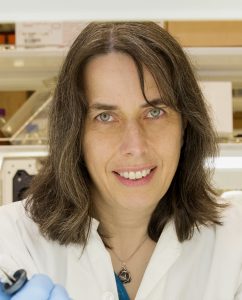
Dr. Caren Helbing has a B.Sc. (Hons) in Biological Sciences from the University of Windsor and a Ph.D. in Zoology from Western University. After postdoctoral work in cancer biology at the University of Calgary, she became a faculty member at the University of Victoria in 1999 and is a past Scholar of the Michael Smith Foundation for Health Research Foundation.
She is currently Head of the Applied Ecotoxicogenomics and Biomolecule Innovation Laboratory and Professor in the Department of Biochemistry & Microbiology. She directs a large productive research group with 400+ research papers and reports and 300+ invited presentations that investigates biomolecules to understand and promote animal (including humans!), environmental, and ecosystem health using a “Planetary Health” approach. Her internationally recognized research activities apply a broad range of cutting edge techniques including transcriptomics, genomics, proteomics, metabolomics, and bioinformatics within three themes: 1) investigation into the molecular basis of thyroid hormone action and its disruption by environmental contaminants, pharmaceuticals, and personal care products, 2) development and application of an antimicrobial peptide discovery platform as antibiotic alternatives to combat antimicrobial resistant pathogens, and 3) development and application of innovative minimally invasive methods including environmental DNA (eDNA) and environmental RNA (eRNA) for obtaining wildlife health information as sentinels of ecosystem and organismal health.
She was elected a Fellow of the North American Society for Comparative Endocrinology (2024) for significant, independent contributions to the advancement of general and comparative endocrinology. She has received several awards including a NSERC University Faculty Award, the early career award for applied ecological research in 2002 from the Society for Environmental Toxicology and Chemistry, the UVic REACH Award for Excellence in Research Partnerships in 2021 for her contributions in the development of molecular