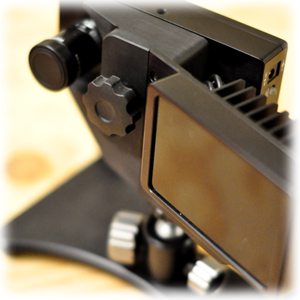
An eye tracker tracks the movement of your eyes. Using eye tracking technology, we will know where you are looking at when you are looking at the picture of a face, a bird, or watching a movie. In the Different Minds Lab, we use the EyeLink 1000 remote system by SR Research. The eye tracking camera (the picture at lower left) records the eye movement at the resolution of 1000 times per second based on the reflections of infrared from your pupils that projected by the illuminator next to the eye tracker camera. One of the advantages of remote/head-free system is that it allows reasonable head-movements. You can put a target sticker on the forehead and the eye tracker will correct the eye movement data according to your head movement in real time. This is especially helpful when you test children.
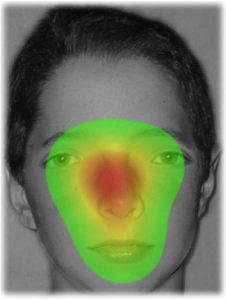
The data collected by the eye-tracker is very rich, and can be analyzed in a lot of different ways. For example, you can look at the number and the size of the saccades that are made during the presentation of the stimuli. The most direct way to make use of the eye tracking data is to visualize the eye movements in terms of heat maps. On a heat map, hotter colour refers to longer time spent in fixating at that location. Eye tracking heat maps are very useful to study high level visual processing. For example, systematic differences were presented in the processing of upright and inverted faces.