The recent changes to pricing rules in alcohol-serving establishments across BC have been met by applause, discontentment, indifference — and confusion. In effect, two changes were announced: the fact that restaurants and bars can now have happy hour drink specials, allowing them to change the price of alcoholic drinks throughout the day, and the introduction of province-wide minimum drink prices, which apply at all times, not just during happy hour.
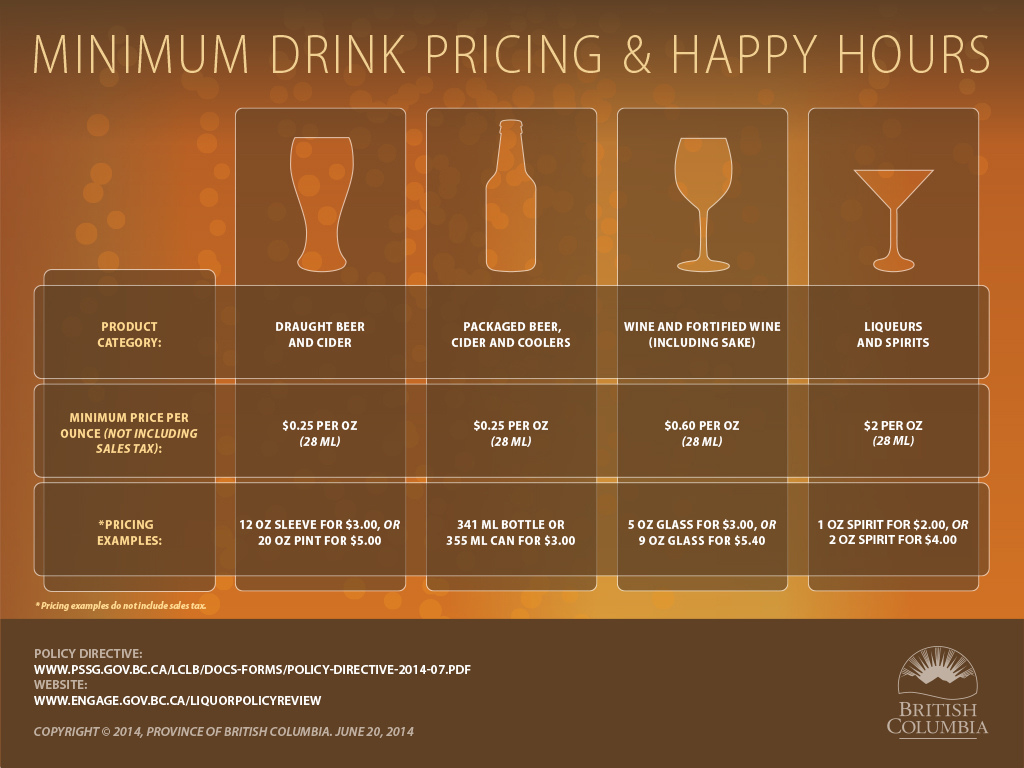
Minimum unit pricing is not a new concept. All provinces, except Alberta and Quebec, have some type of minimum pricing policy. Even prior to these new changes, BC had minimum pricing policies in place in liquor stores, though prices were much lower than many other provinces. These new requirements will bring the rest of the province in line with municipalities such as Victoria, which have had minimum unit pricing policies and bylaws in bars and restaurants for quite some time to reduce violence and other late-night order problems.
While the new requirement to charge at least $3 per standard drink may cause prices to increase at some establishments, many British Columbians will likely not notice the implementation of the minimum unit pricing—and in some instances, happy-hour specials will make booze cheaper than it was before. I can’t remember a time when I paid less than $5 for a beer at an establishment; $3 sounds like a steal. But minimum pricing isn’t really about getting “a good deal;” this bold move by the BC government is a step towards reducing alcohol-related harms in our province.
Every year in BC, there are more than 80,000 alcohol-related crimes, 1,800 alcohol-related deaths, and 18,000 alcohol-related hospitalizations. While many of us enjoy alcohol without incident, these staggering numbers remind us of how many of our fellow British Columbians are negatively affected by alcohol use. The introduction of minimum prices could reduce these numbers.
There is strong evidence that minimum alcohol pricing avoids punishing the majority of responsible drinkers while having the greatest impact on the behaviour and health of those most at-risk. Using BC hospital data, a recent study published in the American Journal Public Health found that for every 10 percent increase in minimum prices there was an immediate 9 percent reduction in hospital admissions for injuries and poisonings ‒ and a similar reduction in serious illnesses caused by alcohol (such as liver cirrhosis and cancers) two to three years later. Similarly, we have found immediate and delayed effects from minimum price increases on alcohol-related deaths. Is $3 really such a steep cost for reducing harm?
The BC government has listened to the strong research evidence supporting minimum prices and has taken a step in the right direction by implementing these prices for bars, restaurants and other establishments that serve alcohol. It is refreshing to see decisions being made will protect British Columbians while also respecting that alcohol is an important part of our culture and economy. However, in order to fully realize the harm-reduction potential of minimum pricing policies and offset the potential impact of happy hours, government needs to follow through on updating and overhauling minimum pricing in liquor stores. According to our research, this will have a much larger impact on high-risk consumption and related harms.

Author: Kara Thompson, Centre for Addictions Research of BC
**Please note that the material presented here does not necessarily imply endorsement or agreement by individuals at the Centre for Addictions Research of BC