
Does Impaired Driving Reflect Impaired Learning?

If you’ve ever driven when really tired, or been in a car with a driver who’s really tired, you know what “impaired driving” feels or looks like. (For those who don’t: in a nutshell, it’s kind of scary.) Chances are, though, you don’t think of being tired as something bad. Instead, you know that being tired means you should be in bed, recuperating by sleeping for a while.

Drug-impaired driving is much the same thing. It’s less about whether a drug is good or bad, and more about where you are when you’re feeling a drug’s full effects. While avoiding intoxication may be the best option with any psychoactive drug, if it happens, the safest place to be enjoying or reversing the buzz is at home, at a pal’s house or in the back of a taxi or sober person’s vehicle. Almost anywhere but behind the wheel.

Even though we all know we shouldn’t drive impaired, it still happens.

  • In 2012, 6.5% of BC drivers tested positive for alcohol, and 7.4% tested positive for other drugs, cannabis and cocaine being the most commonly detected substances, according to a roadside survey report.
  • ICBC reports drug impairment (involving alcohol, illegal drugs and medications) was the key factor in 23% of fatal car crashes in 2013 (speed was key in 28%, and distraction in 29%).
  • Over the last five years, an average of 86 people per year lost their lives in impaired driving crashes on BC roads.

So, what’s going on with us? What narratives are running through our heads about our rights and responsibilities as drivers? What are the best ways to change some of our beliefs and behaviours? These are the kinds of questions we not only need to be asking ourselves, but should also form the foundation of our drug education programs in schools.

Instead, most of the conversations we have with young people about drugs are not really conversations at all, but lectures aimed at scaring students into saying whatever the adults in the room want to hear. The problem with this approach is that it isn’t working. Young people, particularly young males, continue to make up the bulk of those taking unnecessary risks with substances and vehicles. We should be wondering why, and we should be talking to students more often about the things that drive their decisions to drive under the influence.
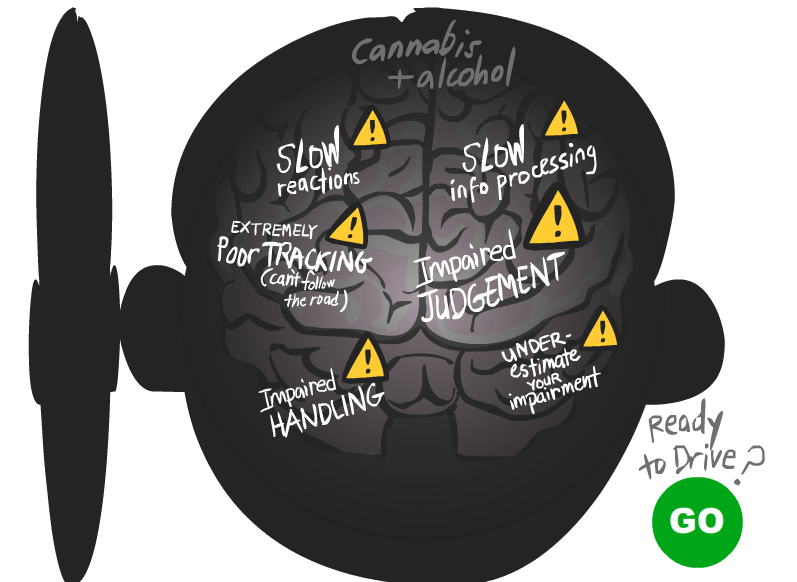
A cartoon image of a brain listing different types of impairments
A screenshot from the drugsanddriving.ca website.

Honest, open and real conversation about alcohol and other drugs is one of the goals of Drugs and Driving, a project involving a range of classroom learning activities, a variety of web apps, and even a free iPhone app. Drugs and Driving is designed for Grade 10 students but can be used in other grades as well. The program is less about telling kids about the dangers of drugs and driving and more about helping them reflect on a range of issues related to impairment. What are the things that might cause impairment? How do I know if I am impaired? Why should I care? How do we make decisions? How can I influence the decisions of my peers? These are important questions for all of us.

Bodner Nicole-

Author: Nicole Bodner, Centre for Addictions Research of BC

**Please note that the material presented here does not necessarily imply endorsement or agreement by individuals at the Centre for Addictions Research of BC.
What good are drinking guidelines if no one knows about them?

Do you know the effects that having a glass of wine a night is having on your health? Or how your risk for certain diseases and cancers increases with every drink? If your answer is “no,” then you aren’t alone. Despite the fact that 78 percent of us drink, many Canadians aren’t aware of Canada’s Low-Risk Alcohol Drinking Guidelines (LRDGs), let alone what the guidelines are (no more than two a day, 10 a week for women; three a day, 15 a week for men). This is why the Canadian Centre on Substance Abuse (CCSA), the Centre for Addictions Research of BC (CARBC) and the Canadian Vintners Association (CVA) explored the educational potential of social media by taking to Twitter this summer to promote the LRDGs.

Part of the reason there isn’t much awareness around the guidelines could be that they are relatively new. Published in 2011, the LRDGs were developed by the National Alcohol Strategy Advisory Committee using existing provincial drinking guidelines, such as those produced by CARBC, the Centre for Addiction and Mental Health and Éduc’alcool. The LRDGs provide men and women with drinking limits that can help to reduce alcohol-related harms like chronic illness and injury. Resources such as a brochure, a poster, and summaries on the relationship of alcohol and cancer, and the impact of alcohol on youth and women have all been developed to promote the guidelines, but the Twitter campaign marked the first time that a coordinated, multi-partner social-media strategy had been used to educate people.

Working together, CCSA, CARBC and the CVA planned and launched a month-long Twitter campaign that ran from mid-August to mid-September, featuring weekly themes, informative resources and a campaign hashtag (#CdnLRDG in English; #DCAFRcan in French). In addition to the above brochures and posters, some of the more lighthearted resources shared through the campaign included the Home Bartending Challenge and the How to Drink Properly video series. The late-summer time frame allowed for tweets related both to events where drinking commonly occurs, such as summer long weekends and frosh week, and to alcohol-related health promotion days, such as International Fetal Alcohol Spectrum Disorders Awareness Day. Online tools such as bitly link tracking, which allowed the group to see what resources got the most clicks, Hootsuite and Twitter analytics, Google Analytics, and Cision social media monitoring, helped the group measure success, and see what worked and what could be improved upon.

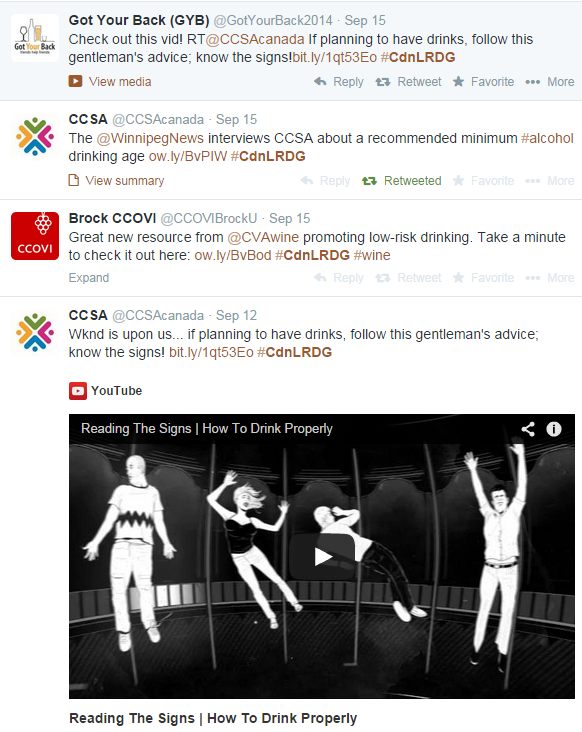
A sample of some of the #CdnLRDG tweets seen during the campaign.

Twitter provided an easy way to spread low-risk drinking messages and engage with respondents. By sharing and retweeting each other’s content, participants reached new audiences beyond their own Twitter followers. The #CdnLRDG campaign hashtag was used in every tweet, so anyone interested in the campaign could follow all conversations. Participants could also include other alcohol-related hashtags in their tweets, effectively “crashing the party” of other conversations — another great way to open up the conversation to more audiences.

Overall, the Twitter campaign increased website visits an average of 78% for the three organizations leading the campaign. However, in analyzing Twitter engagement, it was mostly healthcare organizations and workers retweeting content as opposed to the general public, who might have seen the tweets, but just not engaged in conversation. This isn’t surprising, since most of CCSA and CARBC’s followers are healthcare organizations. Extra efforts will be required to directly reach the general public in future campaigns. Yet the LRDG campaign highlights what educational goals can be accomplished with social media and great partnerships!

Authors: Tina Barton, Communications Advisor; Sheena Gereghty, PhD, Knowledge Broker
Canadian Centre on Substance Abuse

**Please note that the material presented here does not necessarily imply endorsement or agreement by individuals at the Centre for Addictions Research of BC.