UNESCO’s urgent call to action regarding the lack of female representation in social robotics and the resulting proliferation of harmful stereotypes (Dennler et al., 2024; Topić, 2023) necessitates this research. This study directly addresses these gaps by focusing on the “submissive” construct—examining its utility in crisis de-escalation for police and military personnel while confronting the legal and athletic stereotypes that hinder gender equality. Google AI Studio Disclaimer

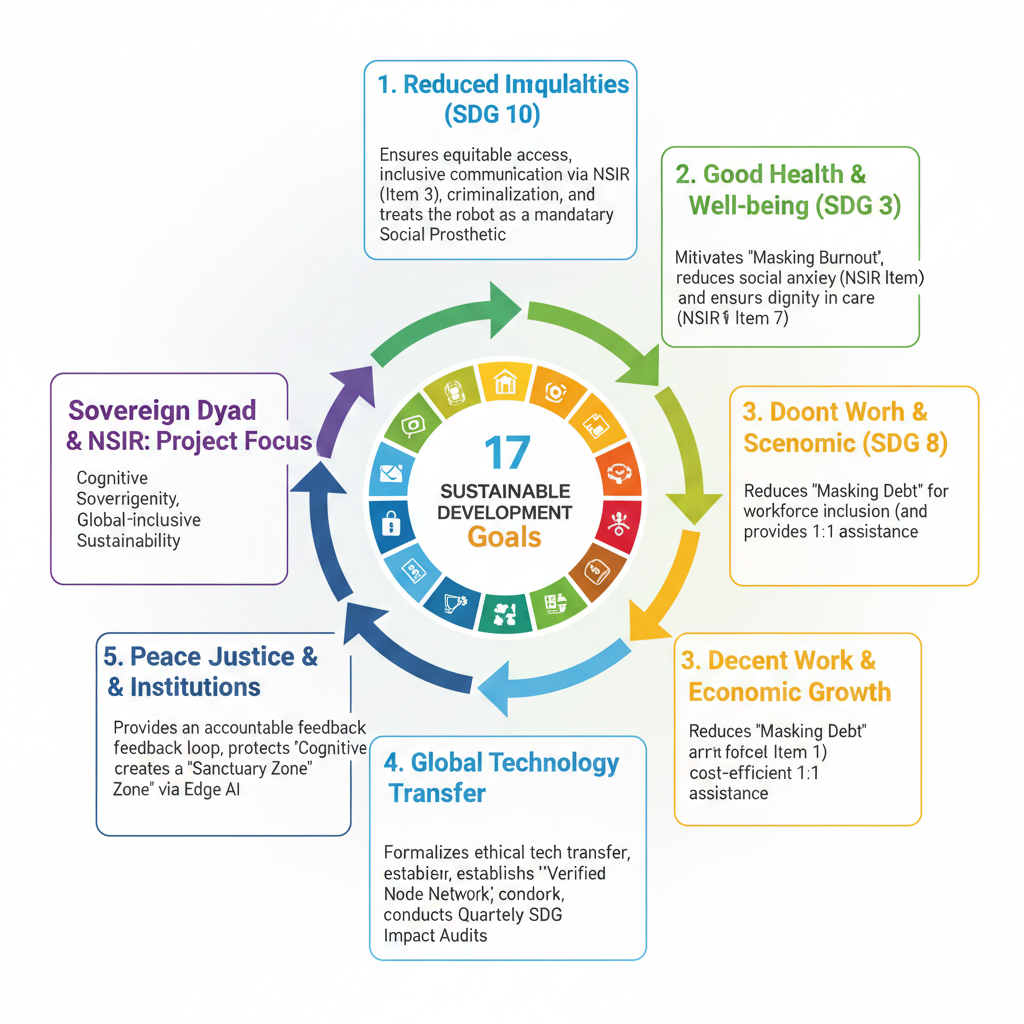
The infographic above illustrates how the Sovereign Dyad project and the Neurodivergent Scale for Interacting with Robots (NSIR) are strategically mapped to the United Nations Sustainable Development Goals (SDGs). By placing the 17 Global Goals at the center of our architecture, we move beyond “standard accommodations” toward a model of Neuro-inclusive Sustainability.
Artificial Intelligence Gemini
In the spirit of the ‘Social Exoskeleton,’ this visual representation of our SDG alignment was co-created with Gemini. It serves as a living example of how AI can be used as a social transformer to clarify and amplify neurodivergent advocacy.
Yes, Sir! (Apprenticeship Model) Implicit Biases of Intelligence
Research Question
This study asks if the presence of functional and volitional submissiveness identity influences the congruent trial reaction time and accuracy reading on an Implicit Association Test (IAT) at the same rate as the incongruent trial.
The theoretical construct explored in the study is the perception of intelligence. Intelligence can be defined in many ways, such as the ability to acquire and apply knowledge and skills, and mental acuteness.
Secondly, this study explores the current literature with keywords: submissive; feminine; social; robot; autism to gather data about the validity of the measurements of submissive in the studies presented. Can students create participatory works celebrating decolonization pedagogies?
A critical analysis of over 80 scales, theories and frameworks reviewed in the literature review suggests the identity and psychological construct “submissive” can be defined and considered in complex ways; and more specifically in response to voluntary or involuntary motives. The ability to be submissive around others, may play an important role in conflict de-escalation and group cohesion.
A meta-analysis of the literature is conducted. The construct submissiveness is examined, defended, criticized, defined and explored through various current social robotic empathy and objective reasoning (Titchener) studies ( Buttner, 2023; Graham, 2025; Kappas, 2023; Lomas, 2022; Offrede, 2022; Park, 2022), feminist theories (Ali, 2021; Calado-Barbosa, 2021; Mandal, 2024) and apprenticeship models (Casey & Wakeling, 2022; Heward, 2024; Hood, 2025).
Apprenticeship models are researched for these and neurodivergent approaches. Students can choose between social robotic research, computer graphics, music and voice dynamics, facial expressions, or discourse regarding mental health as an interest to explore and develop knowledge around.
Power Dynamics
Vekarić and Jelić (2025) note the presence of dominant and submissive power dynamic hierarchies are present in coach and athlete relationships and this includes the presence of markers of submissiveness. Vekarić and Jelić (2025) suggest these markers indicate an individual’s willingness to conform to group norms.
Further, Vekarić and Jelić (2025) posit that the presence of submissive markers fosters a sense of belonging and cohesion within the team. This dynamic was presented as a case study that highlighted the National Hockey League (NHL) Sedin twins.(Crippen & Nagel, 2014).
Pedagogical Shift
This is contrasted by the goal in education to develop critical learners who are autonomous problem solvers. This pedagogical shift represents the changing role of teachers from experts and “sages on the stage” towards a faciliators role of servant leadership (Greenleaf, 1970) and “guides on the side”. This focus on student-centered learning removed the apprenticeship model and teacher-centered activities. This also possibly lead to an impression of apprenticeship, subordinate, and submissive behaviour as passive learning.
Careers with Hierarchical Natures
Military and Police
“The structured, hierarchical nature of the military and police forces means that traits related to voluntary submissiveness—specifically discipline, adherence to rules, teamwork, and respect for authority—are highly valued and essential for success, regardless of gender”(Heward et al., 2024; Norman, & Ricciardelli, 2023; Ruiz Moreno et al., 2021; Teixeira, et al., 2024).
Law Enforcement
“While physical strength was historically a male-associated advantage in some police patrol contexts, modern law enforcement and military roles increasingly emphasize skills like communication, conflict de-escalation, and teamwork, where a diversity of personality types (including those that are more collaborative or agreeable) are highly effective”(Heward et al., 2024; Norman, & Ricciardelli, 2023; Ruiz Moreno et al., 2021; Teixeira, et al., 2024).
Conflict De-Escalation
The study, “Yes, Sir!” highlights the role of submissiveness in police and military training for all genders. There is a consideration of the role of submissivenss for de-escalation. Other disciplines include hierarchical courts of law, team sports, and relationships.
Gender Stereotypes
“Therefore, a man who exhibits “voluntarily submissive” traits like discipline, meticulousness, and loyalty can be a highly effective and successful police officer or military member. It is an individual’s capacity to function within a specific organizational structure and execute required tasks, rather than gender stereotypes, that is vital” to success and referenced by person-job fit (Heward et al., 2024; Norman, & Ricciardelli, 2023; Ruiz Moreno et al., 2021; Teixeira, et al., 2024).
This study is part of a larger Guidance Career Education Resource Catalogue project package found here:
Aims of the Study
The aims for this study are to test the presence of significant differences in Reaction Time and Accuracy for Independent Variable (IV) = Identity and the Dependent Variable (DV) = Intelligence.
Congruent Trials will consist of Identity/Intelligence, Submissive/Stupid
Incongruent Trials will consist of Identity/Stupid, Submissive/Intelligence.
The hypothesis is first impressions of intelligence are inferred automatically from the presence of submissive identity and a significant difference will be shown in both accuracy and reaction times for the Implicit Association Test (IAT) between congruent and incongruent trials.
Implicit bias is a cognitive bias, and a preference (or aversion to) a person or group of people. The IAT measures the strength of associations between concepts (i.e., identity and intelligence). Making a response is quicker when closely related items share the same response key.
Congruent stereotype trials are categories that are aligned with existing stereotypes/attitudes (expect that people will respond more quickly and accurately). Incongruent stereotype trials are categories that are misaligned with existing stereotypes/ attitudes (expect that people will respond more slowly and less accurately).
The difference in reaction time and accuracy between the incongruent and congruent tasks = the IAT effect. A significant difference ( p < .05) in reaction time speed and accuracy between congruent type trials and incongruent type trials will either be evident or not to reject the null hypothesis.
The practical real world applications of the study are to inform the academic/scientific community of recent automatic responses to first impressions.
Methods
A within-subjects one factor design Reaction Time (ms) Accuracy (%)
Stimuli for Submissive -Obedient, Passive, Acquiescent, Unassertive, Yielding, Servant, Not in Charge
Stimuli for Identity – Name, Identification, Pinpointing, Likeness, Specification, Culture, Gender, Career
Stimuli for Intelligence– Reasoning, Mind, Brain, Understanding, Judgment, Education, Grade, Level
Stimuli for Stupid -Mindless, Foolish, Simple, Slow, Ignorant, Delayed, Uneducated
The words for functional and volitional submissiveness were chosen based on the intention of the paper, implying police or military, and the title “Yes, Sir!” of the study; and verified through triangulation (Appendix A) with Google AI.
The method was to search for verification of similarity for a word with the stimuli “submissive” by placing an equal sign between the word submissive and the suggested stimuli (i.e. obedient): submissive = obedient and receiving feedback that concurred with a similarity, as yes or no by Google AI and documented (Appendix A).
The same format was repeated for each suggested stimuli listed in the implicit association test.
submissive = passive
submissive = acquiescent
submissive = unassertive
submissive = yielding
submissive = servant
submissive = not in charge
Additionally, the researcher noted any challenges or parameters, such as specifying the word obedient references obey and authority, while submissive is deeper, as in yielding.
Other implicit association tests (IATs) were consulted; however, the stimuli were not considered appropriate for this study or correct. One example, Kanters et al. (2016) list a submissive-sexy IAT and consider submissive stimuli (Appendix A) for the study to be: weak, scrawny, quiet, delicate, and gentle.
Negative Response to Submissive Stimuli
Quiet was initially considered for this study, as a potential stimuli for submissiveness; however, Google AI disagreed (Appendix A) and noted that submissiveness is representative of calmness. Quiet, on the other hand, can represent survival and freezing, or masking. Kanters et al. (2016) dominant stimuli included: destroy, fight, loud, powerful, and confident.
Materials: TELLab, computer, JASP (data analysis)
Implicit Bias Test:
https://lab.tellab.org/show/paradigm/iat/6919e335f5ab9d05692cdcb9
Procedure: Participants are asked to log into TELLab and follow the prompts clicking the right or left arrow to match the stimuli to the correct category.

Figure 1

Figure 2

Figure 3

Figure 4

Figure 5

Figure 6

Figure 7

Figure 8
Data
Yes, Sir! Implicit Biases in IntelligenceDOWNLOAD
692a34a335b684053d84fb3b_specificDOWNLOAD
Summary:
The TELLab program is one way for Guidance Counselors to go the extra mile and can easily be adapted to help one student or a larger group of students to understand themselves and the decisions they make more effectively.
An action plan for introducing these to school Guidance and Career Counselling practice could include meeting with stakeholders (i.e. Post Secondary, School Board, Ministry of Education, Ontario College of Teachers, parents, large groups of students) for presentations.
Step 1- Compose a program and submit it to Ontario College of Teachers to outline the contents of a curriculum consideration in an academic paper.
Step 2- Approach various stakeholder groups to garner support and feedback regarding the proposal and offering individualized situational contexts by appointment to gather student voice.
Step 3- Utilize the holistic approach to education recommended in the Guidance and Career Education curriculum by integrating play, exploration, and the principles of decolonization.
There is also a need to train students to be global citizens, and the Implicit Association Test is an activity that helps bring students to a minds-on point of learning.
This process is grounded in an inclusive environment where students collaboratively create a social contract and regulate class rules, fostering accountability and risk-taking. Developing self-awareness is one way to help students achieve success.
Theoretical Framework
Masculine Discrepancy Stress (MDS), among other theories, is introduced to discuss the potential stress students may feel when they perceive they must act differently at work from who they are generally on their own.
Voluntary and involuntary submissiveness exist as separate psychological constructs that Guidance Counselors can present as a person-job fit. Submissiveness can be an important construct for students (both voluntary and involuntary) to better understand their feelings when in a position of employment or pursuing their goals.
Students may be asked to explore tables to determine how best to describe scenarios or present sceanrios that might involve (or students that might want to understand more about) the words in these scales, such as, “I show that I am willing to do things to be liked” (Conflict De-escalation Scale, Allan & Gilbert, 1997).
Articles presented encompass complex elements of the call from UNESCO regarding the lack of female representation in social robotics and the stereotypical presentation of women as a result (Dennler et al., 2024; Topić, 2023).
Articles are presented for students to annotate and conduct literature reviews or a deep focus https://web.hypothes.is. It is the hope of the project, the annotation leads to deeper connection with others and this topic.
Students in Guidance and Career may experience, or know someone who is experiencing behaviour such as cyberbullying, and may react by developing an eating disorder. Student behaviour may be visible through their self-esteem, body positioning, dress or other ways. Developing an awareness of visible vulnerability that is connected to low self-esteem can help students to understand potential sexual predators’ use of this information.
Aims
This project aims to foster strong interprofessional relationships through consistent presence, proactive assistance, and the sharing of resources among Guidance Counselors. There is mutual reciprocity. My commitment to collaboration extends beyond casual interaction; it is a professional responsibility that supports the board’s Equity and Inclusive Education Strategy.
Sharing post-secondary and industry resources with stakeholders facilitates a network that works collaboratively to identify and remove systemic barriers, ensuring all students can achieve their full potential. In this way, my background and interest in research can help address systemic barriers.
Students are presented with Tables as a way to understand how their personalities help determine person-job fit and how to measure their own health as they enter post-secondary education and careers. The tables are presented in both word document and pdf version for students to download and complete, edit or save.
The example of the various depression scales and feminist frameworks help students to understand how to design robots for human interaction. The design is a complex mixture of considerations that is still developing and is necessarily diverse (UNESCO; Topic, 2024).
The Appendices help students to understand various considerations in research related to reliability and validity for discourse analysis and facial recognition.
Students will be offered guidance and scaffolding as we dissect articles as a group and annotate articles, highlighting key statements and understandings for areas of their interest (i.e., music, cyberbullying, eating disorders, relationships), and will be provided with the templated tables below to research and document information.
The students are provided with a teacher’s example for social comparison and so they can use to discuss, argue, and clarify what information should be placed under which headings and how much is needed to understand the context of their chosen article and area of interest.
By reviewing current trends in social robotics, students will participate in systemic educational transformation and gain insight into the ways their futures and future job prospects are growing exponentially in certain industries. Concept mapping can be used as a graphic organizer for students to find relevant and grouped themes in the curated academic set.
Literature Review and Data Set of Articles
By choosing one topic of interest, students will understand that they can have their own passions in the careers of their choice by understanding the ways in which they can learn about (List of Tables) and plan for their future.
Incl Criteria 1 Incl Criteria 2 Incl Criteria 3 Incl Criteria 4
Statement
This project follows the six threads of inclusive design laid out here:
Responding to Student Voice: Centers student voices, particularly from marginalized groups, in educational decision-making. Advocates for including student perspectives throughout the process, not just in limited roles.
Designing Instruction: Asset-based and responsive to students’ identities, abilities, and experiences. Maintains high expectations for all learners and empowers them to create positive change.
Establishing Environment as Third Teacher: Highlights the need for school environments that reflect and celebrate community diversity, including the tangible (physical space) and intangible (norms, values) such as language and curricular materials.
Analyzing Data: Emphasizes understanding student experiences and identifying patterns – factors that contribute to success or reinforce barriers. Involves analyzing data through the lens of equity, considering various aspects of student identity (recall the concept of intersectionality).
Engaging Parents, Families, Elders, and Communities: Views schools as community centers and values the diverse input from families and communities. Promotes various forms of engagement beyond traditional school councils.
Building Leadership Capacity: Aims to develop leadership that mirrors the experiences of students and the community. Encourages shared narratives to foster understanding and prevent unintended harm from well-meaning solutions.