
A Somewhat Lengthy Discussion
On the eve of the Great War, Victoria’s labour movement was occupied with a number of different issues. Unemployment in the city was high, and the costs of everyday goods was rising to what one labour organizer called “near-intolerable” levels.i Records from a June 1915 Victoria Labour Council Meeting condemned both the provincial government and the opposition for their failure to act in curbing unemployment and the high cost of living.ii In looking through the records of the Victoria Labour Council, one issue seems strangely absent: that of women and their role in the labour movement. What interest, if any, did the Victoria Labour Council show in women’s issues in the Great War Period (1914-1918), and what forms did this interest take?
The Victoria Labour Council—a local chapter of the Canadian Labour Council–was the main labour body in Victoria in this period. It held bimonthly meetings at its headquarters on Government Street, in which delegates from the various local unions would attend. The records of the Victoria Labour Council indicate that nearly every meeting was attended by at least one female delegate.iii Indeed, author and local historian Bruce Lowther, in his book A Better Future: The First Century of the Victoria Labour Council, writes that : “Women weren’t often a council agenda item and the only women delegates for years were from laundry, restaurant and hotel unions”iv. As the aforementioned unions were in industries traditionally dominated by women, it is hardly surprising that they fielded the largest number of female delegates.
The attitude of the Victoria Labour Council towards women’s issues in this period is perhaps best seen in their less-than-enthusiastic drive for a Women’s Auxiliary. By 1914, labour councils in most other major Canadian cities had established Women’s Auxiliary organizations, which were generally staffed by women and whose responsibilities included labour organization, education, and agitation among working women.v The minutes of a March 18, 1914 Victoria Labour Council meeting record that a “Delegate Beckett” (whose gender is not indicated) put forth a motion for the creation of a Women’s Auxiliary to the Victoria Labour Council.vi The motion was postponed until the next meeting and, on April 1, 1914, the discussion is recorded as follows:
“Delegate Martin then brought up for consideration the notice of motion from last meeting relating to the formation of the Woman’s Auxiliary to the Council and after a somewhat lengthy discussion the matter was on motion tabled indefinitely.” vii
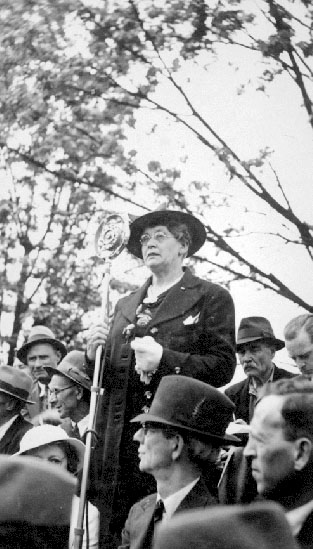
Thereafter, the issue of a Women’s Auxiliary does not reappear in the Victoria Labour Council’s minutes. This is not to say that women’s issues were completely absent from the organization’s agenda. At June 3, 1914 meeting a motion was put forward to “extend a reception to Mother Jones”, referring of course to the famous American labour organizer. Helena Gutteridge, a prominent suffragette and labour organizer largely active in the Vancouver area, spoke to the Victoria Labour Council on April 19, 1916 “on the necessity of organizing women’s workers”, though no further details of her speech are recorded.
On June 21, 1916, the Victoria Labour Council invited a women’s suffrage organization to make a speech at their congress hall.viii This invitation marks the only appearance of the issue of women’s suffrage in the Victoria Labour Council’s minutes in this period. This fact is made all the more conspicuous when put in context: 1916 was the same year a referendum on women’s suffrage was held in British Columbia, the result of a decades-long struggle for voting rights by women’s organizations in Victoria and elsewhere.ix The issue of suffrage frequently appeared in local newspapers in Victoria and would likely have been a common topic of discussion. Despite these facts, women’s suffrage barely merits a mention in the records of the Victoria Labour Council.
Similarly, the minutes of a meeting from July 22, 1916 record the reception of a “Miss Powell”, apparently a labour organizer from Australia. The minutes record that the delegates “requested a short speech” from Miss Powell, who obliged, and the organization extended their thanks.x The subject of Miss Powell’s speech is again not recorded, and she does not reappear again in the minutes.
For the most part, however, women’s issues remained little-discussed among Victoria’s labour organizations. Though from the very beginning women were active in the movement, and the Victoria Labour Council expressed a marginal interest in women’s suffrage and the organization of women workers, this interest did not extend as far as actually devoting time and expense towards these issues. Put simply, the labour movement in Victoria had other priorities during the period of the Great War. In the face of concerns over conscription, unemployment, and immigration, women’s issues were to remain in the background.
iMinutes to Victoria Labour Council Meeting, March 2 1914.
iiLowther, Bruce. A Better Life: The First Century of the Victoria Labour Council. Victoria: Victoria Labour Congress. 22.
iiiMinutes to Victoria Labour Council Meetings (1913-1918), Appendix.
ivLowther, Bruce. A Better Life: The First Century of the Victoria Labour Council. Victoria: Victoria Labour Congress. 25.
vFrager, Ruth A., and Carmela Patrias. Discounted Labour: Women Workers in Canada, 1870-1939. Toronto: University of Toronto Press, 2005. 231.
viMinutes to Victoria Labour Council Meeting, March 8 1914.
viiMinutes to Victoria Labour Council Meeting, April 1 1914.
viii Minutes to Victoria Labour Council Meeting, June 21 1916.
ixLatham, Barbara. In Her Own Right: Selected Essays on Womens History in B.C. Victoria, B.C.: Camosun College, 1980. 62.
xMinutes to Victoria Labour Council Meeting, July 22 1916.