I have a huge lady crush on Ann Friedman. She’s killing it on the internet and I admire her freelance journalism career. (like omg check out her FAQ page, it’s too good for words.)
Her career trajectory is something I envy, but it also seems attainable or at least not uncommon. Ann writes weekly for The Cut, The Hairpin and the Columbia Journalism Review. Her work also appears in places like The New Yorker.
There is a primary source I visit to get information about technology – which for me is usually in the realm of software development. It is called StackOverflow, part of the StackExchange Network. It is a question and answer site focusing on all disciplines and languages in the programming world. It is not just a Q&A site, they do few interesting things.
StackOverflow is heavily gamified. You get points for answering, commenting, up-voting, and even asking. Anybody can use it, although I will admit it can be a little intimidating at times. The website has a pretty strictly enforced “get to the point” mentality. Duplicate questions are not tolerated, and are closed almost instantly. It is even important how you word your questions – it will get deleted if it is asking for an opinion. The site is totally user-moderated; everyone who has enough points is a Mod. One of the fastest ways to get your post modified or deleted is to be too wordy or causal, you need to be to the point and direct. This is because StackOverflow is the resident source for programmers to find code snippets or theories. If you are stuck on something, chances are it has been asked, and answered on StackOverflow before. Because of this, I use it multiple times per day – I would guess between 5-10 times on average.
StackOverflow is so successful because of the enormous wealth of knowledge that the massive user base possesses. They may be a tad rude, especially to newcomers, but the service cannot be beat anywhere online (that I am aware of). Without this community, I would waste so much time trying to figure out something that someone else already knows, and has documented!
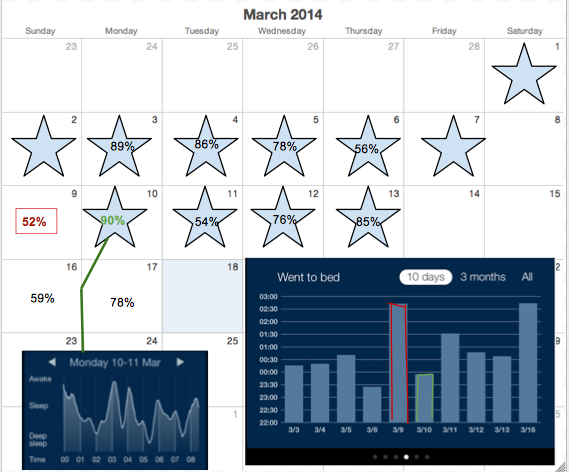
Starred days are days I went to the gym. The percentages represent the quality of my sleep for that night, determined by Sleep Cycle app. The graph, from Sleep Cycle, shows what time I went to bed.
While researching for my class presentation at the beginning of term, I stumbled upon an interesting article by Alexis C. Madrigal, a writer and editor for the well-known American publication The Atlantic. Madrigal is in charge of the technology channel for the publication, and writes several online pieces per week (in fact sometimes he has two or three technology pieces posted in the same day.)
While I was first drawn to Madrigal’s article because he was talking about wearable technology and how it can affect weight loss (something I am interested in), I continued to follow his subsequent articles because they were well written, relatively short (usually between 500-1000 words), and felt accessible to a tech newbie like myself.
At first I was only following Madrigal on The Atlantic website, until February when I decided to bite the bullet and get a Twitter account. To date I’ve used Twitter exclusively as an information source (I currently have not tweeted, and my only follower is Katie), but Madrigal (@alexismadrigal) is one of the people I am following. Despite the fact that the majority of his tweets are links to articles written by himself or colleagues on The Atlantic team, it has exposed me to interesting articles I wouldn’t have otherwise read, including an exploration of why songs use repetition, or a discussion of why the Hasidic community is concerned about WhatsApp. Madrigal’s articles are quite different from one another, but the common thread is that they explore some element of how technology impacts our lives, and they tend to be relatively short, so it doesn’t feel like an onerous investment of time when I sit down to read one. If you haven’t read any of Madrigal’s work before, I definitely recommend it.
Photo of Madrigal used in a Business Insiderarticle about him:
In Marvel’s Iron Man trilogy and the Avengers movie, much of the focus is around Tony Stark and his legendary Iron Man suit which we all know and love. Though another piece of really cool technology in the movie, which is more software than hardware, that many have grown a liking to is JARVIS. JARVIS, Just A Rather Very Intelligent System is an artificial intelligence system that runs all of Stark’s computers, home, surrounding environment, and even his iron suits. Being a very advanced system Stark can communicate to JARVIS flawlessly and can even carry a 2 way conversation with him. He even uses sarcasm sometimes when Stark comes up with a very outrageous idea. In our current society, nearly all of us have our own personal form of a JARVIS, just not remotely near as advanced as him. Many of us use Siri, or other speak command functions. The way Stark uses JARVIS to do things is just like how we use those built in features to call someone or change the radio in your car, or if your fortunate enough even your home. JARVIS is also like a personal assistant for Tony. He can place calls, alter his calendar, send emails, do almost everything a real assistant could do. If JARVIS took over one of the suits he could in theory go around and preform daily tasks that require physical interaction. So not only do I believe that this is a similarity to our current contemporary lifestyle, but also a direction that it is headed in. At the rate technology is advancing today I would not be surprised if sometime in the near future we each had our own personal JARVIS.
Your fourth and final Blog entry ties into your Personal Learning Document. I want you to identify, link to and describe a writer/thinker that you’ve found online and who you follow (on Twitter, Tumblr, a blog or news site, etc.) for information and insight in an area of technology & society that you find relevant — to your life, to your learning, and/or to your current research interests.
What makes them interesting and worth following more than other commenters? How do they use their form of media effectively to communicate? Why would you include them in your own Personal Learning Network as a source of inspiration and insight?
I chose to write about the movie “Men in Black”, because it has always fascinated me with its incorporation of the idea of the existence of extraterrestrials. Also, it was one of the scariest VHS tapes (I thought as a 7 year old) we owned that I was allowed to watch, which has always stuck with me.
The plot follows two agents working for a top secret organization, who monitor alien lifeforms living on Earth cloaking their existence from ordinary people. After the opening scene the movie begins with the recruitment of character James Edwards (later known as “agent Jay”), to replace agent Kay’s retired partner. The main plot is to stop an alien known as the “Bug” species, an over-sized cockroach-like creature, who is threatening the the safety of Earth and possibly the entire galaxy. Aside from the witty humour and running gag that almost everyone you know may be an alien (celebreties, politicians…), the most memorable moments from the film, are the great one-liners and the gadgets used. The most famous of these gadgets is probably the “Neurolyzer,” in short, it erases memories; programmable for long or short term effects. My other favourite weapon in the film is the Noisy Cricket, both for its fire power, and comedic purposes.
“I feel like ima break this damn thing!” —J
There’s no question that the franchise has sparked interests in possible technologies and the existence of out of this world life. There are countless blogs and pages out there dedicated to proving the actual existence of MiB, and the actual existence of aliens. One entertaining page about alien sightings and influences here.
The futuristic technologies of this movie always seemed a bit far fetched to me. From the secret layer, to the weapons, to the cars, and even the fact that the ordinary people were completely oblivious to what was really going on. But to paraphrase Kay, I suppose they have a point when he says it would only cause panic and chaos. Though some of the science behind some of the ideas are fairly sound, we’re just not there yet (article). And it’s not like this was the only alien sci-fi movie out there, the 90’s were full of them. For example, some Star Trek films, Star Wars I, Predator 2, Aliens 3, Independence Day, Mars Attacks!, and so on… Because the movie took place in the present (1997), I never believed that the technology used in the movie could be a present or even a near future reality. Not that I wouldn’t be totally stoked to actually see the stuff in real life.
Now more about the characters: aside from some of the poor or cheesy acting from some of them, I think that where the writers and director were coming from seemed pretty believeable. In the sense that, the MiB characters all seem like dry, serious, boring, hard working people, who’s personalities may have been transformed into these traits because of their recrutment into the MiB in the first place. No contact with outsiders, their existence erased, risking their lives for the sake of those who don’t even know they exist; it seems like a hard life. It particularily shows in Kay, obviously showing signs of regret by leaving his wife for the job at the end of the movie. And it doesn’t faze me at all that Jay fits in to the whole operation without so much as double-take. Maybe with all the reported UFO sightings in the world, theories, and even movies and stories about extraterrestrials embeded into our culture and lives, that he was honestly not fazed by the idea that they are real and living among us (only in the movie of course… right?).
What would it be like to actually encounter aliens in this day and age? Would we take the news as lightly as Jay or even the Coroner? Or no? Though some of the technology in the film arguably already exist, I don’t personally think that the general public is ready for it either. Just like Kay said to Jay when he asked the question. People in general are not smart, and it would only cause panic, so maybe it isn’t such a bad idea to have the MiB looking out for us. For now at least.
What better way to reflect on the technology of the future than through the classic Men In Black? I must admit, the movie is one of my all time favourites. i am not sure why that is the case, but I have loved it since I was first allowed to watch it! (Which would have been at least a couple years after it’s release, due to my strict parents… So maybe 2000?) The movies great humor, continous action and plot set aside, the theme of technology and society is prevalent throughout the film. While the film does focus on a future where aliens are integrated into western society, it also demonstrates future technology for data tracking, education and many other essential needs. The producer’s did a great job of convincing the audience of a very futuristic setting through the use of white furniture, simplistic modern design, and of course, the unfathomable and awe inspiring gadgets and gizmos. All of these small details are facts that our group has been discussing for our final project , while they seem like minute details, they do provide a wealth of information.
Watching this movie after taking this class has made me consider different details of the film. The small sizes of the technology that yield massive impacts, the sleek design of objects and the open spaces that prevail in infrastructure design. An alternate example that prods at larger themes; the famous neurolyzer (as seen below). Is it a remark on the state of society in the future? Poking at the point that humans don’t have the capacity to accept, let alone believe, that there are other human life forms out in the universe? And rather, not only in the universe, but possibly in your office or in your plain sight. Therefore, in order for humans to deal with the fact that there are other life forms on the planet we all live on, neurolyzers have to be used to wipe the short term memory humans as if nothing ever happened.
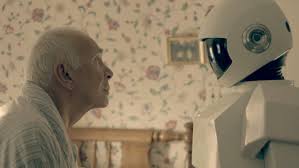
The story of Robot & Frank is of an older man, struggling with memory loss, who is given a robotic Care Aid by his son. Frank, an ex-burglar, is at first opposed to the idea of a robot in his home, and his daughter shares the same anti-tech feelings. Though, both can agree that the robot is a big help with cleaning and cooking. Frank has a change of heart when he discovers a flaw, or a gap, in his robot’s programming: it doesn’t know much about stealing. The robot unintentionally assists him with stealing a small trinket from a soap shop, which launches Frank into his old burglary days. He teaches his robot how to pick a lock, and the robot complies as Frank tells him it is just a hobby which is good for him and his health. Frank, who served time in prison earlier in life, steals an old book from the library as well as an expensive necklace from the home of a snippy young tech guy who offended him.
Frank is one of the only patrons of his town’s library, where Jennifer works. Jennifer also has a robot, Mr. Darcy, who works with her at the library. Jennifer, now, is simply a friend who he has a crush on. In the end, we realize she was actually a larger part of his past that he has sadly forgotten. The library is just being transformed, by the snippy young tech guy’s company, into a kind of augmented reality experience. The kind of experience which has no need for printed books (a prediction similar to Gary Shteyngart’s story). The story-line gives the film an interesting interplay of past and future, a future which feels a little too close for comfort.
Books, or printed books, are predicted as becoming extinct. This idea is something people are reluctant to believe, this is the hardest pill for us to swallow. We were okay with technology doing-away with records, tapes and CDs. We were also okay with technology closing down every movie-rental store, and bulldozing over VHS tapes and soon, DVDs. But, people are holding onto their books. This love for print is endearing in our culture, and gives a kind of omni-present sadness to the comedy of Robot & Frank. There’s something about turning pages of paper which people feel nostalgic for when reading books on a screen. There’s something in the past which we don’t want to let go of and for Frank, it is Jennifer.
In the end, the police are on to Frank. The only way to clear him from trouble is by deleting his robot’s memory. Something he struggles doing, but eventually does. He is then put into a care home where everyone else has a robot except him.
The film’s portrayal of the future felt realistic, robots are helpful and butler-like for those who need help at home. Their advanced programming skews the line between friend and robot. Frank defends his robot as a friend, not a slave. It’s a connection that seems plausible, where technology becomes more of a companion or a loved-one in the future (an idea similar to that of Spike Jonze’s Her). His robot has to remind Frank that he is not a person, and deleting his memory will not do any harm. This is difficult for Frank to comprehend, as he is clearly suffering from memory loss in his old age, and does not want his own memory to be completely wiped.
Robot & Frank is an engaging look into the future as it highlights the totally mind-blowing technology, as well as its flaws and opportunities for manipulation – even by an old ex-burglar who knows little about technology. As Frank says, “the human brain, a lovely piece of hardware,” robots will never be quite as complex or intelligent as the human mind. The future holds helpful and state-of-the-art technology but manipulation is possible.
Perhaps my favourite of the film’s insight into the future was a quick line of his daughter’s answering machine: “Why are you leaving me a voicemail?” My parents and my dentist are the only ones who leave me voicemail. If voicemail becomes a thing of the past, I don’t expect to miss it.