Packets Scheduling over Multiple Paths for QoE Enhancement
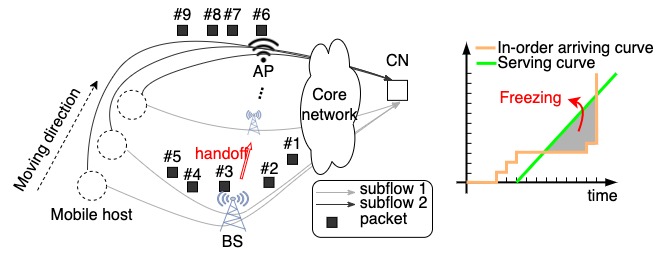
Because mobility is essentially a special case of multihoming, multihoming technologies, such as multipath TCP (MPTCP) and multipath QUIC (MPQUIC) are promising to cope with the connection breakage caused by mobility. However, when scheduling packets onto multiple paths, the issue of out-of-order (OFO) arrivals at the receiver is prevalent and problematic due to the heterogeneity of the paths. As shown in the figure above, when the cumulative in-order arriving curve is under the cumulative in-order arriving curve is under the cumulative in-order data consuming curve at the receiver, the service will be freezing for a while, leading to an unpleasant user experience or even fatal errors. In the presence of not only end-user mobility but also network mobility, the end-to-end path characteristics undergo a fast change over time and consequently the OFO issue is more severe.
We end up proposing a mobility-aware multipath QUIC (MMQUIC) protocol, which utilizes multiple connection IDs (CIDs) to maintain an always-on connection in mobile environments and enables the transport layer agent to obtain uplink variations when the sender is in motion. For the case that the mobile user is a receiver, MMQUIC redesigns the ACK packet structure so that the sender on the other end can be informed of downlink variation caused by the movement of the receiver or the access network. With the knowledge of link variations, we designed a multipath scheduler that uses a probabilistic model to estimate the expected throughput of each path and allocates a certain amount of packets accordingly to multiple paths, ensuring that the reordering delay of each packet is minimized in various mobility scenarios.

Performance Evaluation: the Mobility-Aware Multipath Scheduler (MAMS) uner the MMQUIC framework introduced cross-layer feedback between link and transport layers, significantly outperforming round-robin and other SOTA schedulers. It delivered 5–49% higher goodput and 10–20% lower latency on average.
Research impact: To our best knowledge, this work is the first attempt to comprehensively study the negative impacts of mobility (considering both end-user and network mobility) on multipath scheduling and formulate the reordering delay in mobile environments as a minimization problem. In this work, we simply tag the packet with its sequence number and ensure the smaller the sequence number the sooner the packet arrives. In reality, it is feasible to extend our design to more sophisticated cases, say, tag the packet with its significance, ensuring the more significant the packet the sooner it arrives. Therefore, it would be promising to apply our design to many fields, such as communications in disaster areas where the data has distinguished urgency levels. Along with the theoretical analysis, we developed an MPQUIC module based on network simulator 3 (ns-3), which has been published on the workshop in ns-3 (wns3). Even though the research on MPQUIC has flourished, to our best knowledge, this is the first ns-3 based MPQUIC project that is open to the public, so it will facilitate the development of MPQUIC in new 6G network scenarios.
Multipath Congestion Control over LEO Satellite Networks
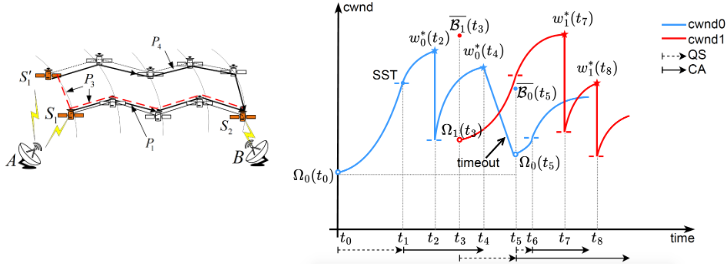
Given the Integrated Terrestrial and LEO Satellite Network (ITSN) in 6G, we try to apply MMQUIC to ITSN in the above figure. Since ITSN is characterized by high bandwidth-delay product (BDP) and high-speed network movement, the network capacity experiences large variations over time and the existing congestion control algorithms would suffer from bandwidth under- utilization or overshooting issues due to the unawareness of the real-time network conditions.
Therefore, we are motivated to develop a novel Mobility-Aware COngestion control (MACO) algorithm. MACO first leverages the regularity of LEO network topology and high correlation among multiple paths to forecast the real-time path Bandwidth Delay Product (BDP) on each path and then designs a new quick start algorithm, in which the initial congestion window (cwnd) is set to a large yet safe value based on the path BDP, largely shortening the duration of network probing time. Due to high-speed mobility, frequent handovers may result in packet loss which might be misinterpreted as the congestion signal and cwnd would be decreased by half. The increase of cwnd in the congestion avoidance stage is in the order of 1/(cwnd), which is too slow to compensate for the degraded cwnd. MACO incorporates a multipath fluid model and the square root function to regulate the window size during the congestion avoidance phase. As a result, the cwnd grows aggressively when the current cwnd is close to the multiplicative decrease point and grows conservatively when the cwnd is approaching maximum bottleneck capacity so that the cwnd can quickly recover to the network capacity.
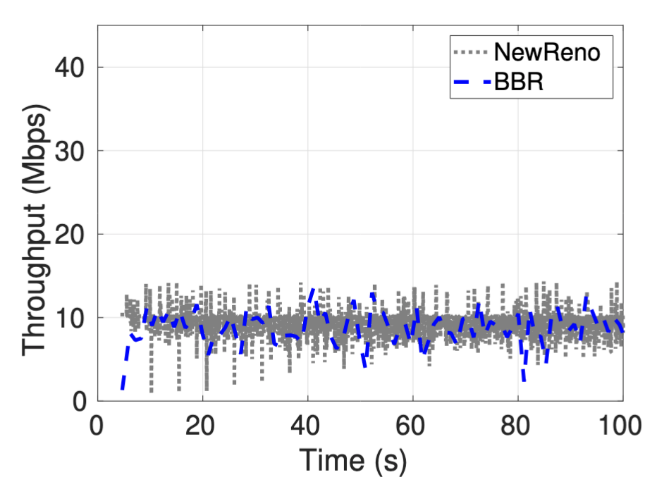
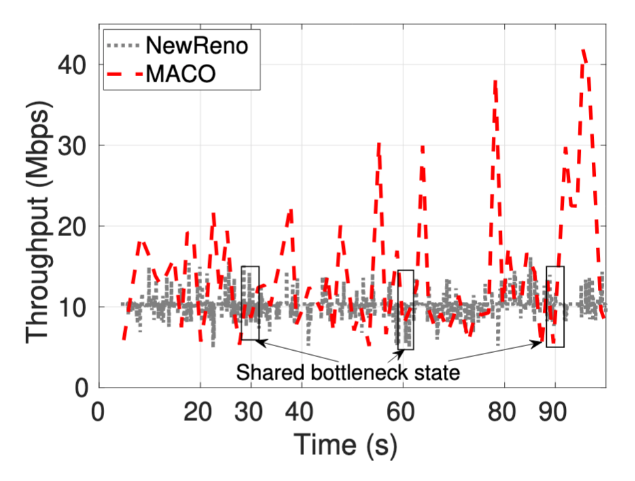
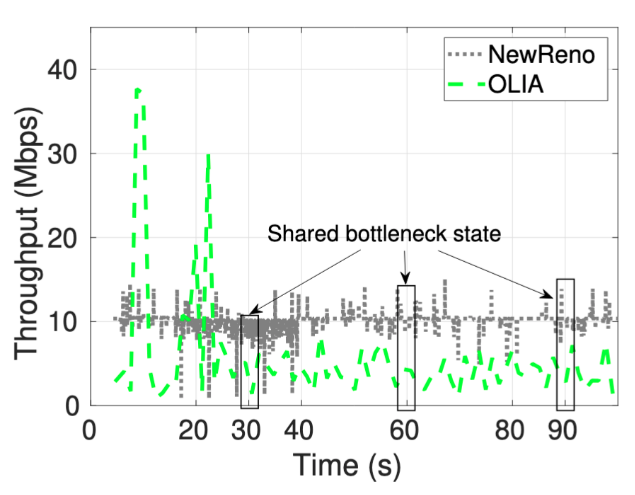
Performance Evaluation: the MACO algorithm extended MPQUIC to predict satellite-induced handovers and outages in TN/NTN networks. It achieved up to 3× higher throughput and improved convergence by 70.67% compared to state-of-the-art schemes.
Research impact: This work gives an analytical framework of MPQUIC-enabled ITSN, and designs a multipath congestion control algorithm, which solves three challenges in such context: bandwidth underutilization, inaccurate congestion signal, and unsatisfactory responsiveness. This congestion control design is also applicable to other emerging highly mobile systems such as unmanned aerial vehicle (UAV) networks or other networks where the bottleneck BDP suffers from large fluctuations.
QoS Guarantee for Video Streaming using Contextual MAB
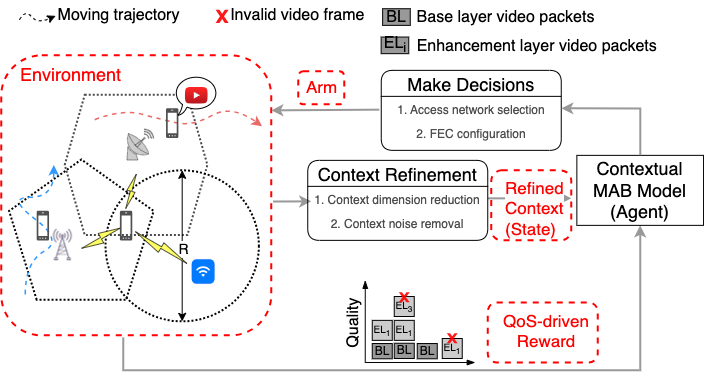
We have witnessed a growing proliferation of video streaming applications on mobile devices. However, ubiquitous mobility poses numerous challenges to rendering good video quality. For instance, the traffic load of each access point is highly dynamic so the available network resources to a certain user are uncertain. The visible access networks to an end-user are generally massive and heterogeneous, it is hard to make an appropriate network selection to meet the QoS requirements.
In response to the above challenges, we designed a QoS-driven contextual multi-armed bandit (QC-MAB) framework as shown in the above figure for MPQUIC to support video streaming in mobile networks. To improve learning efficiency, QC-MAB identifies the most relevant features that affect QoS requirements and then incorporates them into context space. Each arm of QC-MAB is composed of two actions: access network selection and forward error correction (FEC) configuration. Selecting a reliable access network can effectively mitigate the negative impact of mobility on QoS, and whether a packet-level FEC is enabled or not depends on the reliability and delay requirements, as well as the bottleneck bandwidth, delay, and loss rate of each path. Finally, the reward function of QC-MAB is closely related to the pre-defined QoS requirements. The QC-MAB learning agent performs the Upper Confidence Bound (UCB) algorithm to solve the exploration vs. exploitation dilemma, taking reasonable actions to ensure video service requirements.
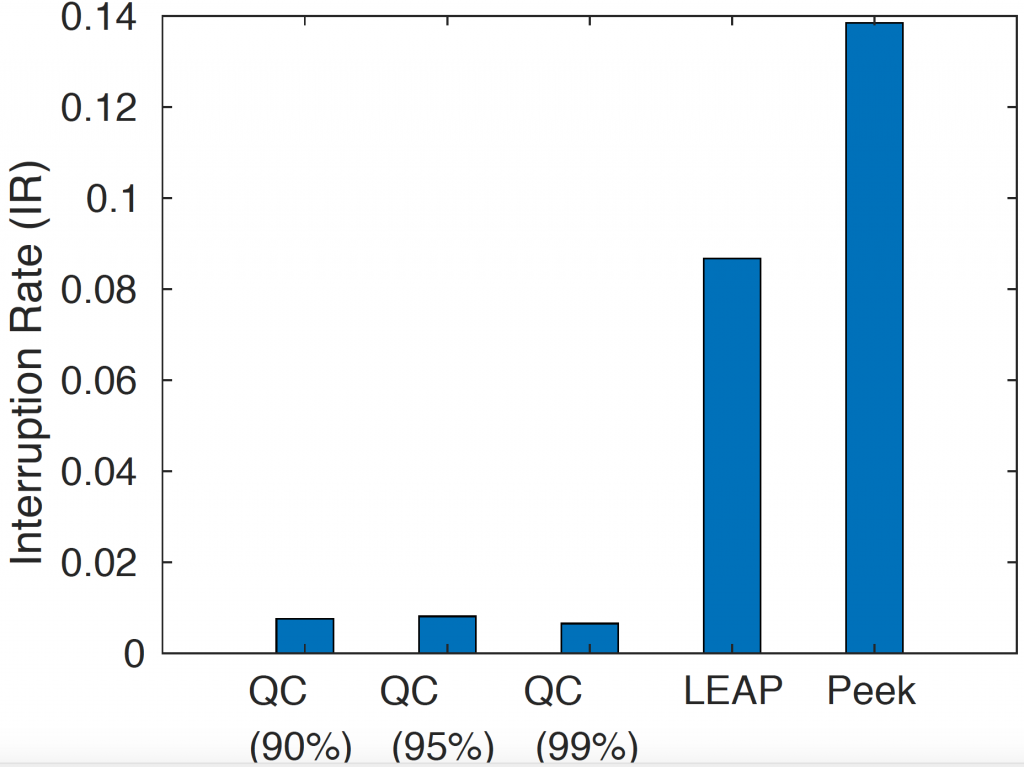
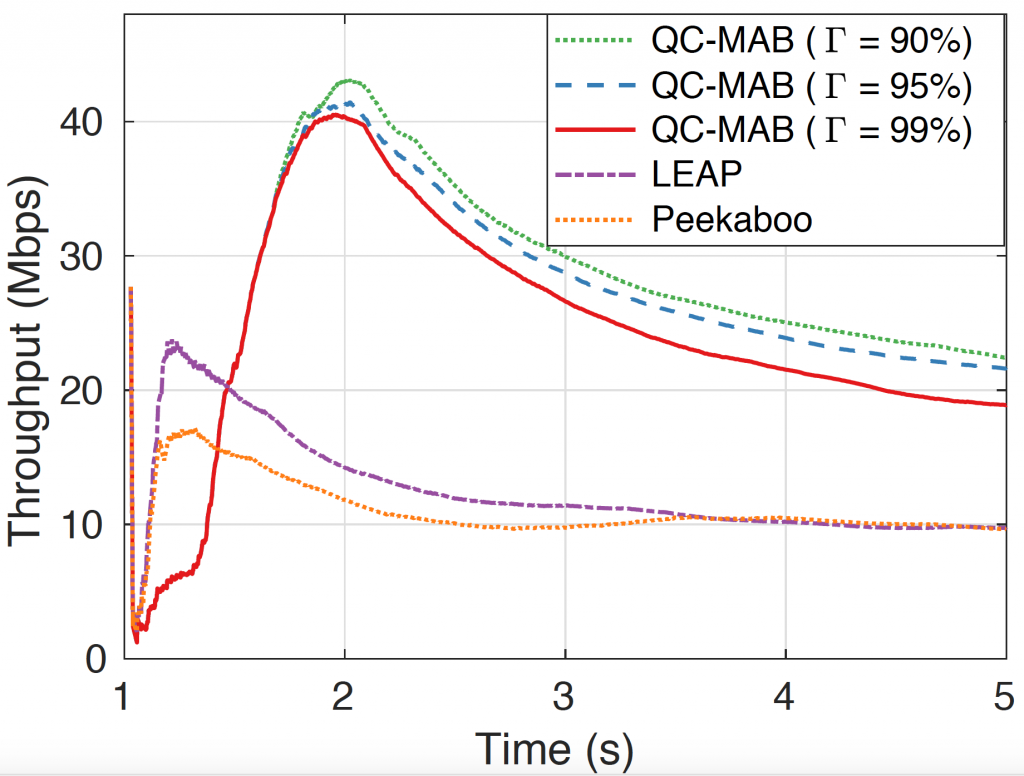
Performance Evaluation: QC-MAB makes an intelligent access network selection and adaptively enables FEC coding to trade off delay, reliability and goodput. It achieves up to 10x lower video interruption ratio and 3x higher goodput in highly dynamic mobile environments.
Research impact: Fulfilling a deterministic QoS guaranteeing (e.g., never more than 1 ms of packet delay across a network) is generally hard in highly dynamic systems, while we shed light on how to render a statistical QoS guarantee (e.g., guaranteeing less than 0.001% packet overdue) for video streaming in ultra-Dense mobile networks.
Meta Learning for Multipath Live Streaming
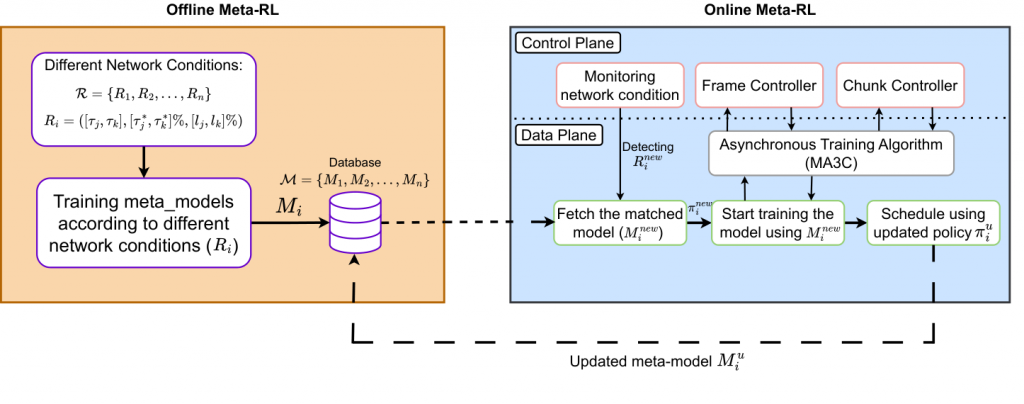
Overcoming challenges in mobile environments, such as bandwidth constraints, user mobility, and network handoffs, is crucial for video streaming applications. To address these challenges, we can use multiple network paths to mitigate bandwidth limitations and guarantee end-to-end delay, enhancing the overall quality of experience for the users. This work presents LiveStream Meta Learning-based Delay Aware Multipath Scheduler (LSMeta-DAMS), a novel learning-based multipath scheduler explicitly designed for live streaming applications. LSMeta-DAMS employs a hybrid meta-reinforcement learning architecture, incorporating both online and offline phases to enhance speed and accuracy for training and decision making. Prioritizing packet scheduling based on frame types and considering the video coding features like group of pictures (GOP), scalable video coding (SVC), and Dynamic Adaptive Streaming over HTTP (MPEG-DASH), LSMeta-DAMS offers a tailored solution for multipath video streaming.
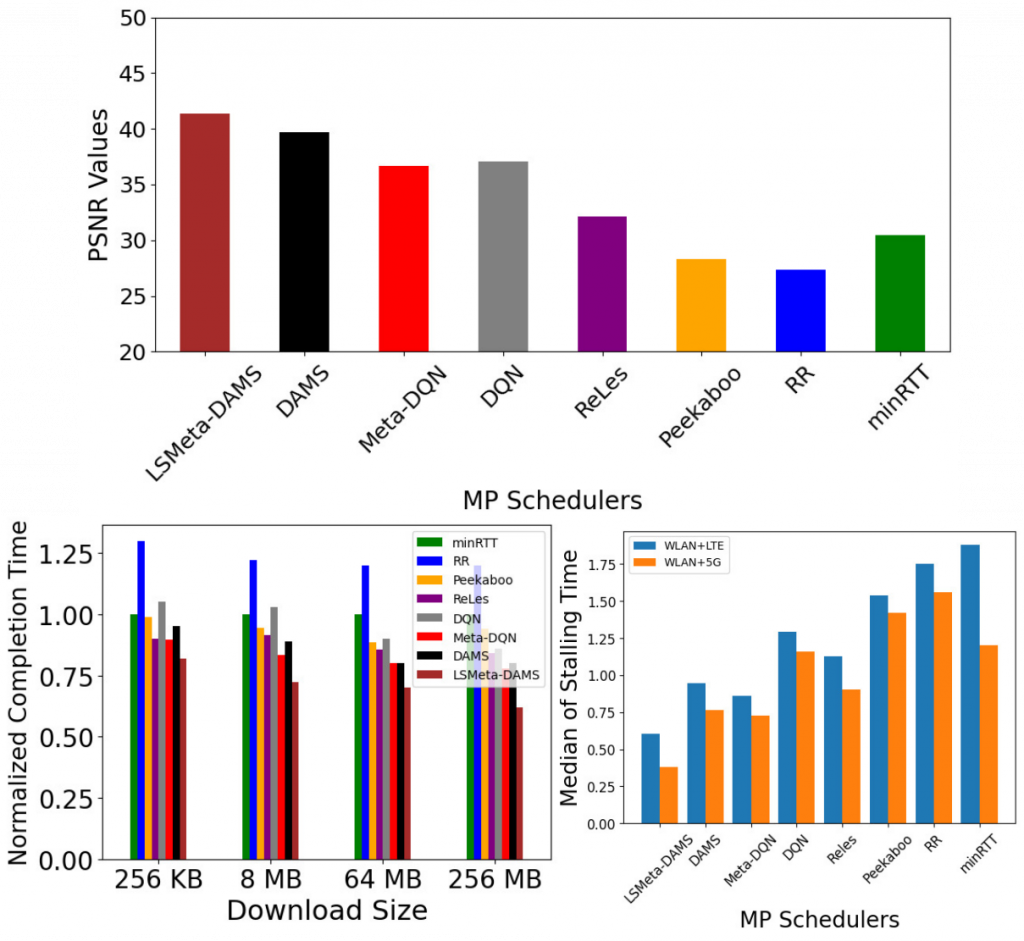
Performance Evaluation: Emulations showed up to 25% shorter download times, 15% better video quality, and 35% less stalling than existing approaches.
QoE-oriented MPQUIC Scheduling for 360 Videos
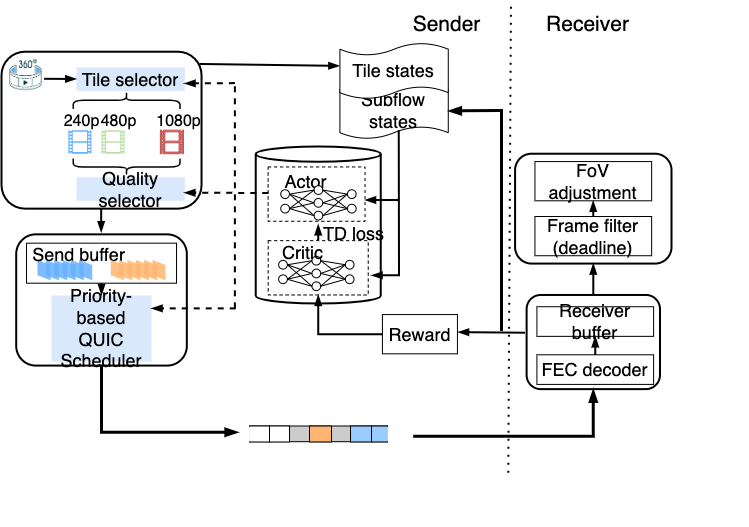
360-degree videos are not only bandwidth-intensive but also highly sensitive to delays. Ensuring both high video quality and smooth playback experience remains a critical issue. Therefore, we introduce a QoE-oriented Deadline-driven (RIDE) algorithm for multipath scheduling at the frame level. RIDE employs a dependency tree to understand deadlines for different types of frames and considers the negative impacts of Field of View (FoV) changes on scheduling decisions. Utilizing an actor-critic framework to train the neural network enables the scheduler agent to adapt to dynamic environments, including network and FoV dynamics.


Performance Evaluation: RIDE employs a dependency tree to understand the relationship of different types of frames and considers the impacts of FoV changes on scheduling decisions. Utilizing an actor-critic framework to train the neural network, the scheduler agent can effectively handle network and FoV dynamics. It achieves up to 4x higher bit rate and reduce the video freezing rate by 50% against benchmark algorithms.
Significance: Our research on 360-degree video streaming has very broad and promising use cases including immersive gaming, remote health care, online education, etc.