Overview
Today’s end devices are equipped with multiple network interfaces in various modes. For instance, mobile devices connect to the Internet through both WiFi and cellular networks. Therefore, more and more researchers are beginning to concentrate on the use of multiple interfaces to improve network performance.
Inspired by the success of MPTCP, Multipath QUIC (MPQUIC) was proposed as an extension of the QUIC protocol. QUIC, initiated by Google, merges the functionalities of HTTP/2, TLS, and TCP over UDP to reduce latency in client-server communication. MPQUIC allows a QUIC connection to utilize various paths simultaneously (such as Wi-Fi and LTE or IPv4 and IPv6).
Compared to MPTCP, MPQUIC is more desirable in mobile environments. First, MPQUIC spends 1 RTT to initialize a subflow if the subflow has never been established before, or 0 RTT otherwise. In the event of a handover failure, MPQUIC would consume 0 RTT to restore the disconnected subflow. Furthermore, each MPQUIC connection is associated with a 64-bit connection ID (CID) instead of a four-tuple set. The connection remains active even if the address and/or port are changed due to mobility.
However, there are still many open issues with MPQUIC, which motivates our work. For example, current experimental platforms for MPQUIC are mostly built on network emulators, while a simulation platform of MPQUIC is not widely available yet, which makes it challenging for the research community to investigate the potential of MPQUIC in diverse circumstances. In addition, MPQUIC is still under discussion by IETF, so the protocol mechanisms are not yet standardized and require more research efforts. For emerging applications with stringent quality-of-service (QoS) demands running over diverse modes, MPQUIC needs tailored algorithm designs such as congestion control and path scheduling to meet the requirements.
With the focus of MPQUIC design to meet users/applications’ diversified demands and address cutting-edge challenges in the future Internet, our team’s research spans from protocol architecture design, multipath-based algorithm optimization, implementation, measurements, etc.
Measurements
1. To identify the limitation of single-path QUIC, we took a real-world measurement to inspect the throughput performance when using QUIC to downloading a large file (5GB) in mobile environments.
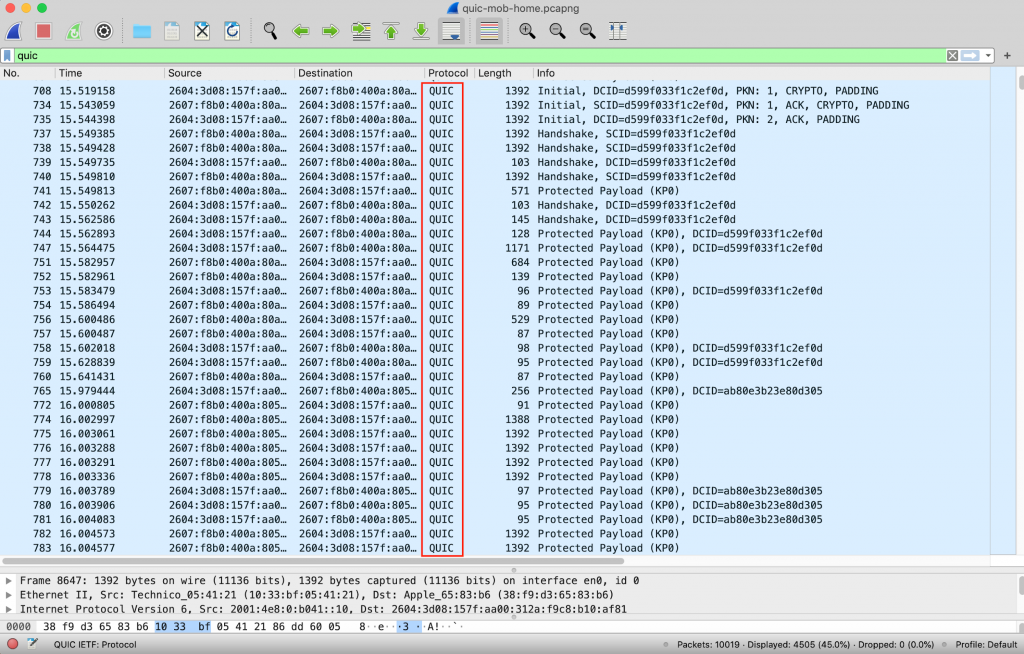
First, we acquire a laptop which connects to a UVic WiFi AP, and enable QUIC on the Google Chrome browser to download a large file. The wireshark screenshot verifies the QUIC is in working order.
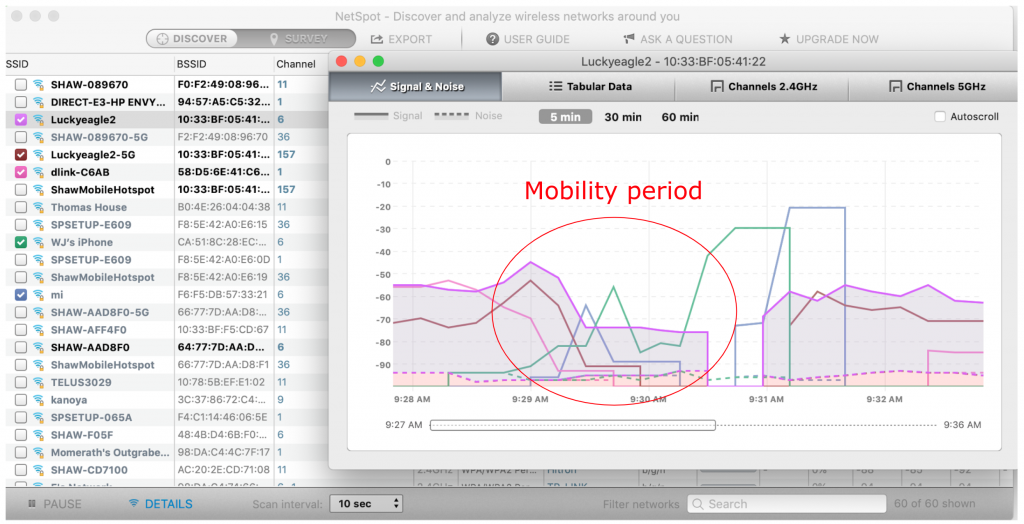
Next, we hold the laptop and keep walking in a building while monitoring the Receiver Signal Strength (RSS) value of the laptop. During the movement period from 9:29am to 9:31am, the RSS is changing under the coverage of different APs.
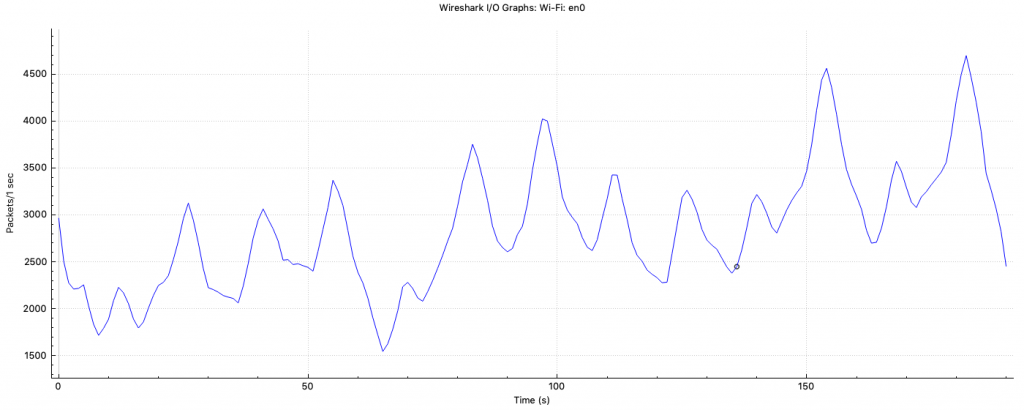
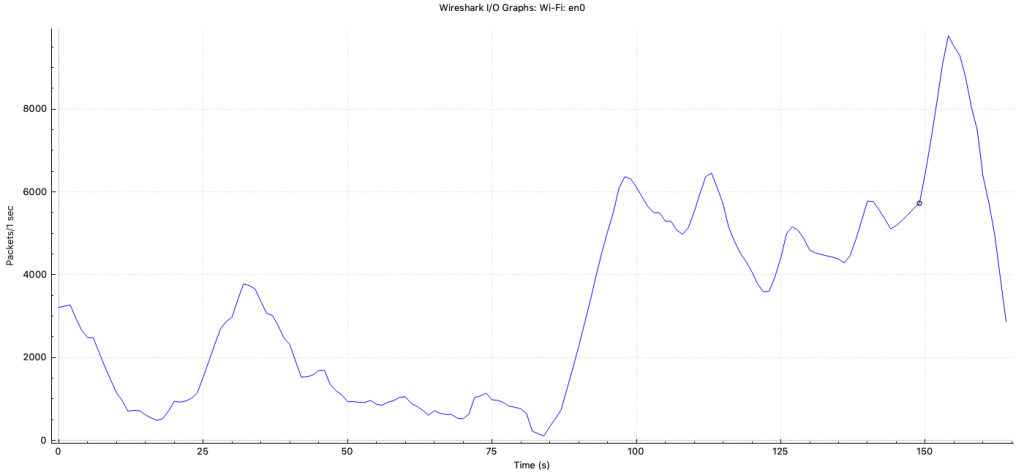
Here we make a comparison of throughput when using QUIC to download the file without mobility and with mobility. Without movement, the throughput ranges from 1500 packets per second, around 17Mbps, to 4500 packets per second, around 51Mbp. Contrarily, in the presence of mobility, the throughput suffers from significant fluctuation such that the highest throughput can be up to 9000 packets per second, while the lowest throughput is down to almost 0.
2. To improve the congestion control design for QUIC, we conducted the real-world measurement of QUIC over Starlink satellite network.
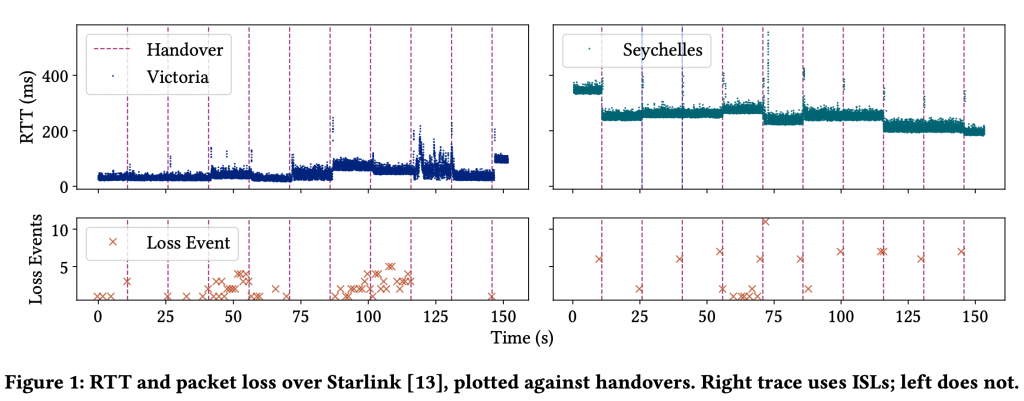
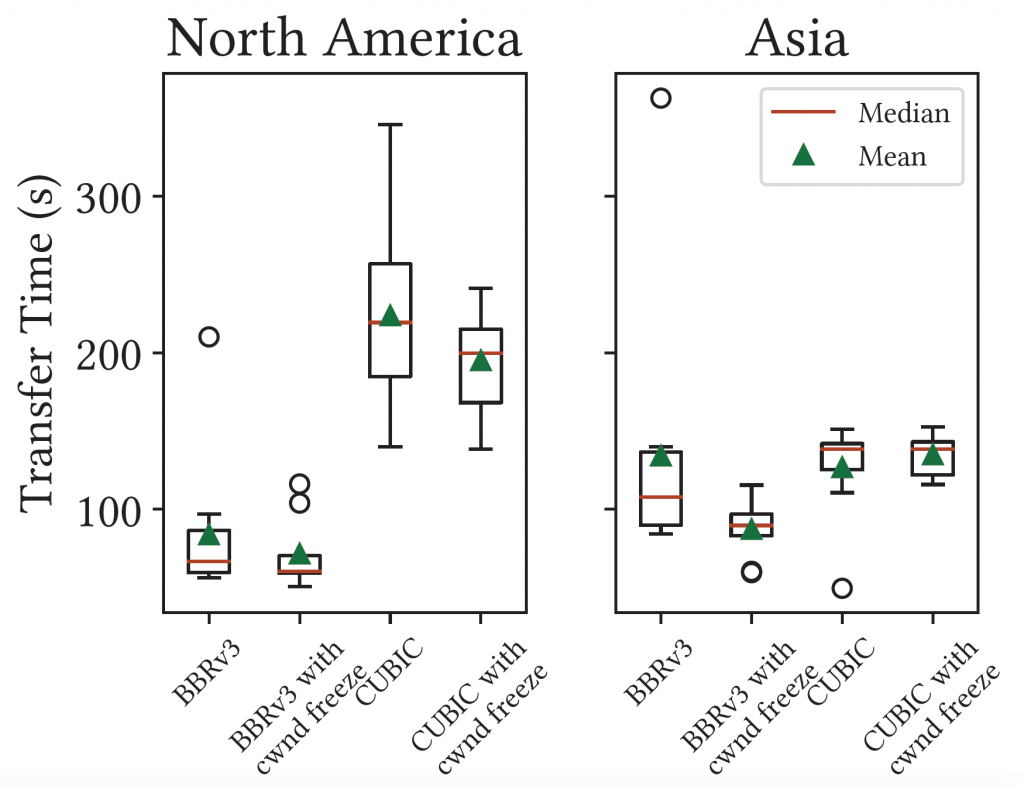
In order to test our congestion control design for QUIC over real-world Starlink networks, we implemented a QUIC client based on picoquic and connected to a Starlink UT located in Asia, associated with the Starlink PoP in Tokyo and a UT located in North America, with its PoP in Seattle. The servers are located in datacenters close to their respective PoPs. This figure shows the average completion time of transfering a 1 GB file from the server to the client at different times in the day.
Implementation
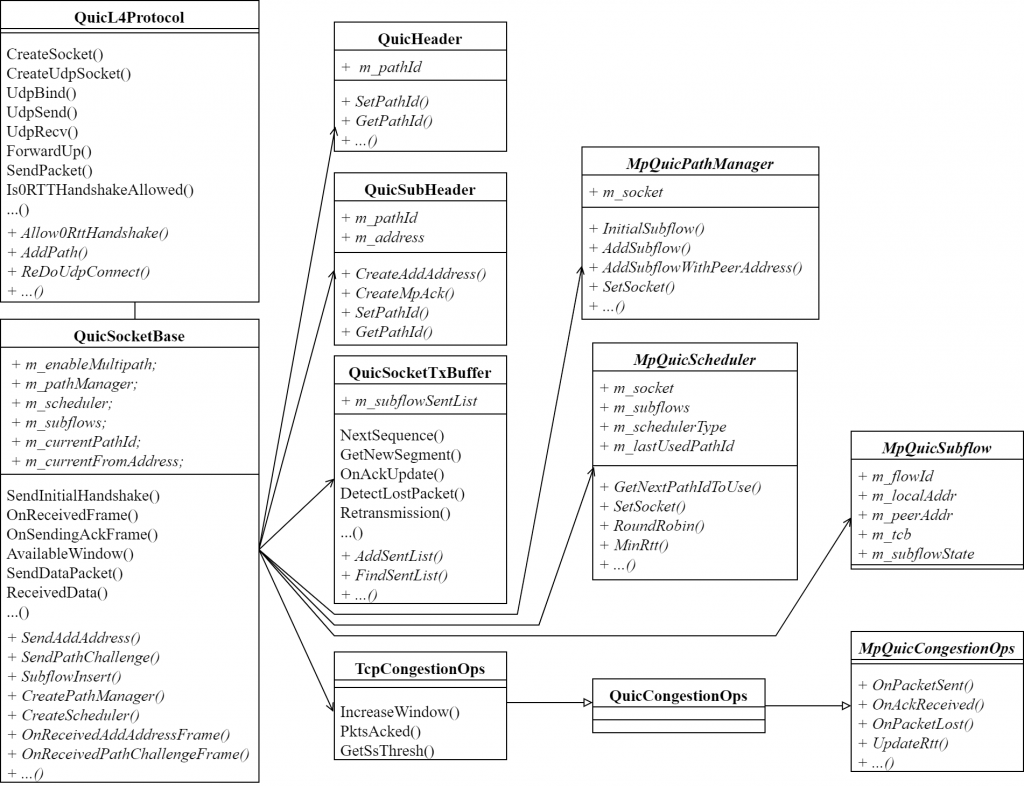
Due to lack of open-sourced MPQUIC simulator, since 2020, our team dedicated to develop an MPQUIC module based on network simulator 3 (ns-3), which has been published on the workshop in ns-3 (wns3). Even though the research on MPQUIC has flourished, to our best knowledge, this is the first ns-3 based MPQUIC project that is open to the public, so it will facilitate the development of MPQUIC in next-generation network scenarios.
Selected Publications
- W. Yang, L. Cai, S. Shu, J. Pan and A. Sepahi, “MAMS: Mobility-aware multipath scheduler for MPQUIC.” IEEE/ACM Transactions on Networking, vol. 32, no. 4, pp. 3237–3252, 2024.
- W. Yang, L. Cai, S. Shu and J. Pan, “Mobility-aware congestion control design for multipath QUIC in in- tegrated terrestrial satellite networks.” IEEE Transactions on Mobile Computing, vol. 23, no. 4, pp. 11620– 11634, 2024.
- W. Yang, L. Cai, S. Shu, J. Pan and Z. Huang, “QoS-driven contextual MAB for MPQUIC supporting video streaming in mobile networks.” IEEE Transactions on Mobile Computing, 2024.
- A. Sepahi, L. Cai, W. Yang, J. Pan, “LiveStream Meta-DAMS: Multipath scheduler using hybrid Meta rein- forcement learning for live video streaming.” IEEE Transactions on Cognitive Communications and Networking, 2024.
- W. Yang, P. Dong, L. Cai, and W. Tang. “Loss-aware throughput estimation scheduler for multi-path TCP in heterogeneous wireless networks.” IEEE Transactions on Wireless Communications, vol. 20 no. 5, pp. 3336–3349, 2021.
- A. Sepahi, L. Cai, W. Yang and J. Pan, “Meta-DAMS: Delay-aware multipath scheduler using hybrid meta reinforcement learning,” in VTC-2023 Fall, Hong Kong, 2023, pp. 1–5.
- S. Shu, W. Yang, J. Pan and L. Cai “A Multipath extension to the QUIC module for ns-3,” in Proceedings of the 2023 Workshop on ns-3, Washington, USA, 2023, pp. 86–93.
- W. Yang, L. Cai, S. Shu, and J. Pan, “Scheduler design for mobility-aware multipath QUIC,” in Proc. IEEE Globecom’22, Rio de Janeiro, Brazil, Dec. 2022, pp. 2849–2854.
- W. Yang, S. Shu, L. Cai, and J. Pan. “MM-QUIC: Mobility-aware multipath QUIC for satellite networks.” in Proc. IEEE 2021 17th Int. Conf. on Mobility, Sens. and Netw. (MSN’21), Exeter, UK, Dec. 2021, pp. 608–615.
- Kamel, V., Zhao, J., Li, D., & Pan, J. (2024, November). StarQUIC: Tuning Congestion Control Algorithms for QUIC over LEO Satellite Networks. In Proceedings of the 2nd International Workshop on LEO Networking and Communication (pp. 43-48).
Demos
In the following demo video, we presented our work, an MPQUIC scheduler LSMETA_DAMS for smooth video streaming in dynamic environments. Compared to benchmark algorithms, LSMETA_DAMS achieves both supreme video quality and the least video freezing events.