Category: Uncategorized
Quote of the Day (James Baldwin)
“History, as nearly no one seems to know, is not merely something to be read. And it does not refer principally to the past,” Baldwin also wrote. “On the contrary, the great force of history comes from the fact that we carry it within us, are unconsciously controlled by it in many ways, and history is literally present in everything we do.” (from Mary A. Heglar’s Twitter Post, Climate Change Ain’t the First Existential Threat)
Touching Place
Hello everyone,
Posting with a heavy heart after the murder of George Floyd and so many horrible images coming out of the States these past days. I felt overwhelmed on Friday and still feel outraged, sad and uncertain about what’s happening and what’s to be done (beyond posting on social media). But I want to take this moment to turn our attention to the importance of never forgetting that racism and racial injustice continue to live in Canada and early childhood along with the rest of the world, and our role in perpetuating and/or challenging the conditions that allow for these injustices to continue.
We’ve focused a lot on climate change, collectivity and the question of how to promote the creation of more livable (live-able) worlds with children and families, but this feels like an important time to slow down and ask ourselves “livable for whom?” The point has been raised before but I don’t think it can be stated clearly enough that climate injustice is deeply entwined with environmental racism which puts certain communities/bodies on the front lines of dangerous pollutants, toxins and lack of clean water among other violations. This includes violent removal/attempts to extinguish title/kinship ties to land, as seen in past Wet’suwet’en land defender struggles in this province. And what about the everyday dynamics we engage in? What does anti-racist pedagogy look and feel like in an early learning classroom? I’ll post a couple of articles/documentary trailer for your consideration on the Resources page that highlight connections to our work and ethical obligations, including the Early Childhood Education Assembly Call to Action Countering Anti-Blackness in Society & Schools, which has some excellent resources.
Another resource to watch for is a chapter by Fikile Nxumalo (2016) called Touching Place in Childhood Studies: Situated Encounters with a Community Garden that offers a way to reconsider what it means to touch and be touched, as part of a commitment to understand ourselves and living and working within particular historical processes that all too often attempt to erase certain bodies and their connections to the land. While always relevant, I thought it might be timely to think with this piece now, because of Nxumalo’s explicit commitment to making racial politics more visible in early childhood and the fact that we are living in a pandemic that requires us to rethink the ways we touch with children and families (or not), going forward. What does it mean to be touched by history as part of an intentional future-making process? What new understandings and connections might that promote/make space for?
I engage touch through art images of gardens, historical imageries of gardening, and specific sociomaterialities of everyday child-educator garden encounters. I engage touch with images not to represent place but rather to enact a politicized (re)storying of place within a settler colonial context - a noninnocent, entangled, and implicated worlding. Bellacasa (2009) refers to this as "touching vision" where "refusing the distinction between vision and touch troubles the ground of objectivity" (p. 308). What might these practices of refiguring presences do? What interruptions might be created to practice-as-usual? What connections might emerge and enact disruptions to visions of already demarcated, categorized, "settled" and defined colonial place?
Thanks and I wish you all a good week ahead. No simple solutions to the strife being laid bare before us, but I’m hoping for a more just and safe week for those risking their lives to stand up and demand justice. Black Lives Matter. Indigenous Live Matter. Racialized Lives Matter. Everywhere, including early childhood.
In solidarity and respect,
Narda
Reminder (Narda, May 26, 2020)
Hello everyone!
Quick reminder to regularly check our Pedagogical Explorations Events page for upcoming events. There is a conversation this Thursday with UVic Chancellor Shelagh Rogers and Carey Newman that sounds interesting!
For those who missed Denise, Kathleen (Kummen) and Veronica (Pacini-Ketchabaw)’s talk over the weekend, I’ll post a link as soon as they’ve had time to review the recording and release segments for sharing, along with the Donna Haraway & Latour talk once the link is shared.
I’m in deep denial that June is around the corner. Feels like a good time for a musical interlude: https://www.youtube.com/watch?v=eguD5AljSCI
Hope you’re all doing okay as we continue to move through the pandemic.
Missing everyone, Narda
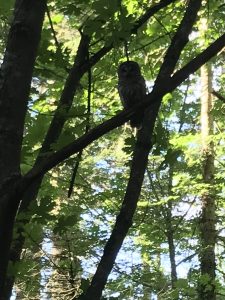
p.s. Been seeing this one and other owls regularly on walks around UVic. Curious what has been happening in our absence in Haro Woods!
Events page, Narda Update (May 20, 2020)
Good morning everyone!
Check out the Events page for 2 events happening today that might be of interest:
- webinar with the Royal BC Museum & Nancy Turner today at 2-2:30pm
- ECEBC Online Prof. Development opportunity this evening: Denise, Kathleen Kummen and myself will discuss the role of the pedagogist in BC, and what it means to work pedagogically together during COVID-19 times
Please note, I will not be available to respond to emails or review posts until tomorrow.
Hope you’re all having a good week so far!
Narda