In preparation of our event on December 5th, we wanted to share an piece to think with, as we come together to share our inquiries with paint.
When thinking about the liveliness of materials; particularly the complexities and comparisons between paint and it’s sentient counterparts, it seems only natural that our relations with paint would also stem from dark and troubling histories.
As Yahlnaaw mentioned in her workshop, “MaahlGa Sdiihlga GawGa – “Returning Missing Seeds”: Reclaiming Indigenous Power Structures”; “Different methods were used to colonize; thus different methods need to be used to de-colonize.”
How do we use paint to think critically about art history; both past, present and future? What is our responsibility in being with paint? What stories are we choosing to tell in our journeys with paint? What narratives do we choose to perpetuate? What values do we uphold? Who has access to the creation and dissemination of art and artistic expression? Why?
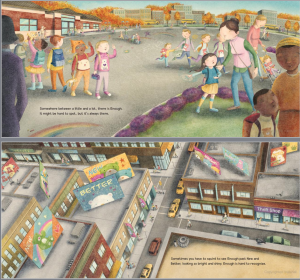
A new book joined us at Juniper Place this week, Enough is….Written by Jessica Whipple and Illustrated by Nicole Wong.
The pages hold words that feel, on many levels, important right now.
In our supervisor meeting yesterday we spoke about our role as educators in this time. Asking ourselves what we are going to ‘Do’? What ways, in our everyday, are we going to disrupt the ‘noisy’ messaging of neoliberal ideals, consumption and the drive for economic gain above all else? Listening, seems even more important now than it did two days ago.
I would like to share these simple, yet powerful words by Jessica Whipple:
“Somewhere between a little and a lot, there is Enough. It might be hard to spot, but it’s always there. Sometimes you have to squint to see Enough past New and Better, looking so bright and shiny. Enough is hard to recognize. Hearing it is even harder. More is so loud and pushy and Most beats down your door, but Enough whispers, “I have all I need”.
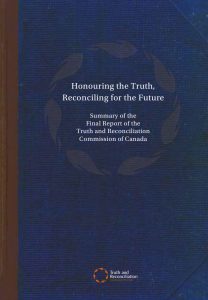
“As long as we have that belief and the need to improve the future, then the future will be improved.” -Murray Sinclair (Jan. 24, 1951-Nov. 4, 2024, Peguis First Nation, Métis/Ojibwa), the former chair of Canada’s Truth and Reconciliation Commission (TRC), judge, senator (from CBC News, Mar. 23, 2018, YouTube – link to video below)
We would like to say thank you to everyone for making last weeks Pro Day so wonderful and engaging. At Juniper Place, we are excited to be thinking with Listening this year. Listening is entangled in all that we do and has been particularly important to us over the past couple of months as we adjust to a new year, new energies, and new ways of being at Juniper Place. We would like to offer a few of the questions, thoughts and ideas that we are starting out with:
We have been thinking deeply about what it means to slow down, to be present, and to Listen.
We are a community and we believe we must seek connection, have an openness to truly know one another (more-than-human and human) and listen with our whole self.
Listening at Juniper Place is grounded in acts of feeling.
We are asking out selves:
What engagements, connections, experiences, and ways of being in the world do we open ourselves to when we expand our conceptualization of listening beyond the simple act of hearing?
How do we listen to each other, respecting each others knowledge, experiences and ways of being in the world beyond what is simply audible?
How can we get to know and feelone another?
How do we listen with the more-than-human world?
We are also considering what is needed to foster an environment of Listening:
Willingness to reconsider what we ‘know’
Openness and self reflection
Curiosity
Desire to connect
Paying Attention
feeling/empathy
A few thoughts we are thinking with…
Dame Evelyn Glennie (2024),
“Listening is the glue to humanity…[It’s] the thing that creates a bridge between one person and another, whether that is the spoken word, the written word, or whether there are no words, it’s that presence. And so we always think that in order to listen, it has to come from a sound, so we must hear something. But actually listening, really, is about paying attention. It is about literally being in that present moment. .“ (Dame Evelyn Glennie, 2024)
Carla Rinaldi (2001) presents a definition of the term Listening:
“Listening as sensitivity to the patterns that connect, to that which connects us to others; abandoning ourselves to the conviction that our understanding and our own being are but small parts of a broader, integrated knowledge that holds the universe together.
Robin Wall Kimmerer (2013)
“Paying attention is a form of reciprocity with the living world, receiving the gifts with open eyes and open heart.”
Thanks for reading! We look forward to exchanging ideas as the year unfolds.
There’s been a lot of discussion and participation by some of you over the past year about Inclusion. ECEBC has recently put out a position paper on this very topic. I’ve uploaded for your convenience to read, just click link above.
Opening statement from ECEBC:
We are grateful for the guidance, collaboration, and comments provided by the many stakeholders who participated in this creation.. This position paper is a visionary document. This position paper joins families, activists, and scholars in asserting that inclusion is an urgent political concern in early childhood and the broader global community. ECEBC acknowledges that an inclusive society must first disrupt dominant and social constructions of what it means to be human that reflect idealized images (Kafher, 2013). For inclusion to thrive, we must first refuse predetermined hierarchies based on ability, body shape and form, chromosome composition, gender, race and other forms of human categorization.
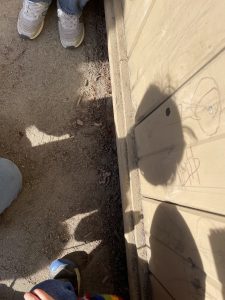
Bare feet at Garry Oak Place (Click here for Feet images & musings:))
How did it start?
When Gary Oak Place started, we adopted from other centers, the rule of we can walk bare feet on the grass and sand but need shoes to walk around the rest of the yard. After observing the children’s relationships with shoes, feet, each other, and others, we were curious to see what would happen if we allowed bare feet all over the yard. We decided to document our pedagogical inquiry for this wonderful moment.
Our Curiosities
Do they perceive the change of seasons differently with bare feet?
How might we experience the change of seasons through our feet?
On hot sunny days or cool rainy days
How do children engage with yard and materials? Does it change if they are bare feet?
With painting, sand, woodchips, grass…
How might children’s relationships differ? With bugs, with friends, with plants…
What opportunities arise when they are bare feet? For friendships or for nature?
Touching toes each other, helping socks and shoes…
Are there limits to roadblocks to being bare feet?
Bikes, tires…
How do children engage with bare feet outside of Garry Oak?
At beach, park, yard, at home…
What kind of medicine are they receiving from the earth?
Onion on feet would make fever go down, pressure points on feet (acupuncture)
I wonder about language with its raw frayed fringes delicately trying to express spirit as each word drips from lips to rest in blank spaces between us
—Lee Maracle (Stó:lō), Talking to the Diaspora (in Robinson, 2020, p. 77)
Reference
Robinson, D. (2020). Hungry Listening: Resonant Theory for Indigenous Sound Studies. University of Minnesota Press.
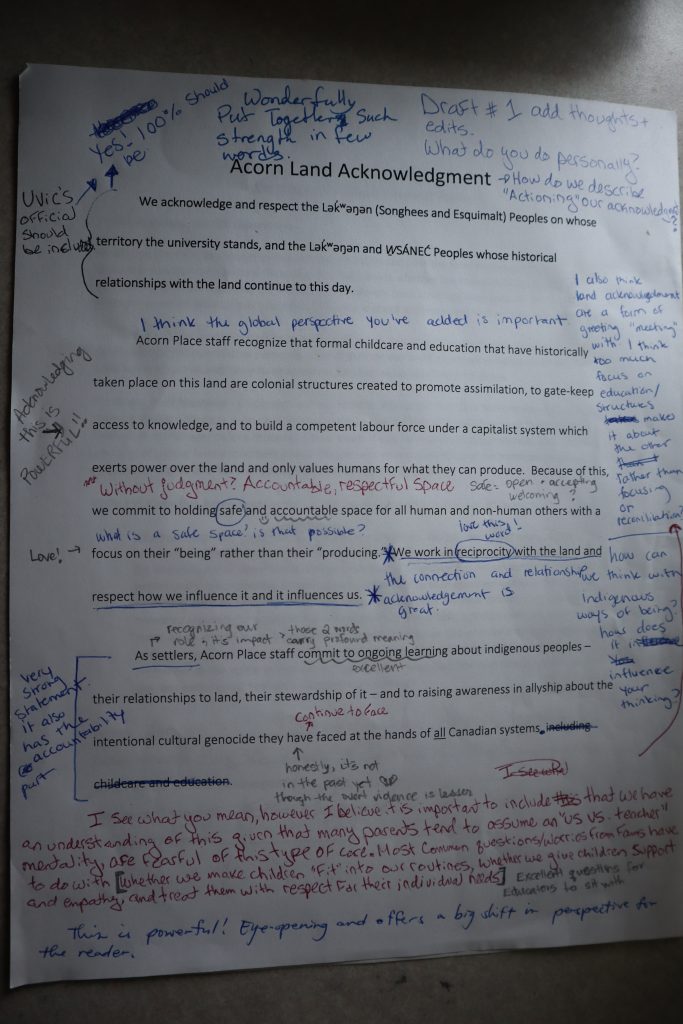
As I work through editing our draft land acknowledgment I find myself so pleased at its messiness. Something about how the handwriting hugs the print and brings so much personality to the page.
The image exemplifies collaboration. I love its liveliness – scribbles, underlines, questions, and redactions.
Thank you so much to Sadaf, Michelle O., and David for your feedback (sorry if I missed anyone, make yourselves known in the comments).
Please add your feedback below if anything strikes you!
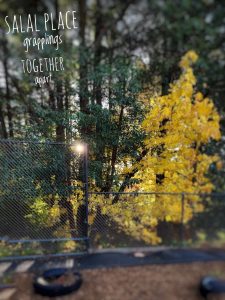
Salal Place yard is carved out of the forest. We notice the entanglement of these spaces with more-than-human others who flow through, over and under the fences surrounding the yard. Are we ever truly separate and removed from forest?
We try to resist entering the forest with humancentric notions of being in nature. But because we are human, we wonder and struggle with what this even means…? Recognizing the limitations of “humans self-assessing humancentrism”, our attempts at resisting are imperfect at best – but necessary. In alignment with our pedagogical commitments, we continue considering the ecological impacts of co-existence. Entanglements with sand, forest, paths, lunch waste, slugs, humans, bird nests contribute to the conversation. Tensions form as we notice binary thinking creeping in. In our considerations of staying out/going in, destroying/preserving, entering/damaging. We reconsider our response(ibilities). How do we ethically respond to forest as it was.As it exists today.Keeping open possibilities of who it might become, and us along with it…as we grapple with learning to live well, together-apart.
In April-May, Noreen, David, and Taeko took some time to reflect on the unique role they inhabit as ‘Float educators’ within UVic CCS programming. Among other things, this includes rethinking the way they move between centres and expectations of working in accordance with each centre’s values and ethos statements while collectively “embrace the department’s philosophy and policies, the BC Early Learning Framework, and all provincial regulations to maintain a standard of care that contributes to the Child Care Centre’s philosophy and overarching ethos” (opening line CUPE Local 951 Position Description of a UVic ECE).
How do we see our roles? What does it mean to work as a float within and across teams? How do we meet some challenges a float position demands? When do we feel most grounded and connected as valued contributors to the wider CCS educational project and community?
The fluidity of moving between programs offers a unique lens through which we (Noreen, David, and Taeko) are able to witness and engage in practice. Contributing in practice to ‘living’ (upholding) the philosophy and overarching ethos of multiple centres is something we are responsible for. Yet it does not ‘magically’ just happen. Earlier this month, we had time off the floor to listen and engage with Silvana Calaprice’s conversation on pedagogy, and reflect on our role alongside the purpose of early childhood education (ECPN, 2019); this opportunity has afforded time/space to share our perspectives by writing this blog with Sadaf and Narda, and hear from each other in the process of reflecting on some of the ways our everyday engagement with(in) teams is influenced by:
-expectations from colleagues,
-unforeseen circumstances arising on any given day, and
-our experiences and understandings of our professional role and responsibilities
This journey of collective reflection began with examining what to ‘float’ and/or ‘floating’ means:
float·ing /ˈflōdiNG/
adjective
1. buoyant or suspended in water or air.
“a massive floating platform”
Similar: Buoyant; buoyed up; nonsubmerged; on the surface; above water; afloat; drifting; hovering; levitating
2. not settled in a definite place; fluctuating or variable.
“the floating population that is migrating to the cities”
Similar: Unsettled; not settled; not fixed; transient; temporary; variable
Interestingly, a quick Google search of the words ‘float and pedagogy’ also told us that that Emily Carr University (Vancouver) has created a ‘Float School’ with pedagogical experiments and actions:
Float School is the catalyst and culmination of many embodied, affective, and improvisational experiences that create the opportunity to ask, “what can school be?” We find ourselves asking this question, as artists and educators, because we are often drawn to imagining how else we could learn together, and under what other terms, feelings and environments learning could occur. Float School is at once a site, a time, a collective endeavour, and a school. (para 1)
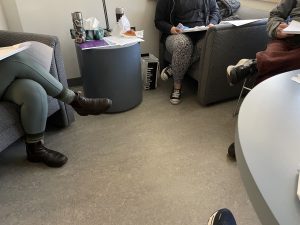
Tuesday, April 16th : We sat down together in the Building A staff room, to read our responses to questions Narda and Sadaf had posed out loud. This included responding to questions about who we feel accountable to/for/with in everyday moments with(in) and between centres.
Taeko, Noreen & David, in conversation. April 16, 2024
-What stood out for us after reading the first 4 pages of the Family Handbook? -How does what is in the handbook connect to your ongoing commitment to the work we are all doing together, at CCS? Or does it not?
Noreen:
On Accountability:
“Accountability breeds response-ability” Stephen Covey
There are many kinds of accountability, within many contexts. Narda asks “How do we live ‘being accountable’ in the absence of being embedded within one particular team? Accountable to whom?”
A quick simple response might be something like, I’m accountable to myself. I’ve a strong personal code of conduct, of ethics, of morals. But I feel that’s not really the answer to Narda’s question. Clearly I’m accountable to every single soul who is part of the CCS community. As a Float, I’m not embedded in one single Centre, but rather was hired for Centre A primarily, and every Centre, as needed. I’m accountable to my employers, my team peers, the families, and children in our care.
And I’m struggling to answer this thoughtfully in the moment – the volume is pumped up this Friday just outside the door! Will need to be continued.
On professional responsibility(ies) and some of the challenges of being a float:
Thanks for the release time for me to sit down and write something about my own reflections of being a float at UVIC CCS. I have honestly been very grateful for this float job which has offered me consistent opportunities to work alongside different age groups of children ,in consistent length of time, to observe their unique thriving social and physical development and growth. While I have learnt so much from my fellow educators, who are so welcoming, loving, caring, open-minded , and always ready to share and teach, in different programs about how to work with every unique child, I have built up trust relationship with so many children, and their families and my colleagues as well, over the years by living and encouraging empathy and care through my presence, role modelling, and positive guidance, etc, which in my opinion is my first accountability within the greater CCS community.
As a float, I have played a unique role over the years to serve as a bridge, or rather a comfort source, for the young kids moving up from one centre to a new one where everything is strange especially at the very beginning week or month. It’s been a great relief for their parents to know that there is someone their child knows at the new program who could help the child to feel comfortable to come to the new centre and have a smooth transition to settle down asap. At the same time I make a unique contribution to help the program accommodating such new kids run and operate smoothly through the transitions that otherwise could sometimes be challenging and time-consuming. I believe, through my own experience, that this unique support to such kids moving up is also one of my accountabilities as a float.
A few of my colleagues once said to me that I am a very solid colleague to work with. Frankly I did not really understand it and thus did not think much about this comment when I heard it for the first time. I started to reflect on it only when I heard the same word Solid for the second time that I realized that my colleagues feel that they could rely on me when they need me. In other word, I am accountable in my colleagues’ eyes. Accountability in my eyes means professional responsibility not only for the children in our care but also the team members we work with. In this new era of pedagogical commitment, it might also require continuous improvements of intentional critical reflections and innovations, individually and collectively, to promote children’s wellbeing and development.
To work as a float at the greater CCS community, for me, is like participating in a large scale peer mentoring program where everyone, including the children, families, colleagues and myself, is a capable and inquisitive mentor, with unique histories, personalities and theories, to everyone else during our daily engagements, explorations, and relationship building at every moment together. This is how we all grow and learn together through diverse and multiple relations. It can never be overstated how much I personally have learnt and benefited from this special peer mentoring program.
Last but not least, despite all these benefits of working as a float, it does not necessarily mean that there are no challenges in a float’s daily work. One of the major challenges I have had, especially in the beginning, is the conflict of approaches to or guidance on children’s behaviours in different programs. For example, some programs ask children to keep some materials in use in a designated area while some others may allow them to travel anywhere a child goes. What makes it even more challenging, or confusing, is that sometimes even the same educator would take contradictory approaches on different days. Another challenge I once had as a float in a pre-kindergarten program was what one of the kids said to me when I was trying to offer him some positive guidance on his behaviour toward another child. He said, ” David, you are not in charge of me. You are only a sub!” A few days later, another child in the same program said similar thing to me.
I understand that my role (float) is important to make teams work smoothly within the Uvic CCS.
As a float, I enjoy building relationships between children, families, coworkers and spending time with them. We work as a member of the childcare centre teams. I feel like we don’t belong to one particular team, but we belong to all of them. (I would say to UVic CCS teams maybe?) There’s the statement in Family Handbook; “As educators, it is our responsibility to live and encourage empathy and care through our childcare environments, materials, curriculum and pedagogies.” I totally agree with it and I feel like the floats do the same but also more support to make the teams work smoothly. (Ex. We are there for their release time, helping gradual entry etc.) We are a part of teams of course, but we are floating as it flows. Floating wherever they need us.
Garry Oak Place, where Taeko has spent considerable time lately.May 2024
A few challenges I feel are, As every child is unique, every centre is unique and slightly different for materials, transitions /routines, the way of guidance. It is honor to get different perspectives and learn from them. In the other hand, it sometimes makes me confused as well.
I usually work in infants and toddlers, and when transitions happen between those programs (especially between Acorn and Willow) I could support them for smooth gradual entry. And that is one of my accountabilities as a float working within different programs. Also, even I am not in the program all the time, I feel that our accountability is the same as regular staff and accountable to children/families and teams to provide nurture and qualified care. And I need more communication and taking initiative to be in part of their teams.
****************************************
During our Tuesday, April 16th in-person discussion, Noreen read a previously written piece she had crafted 1 year prior that feels apropos for sharing now in connection with floating questions we continue to sit with.
We invite you, our dear colleagues, to float back with us by reading her recollection from the day a family of owls visited some of the centres (lovely reminder of what happens when cherry blossoms, children, educators and families ‘meet-with’, witnessing us as we witness them):) Thank you for your time and interest in our blog! Noreen, David, and Taeko (in collaboration with Sadaf and Narda):
Noreen’s reflection:
I’ve been thinking about and wanting to write something for a while now, while still familiarizing myself with the new to me ECE language used in UVIC Child Care Services. Having spent the last six months in a “Float Position”, I’ve had the opportunity to spend time in all seven of UVIC Child Care Centres over the past six months. There have been many days when I’ve worked in two Centres in one day, and even three Centres on one occasion! To me there is a light buoyant feeling to the word Float, it’s a cheery word. Like the cherry blossom petals drifting along the ground, after a spring breeze, landing on the roof of a car, or on the sidewalk, to be caught in the wind, lifted up and tossed back in the air before softly settling down again. So I started to write a reflection on this Float position, to share some of what’ve I’ve learned so far.
An ECE Float position requires an Educator to build relationships with dozens of children, their parents, grandparents, and nanny’s, along with each Centres core staff team members, other Float and Supply staff, Administrative staff and Supervisors, quickly. Remembering which child dislikes help with dressing in one room, which verbal cues an Educator uses with a child in another room, who has allergies, and who is practicing toileting skills. What distresses and what comforts and supports in each room. And of course where to keep my personal belongings in each Centre, moving everything back and forth as needed, sometimes with little to no notice. The ability to flexibly adapt is key.
Now settled in to the Cedar Tree Room predominantly, I’ve witnessed a team of Educators massaging the idea of “The Fence” as their overarching pedagogical exploration. A few very recent visits from Narda helped shed more insight and at the same time asked more questions around what a Fence represents in a broader context. What might this fence that surrounds the Cedar Room’s yard on three sides represent to the children, their parents and to the Early Childhood Educators in the
room? Those were some of the initial queries opened for discussion, when the front entrance was locked due to the Covid pandemic and children and their parents learned how to part for the day at the back gate. And there were questions raised too around the non human life on the other side of our fenced community, and how might we be of impact to them?
watching us, watching them
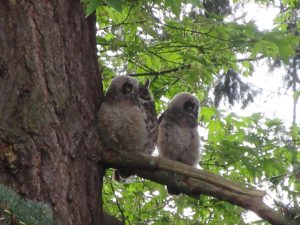
I asked this of myself when what appeared to be a family of four owls were seen perched on a branch of a tree just on the other side of our Centre’s fence. I saw them when I arrived at 9am, and they were still there when I left at 5pm. Occasionally they vocalized. From their vantage point, we seemingly were not a threat, as far as I could tell. Like they knew that the fence kept them and their territory safely apart from us. (I may be projecting here.) These owls didn’t seem to be bothered by the swooping crows, ravens, circling hawks or eagles either. For a moment I felt like we were almost living in a human zoo – behind a wall, a boundary we had built, to keep our children safe. We look through the fence to see a beautiful world filled with deer, birds, squirrels and magnificent trees and the Erik Carle book came to mind, “Brown bear Brown Bear, what do you see?” I change the words to “Brown Owl Brown Owl, what do you see?” “I see forty people looking at me!” So it is – we are watching what goes on during the day on the other side of our fence. But so too are we being watched on the other side of their fence.
Feelings of amazement to see owls out during the day, along with a special kind of excitement, privilege even, was mixed with a kind of ominous feeling as well. The symbolism of an owl sighting can mean death, rebirth, wisdom or prophecy, depending upon your cultural heritage, spirituality and beliefs. I was motivated to do a little bit of internet researching, to learn more about owl behaviour, and I think that they may have been very hungry, and/or were perhaps getting ready to try out first flights. Regardless, sharing the immediate environment with the owls proved to be a rich experience for most of us.
Family encounter
Seeing the owls first thing in the morning, upon arrival to our Centre was initially an event really. Staff and children pushed up to the fence, pointing, exclaiming, and cameras were fetched. Periodically, throughout the day, we paused our work play to check in and see if they were still there, and what were they doing. On our side of the fence lunch happened, naps were taken, and still, the owls remained perched in the branches looking down upon us. The time came for parents to come and pick up their children at the end of their days, and the owl news was shared. Some parents were allowed in to the yard to have a quick viewing, while others walked along the fence line, on the other side of our boundary to have an even closer look. This was more than just a trace, as the owls were physically still there, and it was real-time involvement with families, to “ask for their input and reflection.” (BC ELF, 2019, p. 58)
“What were the owls thinking?” I wondered, and continue to wonder today, and I wonder if they’ll return after the weekend? I spoke with some children, and they commented and asked questions such as “maybe their eating – what are they eating?”, “where do they go when it’s raining?”, maybe they just went away, but they’ll come back later”, “maybe they went to sleep” and just like that, the children ran off to get busy in the yard on this side of the fence. We have a great opportunity now to expand this experience, as a living enquiry. What kind of owls were they? Have they been here long? What significance do they hold, if any, for the lək̓ʷəŋən peoples on whose traditional territory UVIC stands, and the Songhees, Esquimalt and WSÁNE ́C peopleswhose historical relationships with the land continue to this day? If they do not return, we’ve got photographs, memories, and a few owl feathers that floated down to remember the time that the owls allowed us to watch them through and over the fence. It is my hope that “Remembering the event or moment and retelling it and wondering more about it engages children and extends their thinking.” (BC ELF, 2019, p. 57)
So it seems that what I had initially intend to write about, a reflective piece on my experience as a “Float position”, turned in to a sharing of our experience with the owls over the fence. Yes I somehow floated over into the pedagogical exploration of “The Fence” and it got tossed in to my reflective narrative. Like the owl feathers that floated down to the ground.
*This was my first attempt at writing something while at UVIC Child Care Services. At the time, I welcomed input from those wise owls around me! I know it is through a supportive and keen sense of team work that personal and professional growth can happen. I’d like to help “create environments in which both adults and children can reflect, investigate, and be provoked to deepen understandings.” (BC ELF, 2019, p. 75)