“Surely, this is the hardest work we must do, this work of being willing to think differently.” (St. Pierre, 2000, p. 478)
A UVic Online Academic Community site
Thursday, March 12th
Acorn Place 9:30a.m. - 10:30a.m.
Cedar Place 10:40a.m. - 11:40a.m.
Friday, March 13th
Sitka Place 9:30a.m. - 10:30a.m.
Juniper Place 10:40a.m. - 11:40a.m.
Tuesday, March 17th
Arbutus Place 9:30a.m. - 10:30a.m.
Salal Place 10:40a.m. - 11:40a.m.
Wednesday, March 18th
Cedar Place 9:30a.m. - 10:30a.m.
Acorn Place 10:40a.m. - 11:40a.m.
Tuesday, March 24th
Juniper Place 9:30a.m. - 10:30a.m.
Sitka Place 10:40a.m. - 11:40a.m.
March 25th
Salal Place 9:30a.m. - 10:30a.m.
Arbutus Place 10:40a.m. - 11:40a.m.
March 31st
Acorn Place 9:30a.m. - 10:30a.m.
Cedar Place 10:40a.m. - 11:40a.m.
Tuesday, February 12th
Sitka Place TBD
Cedar Place 10:40a.m.-11:40a.m.
Tuesday, February 18th
Juniper Place 9:30a.m.- 10:30a.m.
Arbutus Place 10:40a.m. - 11:40a.m.
Wednesday, February 19th
Salal Place 9:30a.m. - 10:30a.m.
Willow Tree Place 10:40a.m. - 11:40a.m.
Monday, February 24th- Friday, March 6, 2020*
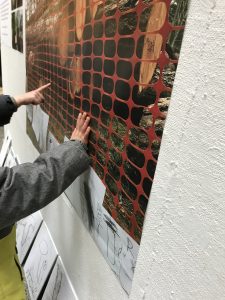
Sensorial Becomings: Climate Pedagogies with Children exhibit in the UVic A. Wilfrid Johns Gallery
*Inquiry time will take place in the exhibit during this time.
Denise and I would like to invite anyone interested in working in a focused way in the lead up to our exhibit to participate in the process of curation for our exhibit installation on January 28th. This will be a small committee (4 educators max) and require the ability to participate in a bit of an intensive burst over the next couple of weeks to:
Let us know by the end of Thursday, January 9th if you are interested in joining us for this part of the exhibit curation process. We will be emailing more information out to those interested on Friday and be scheduling a time to meet soon after. Of course, there will be opportunities to engage with the exhibit in other ways down the line but for those of you interested in helping out in this final push in getting it ready for the public, we welcome your input and assistance! 🙂
Traces of our CAN Inquiry documentation will also be on display at the Western University Colloquium exhibit at the end of this month as well as in the London Children’s Museum in a larger exhibit, along with the other CAN collaboratories. With so many CAN Collaboratory sites coming together from around the world, Veronica Pacini-Ketchabaw and the CAN Colloquium exhibit organizing committee have created ‘site groupings’ to work together to create ‘collaborative CAN inquiry moments’ for the gallery space there. Our documentation will be put to work with Weathering Wanderings (Mindy Blaise, Tonya Rooney) and Conversations with Rain (Jo Pollitt, Mindy Blaise, Vanessa Wintoneak) to create a ‘sensing, noticing, breathing, wondering’ moment that highlights trees-rain-weather-walking-with pedagogies.
Nicole Land and her Ryerson University grad students are exploring ways to create a short video of the entire exhibit to share back with us all, including children and families! We’ll keep you updated on that as things continue to unfold. Excited to see what happens with our CAN inquiry documentation when it comes together with the others in Ontario!
The Conversations with Rain creative team has also published ‘response journals’ in connection with their project, to engage deeper with the concepts. These response journals are open-ended and might invite some interesting engagement within our own contexts, which they will be sending our way for you all to see, experiment with, and share with families as well. Link to the Conversations With Rain state exhibit currently on exhibition in Perth Australia: https://artgallery.wa.gov.au/learn/artist-activation/conversations-with-rain
Look fwd to hearing from those of you who are interested!
Narda
Thanks to everyone who made it out mid-week to join us for a cozy, reflective gathering to hear more about Vanessa’s research in Perth and multiple voices engaging in the room! Delicious food as well (thx Kim!) And huge thanks to Vanessa for leading us in a choral reading of Blaise, Rooney & Pollitt’s ‘Weather Wanderings’ and sharing insights and reflections from her ongoing walking-with research in Perth yesterday evening. Among other things, she challenged us to break with habitual ways of ‘walking to’ and open ourselves up to new considerations by ‘walking-with’:
But look what happens when we take another approach. When we shift our focus. Instead of assuming that children are the protagonists and are the centre of our walks, what happens when we position water and wind as the main players? How might this make room for different kinds of noticings? How might water and wind bring together relations with children, animals, and the world? What kinds of relations emerge?
The Weather Wandering reading (animated by so many lovely voices) offered other considerations:
We think of our walks as wanderings; this means that bodies flow and meander with weather and generate new wanderings. Weather wanderings expand on Tonya Rooney’s (2018; 2019) weather worlding inquiries with children. Weather wanderings interfere with the developmental child because they shift our thinking beyond focusing exclusively on the human child body, and what they are learning or sensing, to witness the intermingling of weather with place, animals and plants across time and space. (pp. 166-167)
Notes from educator voices in the room:
Things that stood out from reading/tweaked curiosity for further considerations from educators in the room:
We ran out of time to get into the other two stories, but Vanessa has added links in the attached notes for those interested.
Kim stayed extra late putting away food, dishes so I’m not sure where this intention was left, but we chatted about the possibility of leaving some paper and pen out in the staff room for folks to jot down after-thoughts, larval ideas (Nxumalo et. al, 2019) somehow weaving our time together into a CW microblog post. We welcome any thoughts you may have on this and will keep you updated as progress is made.
Best,
Narda
A) We invite you to continue to read and think about your Place’s ethos statements. Kim shared an email with an invitation to work with your ethos and have them made into large posters for your Place. There will be some opportunities to consider ethos statements individually and in teams on the 20th.
B) We invite you to review some quotes from the ELF shared below, read one article (an FYI article is also provided) and some ELF pages on pedagogical narration, watch one video of a keynote address, and listen to one radio program. Below you will find the quotes and resources listed as they connect to different parts of our day. The readings can be found as PDFs in the Resources section of this CCS website.
REVIEW – ELF Notes:
LISTEN [24 minutes]: Taig, J. (2019, February 18). Parenting throughout history could be weird, and downright dangerous. In CBC’s The Current with Anna Maria Tremonti. Retrieved from https://www.cbc.ca/radio/thecurrent/the-current-for-february-18-2019-1.5021628/parenting-throughout-history-could-be-weird-and-downright-dangerous-author-1.5021677
FYI READING:
Hodgins, B.D. (2019). Mattering threads, knots and black holes. In Gender and care with young children: A feminist material approach to early childhood education(pp. 58-111). New York, NY: Routledge.
REVIEW – ELF Notes:
READ: Motegi, N. (2019). Reconciliation as relationship: Exploring Indigenous cultures and perspectives through stories. Journal of Childhood Studies, 44(4), 82-97.
WATCH [50 minutes]: Taylor, A. (2018, April 11). Following and narrating children’s common world relations. Keynote address ECEBC Conference, Vancouver, Canada. Retrieved from https://www.youtube.com/watch?v=G6IW1yyH_1k
REVIEW – ELF Notes:
READ [PAGES 51-59]: Government of British Columbia. (2019). BC early learning framework. Retrieved from https://www2.gov.bc.ca/gov/content/education-training/early-learning/teach/early-learning-framework
Methods for Speculative Pedagogies - A Research Conversation on 'Walking-with'
Wednesday, December 11, 5:30 - 7p.m.
Location: Bldg A Atrium
Guest Speaker: Vanessa Winoneok, PhD Candidate, Edith Cowan University, Perth Australia, W.A. Australia.
Vanessa is “interested in experimental and creative methodologies [and is] currently developing speculative pedagogies by walking-with Derbarl Yerrigan, educators, and young children in Perth.” She will present to us on her ongoing ‘walking-with’ research with Mindy Blaise, educators and children in Perth, Australia.
For those of you who are able to attend, you might find Weather Wanderings (Blaise, Rooney & Pollitt, 2019) valuable to look at prior the session. It is a 3-page article that is grounded in walking-with weather pedagogies.
We wander: not to watch children progress to the next developmental milestone, nor to see them navigate a weather world where they are at the centre, but, rather, to wonder with unfolding, lively and, sometimes, unruly weathering-with relations. Our weather wanderings
are a type of ‘slowing down’ that Isabelle Stengers (2018) advocates. It renders us attentive (Stengers, 2015), and opens new pathways and possibilities for coming to know the world.
Gatherings of/with/in Collectivity Session 1
Tuesday, December 3, 5:30pm-7pm
Location: Harry Lou Poy Bldg Atrium
Potluck (please bring small item for sharing)
Reading/resources: FreshEd podcast #180; Peter Moss (2014) pages 89-91 from chpt excerpt, Sylvia Kind, Collective Improvisations
My image of the educator is similar, ‘rich’ and competent with enormous potential, and active learner co-constructing knowledge in relationship with others, not least children, with the school as ‘a place where adults and children learn together’ (Hoyuelos, 2013, p. 126)…This educator is a reflective practitioner, a theorist and critical thinker, aware that ‘when you do practice, it’s because you have a theory…[and that when you] think, it’s because there’s a practice behind it (ibid, p. 191)…She is also a researcher and experimentor, seeking new understandings, new knowledge, new ideas, these identities manifested in various ways: ‘as a way of thinking of approaching life, of negotiating, of documenting’. (Moss, 2014, p. 89)
What does it meant to de-centre the educator in ECE practice? How do we do this in a way that honours educators as participants in the process of learning without leading us into the trap of making ourselves disappear in the process of engagement? Is there a line between engaging children in conversation and imposing our beliefs on them?
Cedar Place has been trying to come together, as a collective, to learn to tell stories together. New stories. It began with a discussion about a tree being cut down behind the centre. The children were intrigued, curious, and affected by the process of the tree coming down. It was noisy. It required ropes but little discussion or warning that this was going to happen (my understanding is that workers came and took the tree down quite quickly). Some of the children retold the story to their parents over many days.
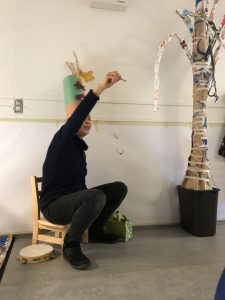
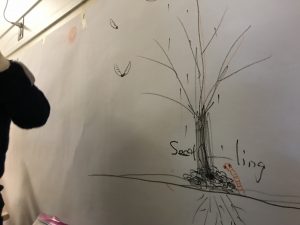
We’ve been thinking with Donna Haraway’s concept of “storytelling for earthly survival”. Johanna and Diana have been making space for Key to take the lead in storying the life of a tree. Many trees. But one in particular that now lives in their centre. Its life story is unfolding on the wall (with markers and paint) while children sit in a circle to listen and engage. Some children shout back at Key-tree as she tells stories. Others sit silently watching. Some squirm and try to walk away (but not as many as you might think). Most seem interested to see what is happening. Some try get up very close to Key-tree to watch her paint. Some notice who goes in and out of the circle. These moments of coming together have become somewhat of an event where Key puts on her tree hat and become ‘Key-tree-story-teller’.
Fabrizio Terranova (2016) created a film called ‘Donna Haraway: Storytelling for Earthly Survival’, whose “contributions to feminist studies of science and technology resist and even rebel against hegemonic ways of thinking and living. But what form should such stories take? What might they sound or feel like?”
It is Donna Haraway’s ideas about “storytelling for earthly survival” that came to mind when Cedar first met with me (Narda) to discussed inquiry ideas for experimenting with ‘collectivity’. It still does. I am fascinated by everyone’s openness to keep trying to tell new stories with the children as a collective and the way that the children ‘stick with it’, you all ‘stick with it’ and how much effort everyone is doing to ‘stick with it’ even if there have been uncomfortable moments and moments of not knowing where things are going.
In the film, Donna Haraway talks about what is required to do restorative, collective work in the process of striving to create more livable worlds. Whatever we decide ‘it’ is (that is, whatever we decide is the focus/problem/issue we need to work on together)…She says:
"The only way to come to grips with 'it'. To come into the presence of 'it' is to constantly keep doing positive things. You have to keep trying to make an experiment work. You have to constantly keep writing this particular story, not some story in general, but this story...The only possible way is to - again and again and again - engage each other in doing something."
Last week’s inquiry time took a turn…
Original intentions to go to the forest were derailed by the wind and parental concerns about safety after a large branch fell in front of a parent’s car (?). The children were excited to go outside when I arrived, but instead of simply saying no or trying to redirect their attention away from the wind Key, Johanna and Diana decided to ‘stay with the trouble’ of the wind and invite the children to think about why we could not go to the forest. They met the children’s desire with respect and created the conditions for them to witness the wind and listen to the story it was telling with the trees.
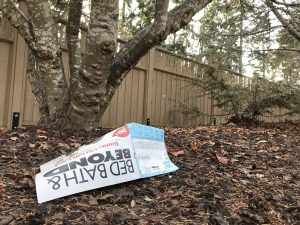
With the wind pushing recycling around the parking lot (part of the story too), we watched huge Douglas fir trees sway as gusts of wind wound their way through with you all on the edge. “Not today!!” shouted one child. Another tried to run to collect recycling that was swirling in the parking lot (stopped by Xiao who picked it up with him).
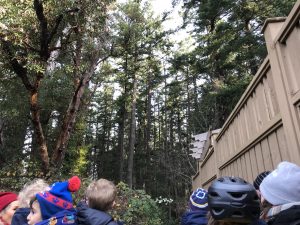
Before we left a chorus of voices shouted encouragement to the trees:
“Hold on!!!!!!”
“Be strooooong!!!!”
“Hold on!!!”
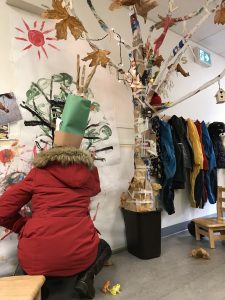
 We walked back to the centre. Another tree-Key story emerged.
This time the story transformed children into hungry frogs, unsuspecting educators and a pedagogist into insect-infested trees, after the tree on the wall grew and changed in the process of the new story being told. At the end of it all: frogs were fed, trees stopped itching, the tree on the wall grew a thicker trunk with a hole so the owls had a home. All the while, the wind-story became something other than simply a shutting down or diverting attention story.
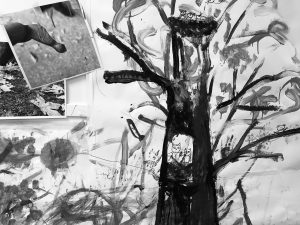
Peter Moss mentions ‘the Dark Mountain Project’ in a book that addresses the importance of learning to tell new stories in early childhood education: :
“We believe that the roots of the converging crisis of our times lie in the stories we have been telling ourselves…We will reassert the role of storytelling as more than mere entertainment. It is through stories that we weave reality.” (Dark Mountain Project, 2009a)
“The Dark Mountain Project is a network of writers, artists and thinkers ‘who have stopped believing the stories our civilization tells itself…[as the world enters] an age of ecological collapse, material contraction and social and political unravelling’. These once potent stories but now unbelievable stories, they contend:”
Tell us that humanity is separate from all other life and destined to control it; that the ecological and economic crises we face are mere technical glitches; that anything that cannot be measured cannot matter. But these stories are losing their power. We see them falling apart before out eyes. (Dark Mountain Project, 2009b)
Reference:
Middleton (2019):
The very notion of common worlds is an active, inclusive, more-than-human one which is borrowed from Latour (2004) but also inspired by Donna Haraway's (2008) generative and collective 'worldings'. More like an aspirational verb than a descriptive noun, common worlding or the commoning of worlds requires a persistent commitment to reaffirm the inextricable entanglement of social and natural worlds-through experimenting with worldly kinds of pedagogical practice. This means pushing past the disciplinary framing of pedagogy as an...exclusively human activity and remaining open to what it might mean to learn collectively with the more-than-human world rather than about it, acknowledging more-than-human agency and paying attention to the mutual affects of human-nonhuman relations." (Taylor, 2017, p.8)

Reference:

Taylor, A. (2017). Beyond stewardship: common world pedagogies for the Anthropocene. Environmental Education Research. Retrieved from http://dx.doi.org/10.1080/13504622.2017.1325452