Protected: Common Worlding: Together-Apart exhibit
There is no excerpt because this is a protected post.
A UVic Online Academic Community site
There is no excerpt because this is a protected post.
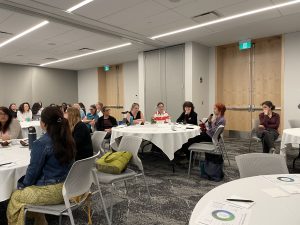
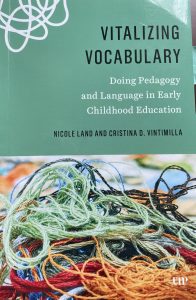
Reading the first and second chapter of Vitalizing Vocabulary: Doing Pedagogy and Language in Early Childhood Education along side with the BC Early Learning Framework has deepened my understanding of the role of language not just as a tool for communication, but as a powerful medium for creativity, identity, and community-building in Early Childhood Education. Both texts challenge traditional, top-down pedagogies and invite educators to see dialogue as a shared and dynamic process—one that is deeply ethical and filled with possibility.
Situated dialogue, as proposed in Vitalizing Vocabulary, is more than just listening politely or prompting children to speak. It means truly being present with children, allowing their questions, thoughts, and emotions to shape the direction of the conversation and the learning that unfolds from it. This resonates strongly with the BC ELF’s principle of creating inclusive spaces where children’s voices are heard and valued. It supports a pedagogy that is relational, collaborative, and responsive.
When children are given this kind of space—when their words are not merely corrected or directed, but instead welcomed, extended, and even challenged—they begin to see themselves as thinkers and makers of meaning. This is where creativity and self-expression flourish.
In environments that embrace situated dialogue and relational pedagogy, children learn to engage with what is available to them—materials, language, movement, images, sounds—to create and co-create worlds of understanding. They build structures with blocks and with ideas. They paint pictures and tell stories that merge imagination and experience. They negotiate, reframe, and invent. This is not creativity for the sake of performance, but creativity as a form of living inquiry—an ongoing process of making sense of the world and one’s place within it…
*Link to Karina’s full post with photos here: Karina’s Reflection May 2025
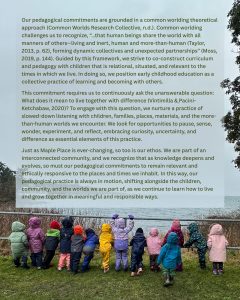
During the March 21st early closure, we invited families to come and celebrate one year of coming together with Maple Place. During the open house we shared our documentation, Coming Together with Place, an invitation to listen, to notice, and to respond with care. In the documentation we explored how our first year with Maple Place has not just been about us; it has been about learning how to be together with place. In this post, we share a glimpse into the open house – a summary of the text and photos of the exhibit panels, and our ethos which we wrote together after a year of thinking together with Place. We offer traces of our learning, echoes of our conversations, and the many ways we are coming to know and care for this place and one another. If you are interested in seeing the full exhibit, you are welcome to stop by.


After a year of coming together with Place, here is our Ethos:
April 3rd 9:15am – 9:45am Collective Reading Group:
Tiny human geographies: babies and toddlers as non- representational and barely human life? (Holt & Philo, 2020)
Participants: Diana (Sitka Place), Cinder (Cedar Place), Kelcie (Acorn Place), Paty (Maple), Leanne & Kowisara (Juniper Place), Mary & Crystal (Willow Tree Place), Sadaf, Narda
Thanks to everyone who joined online today! Today’s discussion was a reminder of what slow reading-pausing-discussing-unpacking words-listening (to each other’s reflections on moments from practice) offers, in terms of nurturing a new ‘collective reading practice’ or ‘habit’ into existence. Whether we read a single paragraph or work through a whole page, we pack a lot into these 1/2 hour sessions! Looking forward to picking up again on page 7 next Tuesday.
We began with a brief recap of last week’s discussion. Some stand-out points/questions in conversations thus far and from last week:
–Why, in a subdiscipline concerned with the agency of children, are babies and toddlers largely absent? (p.3)
–Babies and toddlers tell us something more aboiut what it means to be human in a lively and agentic world (p.3)
–discussions of societal tendencies to see babies and toddlers as “out of place” in so-called adult spaces as culturally determined (as a Euro-Western-North American phenomenon which is different from other places in the world)
–Ildikó’s question (and enthusiasm about considering): What happens if we follow children’s ways of moving, knowing, feeling in the world? What does this do to ‘us’ as educators. How might it shift our practices? What else could we learn? (to move with children instead of simply defaulting to managing behaviours, etc.)
Brief discussion/clarification today on terminology:
Babies themselves exert their will and desires in the world ... babies approach city life with a very different sense of sociability to that of adults ... mother-baby assemblages can destablise received understandings ... a line of flight from normative ways of being ... . (Boyer 2018a, 49)
Thoughts/reflections/offerings as we moved through page 6:
-In response to the line the “responsibility that adults usually feel for child welfare, which always limits and constraints child agency (Vanderbeck 2008), at the same time positioning babies and toddlers as, so it seems, these particularly incapable, necessarily dependent barely-humans.” (Holt & Philo, 2022, p. 6) Kelcie made connections with tensions that occasionally come up with feeding babies. Reminded her of moments when a baby is telling them “I’m not hungry” Who defines what’s necessary in those moments? How does a ‘child’s agency’ meet with the obligation of meeting a child’s basic needs? These moments often become a question of ‘how’ versus one set of rules for every child in every situation. We don’t force children to the table, but how do we offer them food? “Look! this is waiting for you when you are ready” She shared moments when other babies tug at sleeves of the child who hasn’t eaten, trying to help get them to go eat. This led us into a new consideration “who is understood as being the ‘care-er’ versus the ones who are solely ‘cared for’?” Power dynamics of normative ages and stages disrupted. How we understand these things also speak to our image of the child.
-Diana shared ‘sticky situations’ where we use to give children less choices. In the past it may have been “time to put your coat on” whereas now more often the approach might be inviting them to put it on. She expressed discomfort with looking at cold children who may have refused to put their coat on. Where is the line?
-this took us into ethics, the role of the educator, and discussions about top down approaches which have potential to promote a disconnect between mind/bodies. There is so much change happening in society right now. Rather than looking at is as a “we ONLY do things ‘this’ way or ‘that’ way” the question of ‘how’ becomes more important. How we offer jackets, how we offer food, how we open up opportunities for young children to make decisions for themselves, of course without jeopardizing keeping children ‘safe’. What about the importance of cultivating a sense of ‘consent’ from the youngest of ages, when it comes to bodies? How might we rethink the ways power gets distributed within a centre? The language we use to communicate with children matters and shapes how children (at any age) learn to respond and treat each other. Sadaf and Mary contributed to this conversation too.
-we finished page 6 and wrapped up with the term “strange otherness” 🙂
Thanks again everyone for fascinating discussion.
Hope to see you again next week – we only have a couple of pages left in this piece and will be moving onto the Pro-D Day reading after that.
Best,
Narda
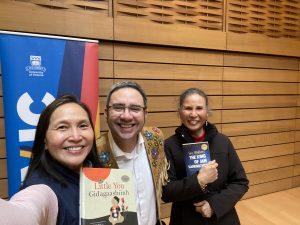
Hi all!
I’m adding this short post to share a positive experience with Key, Linda and Sadaf on March 15th at First Peoples House. When the UVic Alumni Association advertised this event with Richard van Camp, as two unforgettable storytelling sessions they weren’t kidding! What an amazing speaker and storyteller! The audience went back and forth from laughing loudly to being quiet and reflective as we listened to the stories he shared. So grateful to Kim for sharing the brochure and I sincerely hope you all get a chance to take in one of Richard’s events on campus before his tenure is done, as UVic’s 2024/2025 Indigenous Storyteller-in-Residence.
March 15th Storytelling Sessions:
10 a.m. – 11 a.m.: Storytime for little ones at First Peoples House
A special session where Richard will read from his beloved children's books, including Kiss by Kiss, May We Have Enough to Share, We Sang You Home and Little You. These stories celebrate the beauty of childhood with themes of love, connection and belonging. Alumni with young children and local community members are invited to register for this session.
12 p.m. – 1:15 p.m.: A Deep Dive into Indigenous Storytelling
Richard will showcase a variety of his novels and explore the vital role of storytelling in Indigenous cultures. This session will also include an exclusive screening of Inkwo for When the Starving Return, a stop-motion animated short directed by Amanda Strong and co-written by Richard, based on his short story Wheetago War, from the collection, Night Moves. The film is presented with the support of Spotted Fawn Productions and the National Film Board of Canada and has been selected for the 2025 Sundance and 2024 Toronto International Film Festivals. We encourage alumni, students, faculty, staff and community members to attend. Please be aware that the film is intended for mature audiences, and it is recommended for viewers ages 16 and older.
Here’s a link to a short video (6 min 12 second) of Richard van Camp (2020) sharing a story, to give you a sense of his gifts as a storyteller and speaker: Contemporary Indigenous Storytelling by Fort Smith, NWT, Tlicho Dene Storyteller Richard Van Camp
 If you get a chance, I highly recommend checking out his NFB collaborative stop-motion animated film If you get a chance, I look forward to watching Inkwo for When the Starving Return. (sure it is available to watch through UVic Libraries, if not available through the NFB website itself).
With gratitude for this fabulous day!
Thanks to all who showed up for the online this morning! Fabulous discussion and much to consider in our Collective Reading Group conversation. I’ve sent a calendar invite for those interested in continuing to meet the same time next week in the hopes we can keep the conversation going.
See (below) for notes from our conversation (feel free to add/respond in comments if I’ve missed or if anyone else wants to weigh in on the conversation!). Grateful to all who contributed to this great conversation:
March 11th 9:15am – 9:45am Collective Reading Group:
Tiny human geographies: babies and toddlers as non- representational and barely human life? (Holt & Philo, 2020)
Participants: Josephine (Arbutus Place), David (Cedar Place), Celine & Suzanne (Acorn Place), Maureen & Karina (Juniper Place), Noreen & Meredith (Salal Place), Nina (Willow Tree Place), Sadaf, Kim, Narda
We began by reading the Abstract and moving slowly through the first two pages. Our first pause was to refocus attention on: purpose and intention of the piece (who do the authors had in mind in writing and publishing this piece?). While written for a ‘Human Geographies’ academic audience, the piece invites audiences into considerations about larger societal questions about who is considered fully human in the first place.
-the authors call is a ‘speculative’ piece. What are they speculating about? “What kind of human is at issue here?” Ethical, political and religious tensions are being raised, in connection with IT relations.
-On whose terms are babies and toddlers measured as ‘contributing’ members of society, or not?
-How might we meet with this article? As EC practitioners, working with children everyday (as advocates/researchers/educators/with curiosity/as learners…?)
–Who is the ‘we’ the authors refer to? And, if ‘we’ disagree with the ‘we’ the authors talk about throughout the piece, are we able to take note and think beyond initial reactions to consider where these ideas come from? How do these ideas continue to live in society? In policies that guide our work? What about our own complicity, from time to time, in using certain words to describe the behaviours of the children we are working with? For example, as Sadaf mentioned using the word ‘silly’ does something to frame/dismiss toddlers’ behaviour.
Co-author, Chris (Philo), highlights the “capable, responsible, autonomous, self-determining, ‘rational’ subject” (p. 2), which “tiny, barely humans” are often excluded from being considered as. As we discussed, the authors are making a ‘double’ move in this piece: 1) naming certain ‘modes of being’ that tends to set babies outside of being considered full subjects in Western society, 2) deliberately using language/words in a provocative way to do so (choosing words to ‘playfully’ try to get readers attention/students’ attention through slides chosen for a lecture).
We paused here too.
While acknowledging what the authors are trying to do, we wondered if they aren’t inadvertently doing the very thing they claim to be working against: demeaning infants and toddlers. This is not an easy piece, as Kim pointed out, but it has been great getting into such a deep discussion about these issues. We are still in early stages of reading the article and I welcome (and love!) digging into the tensions and believe it is always worthwhile stepping back to consider ‘on whose back’ any argument is framed/made/claims are made. This does not mean it is a ‘good’ or ‘bad’ piece. But it is doing something with us that might be worth noting as we move along.
Celine and Kim said they were offended at times reading the piece, in terms of the words chosen by the authors to describe babies (offensive, negative connotations with some of the words). As I (Narda) said, I had my back up at times too but reminded everyone that the point of sharing this piece was as a provocation for us to think together about some of the exclusions that continue to place IT outside of certain conversations in ECE. Also to examine how/why we, too, occasionally fall into the trap of narrating baby and toddler ‘doings’, in ways that align with seeing them as ‘lesser’ humans? It will be up to each of us to determine whether the authors are successful or not, in the way they approach writing the piece. What, if anything, does the piece offer that is worth considering?
Words that provoked/awakened/offended:
-dribbly; scrumpled; messy; lazy; odd;
Meredith raised a point about what this piece being up for her: how hard we try to be respected in this field, in a society that only sees babies, toddlers and children as ‘lesser’. This makes the struggle more more glaring (obvious). If this is what we are up against, it is no wonder our profession is so disrespected too! Material and political implications for these underlying assumptions.
Celine and Sadaf raised question about how these assumptions show up in our language (how we create binaries defining children on one side of the binary, the words we use without thinking about their impact on how babies, toddlers and children are viewed).
David spoke to the ‘strange’ language used in the box to describe (Chris’ slide he used in one of his geography classes). Of course, he never thinks of toddlers as “lazy”, “they are just being who they are!” It was so strange to think about infants and toddlers in this way (which is probably the point the authors are making, but funny/weird to consider them in this way). ‘Odd bodies’ too is a reference to proportionality in IT bodies. We talked briefly about underlying assumptions about who is considered ‘productive’ in society? Who is this productive, so-called normal body/mind that babies, toddlers, and children are being measured against? Nina raised a question of: What about adults who are the same? (more said here that I didn’t write down).
Suzanne picked up on the point about ‘odd bodies’, asking if this wasn’t exactly the point the author was trying to make by creating the slide in the first place. Deliberately drawing attention to the absurdity of ‘measuring’ children against this ‘rational, capable, responsible, autonomous, human subject (hope I have this correct Suzanne!).
Looking VERY forward to continuing the conversation/collective reading next week!
Thanks again,
Narda
Hello everyone,
Here’s a link (below) to a thought-provoking piece that offers insights into questions about what it means to be fully human. Children of all ages are often set outside the sphere of ‘serious’ (adult) concerns, but there are a particular set of exclusions at work in the realm of non-verbal relations. What does this mean for our practice and research at UVic CC? Among other things, the authors ask:
What do we do with societal assumptions about babies-toddlers being non-representational subjects par excellence unable to represent themself?...Babies and toddlers, at least in the Global North and wealthier sectors of many Majority World nations are disruptive; they challenge and transform expectations of how space is experienced and performed. In so doing, as tiny humans, almost always regarded unquestioningly as human despite flouting most human ‘norms’ of conduct and (self-)representation, they starkly expose and rupture those norms which otherwise remain tacit and hidden. (Holt & Philo, 2022, p. 8)
As always, when reading this piece it’s important to consider the context the authors are writing from. For the most part, the piece is focused specifically at questioning why babies and toddlers are largely excluded from the sphere of ‘children’s geographies’. Of course, not all societies, cultures and communities hold the view of babies and toddlers the authors are pushing back on. However, they raise interesting considerations about societal assumptions that intersect with some of our considerations this year with what it means to live a pedagogy of listening. What views do we hold about ‘the agentic or compentent child’, for example, that influence everyday practices? What does a common worlding approach bring to the conversation? I thought it might be an interesting read to think with, within and across our different contexts.
*Note: the authors use the terms ‘Minority’ and ‘Majority‘ worlds which is alternate terminology to what many of us might be used to. As Sadaf Shallwani (2015) points out:
Majority world / Minority world: The term ‘Majority world’ highlights the fact that the majority of the world’s population lives in these parts of the world traditionally referred to as ‘developing’. The term ‘Minority world’ is similarly used to refer to those countries traditionally referred to as ‘developed’, where a minority of the world’s population resides.
ABSTRACT

We question the relative absence of babies and toddlers in geographies of children and youth, while also acknowledging what may be signs of a new subfield in the making. We argue that there is an exciting opportunity here because babies and toddlers are at the crux of what it is to be human, raising potent questions about exactly ‘what kinds of human’ are they? We argue that babies are the ultimate non-representational, in certain respects barely-human, subjects who express their agencies in non-verbal ways. Toddlers too are disruptive to the socio-spatial order, and their disruption exposes the normative expectations of behaviour in place. Close attention to these tiny humans and their ‘micro- geographies’ provides insight into ‘lines of flight’ that configure our studies, and maybe even our worlds, otherwise.
Would love to hear thoughts on the piece!
Thanks,
Narda
Listening is an active verb…
It requires openness to change. It demands that we value the unknown, and overcome the feelings of emptiness and precariousness that we experience when our certainties are questioned.(Rinaldi, 2001,p.3)
Salal Place has been putting a Pedagogy of Listening to work in new ways, in an effort to activate pedagogical experimentations with children in their centre.
Scarves are a familiar and beloved material within Salal Place. Alongside countless moments that constitute each day, scarves have become a dynamic co-participant for reconsidering ways that bodies and ideas move throughout the centre. Salal Place team is engaging with scarves as a method for learning to listen in new ways and co-create (and tell) new stories this year. Their ‘big body movement room’ has become a space for gauzy fabrication, a place where lines, tensions, slipperiness, the weighty-ness of scarves (and weightlessness, at times!) can be explored.
On Jan. 20th Sadaf and Narda removed books, materials, etc., and arranged scarves throughout the centre in ways (we hoped) might provoke new flows and encounters with children, scarves and educators the next morning. Children filtered into the centre the following day. Movement with scarves morphed and changed along with the increasing morning light and bodies. This provocation was intended to amplify (and document) scarf-child-educator encounters. See below for some of Emily’s notes from that day and a quote from Sylvia Kind and Adrienne Argent (2019), who the team has read and been thinking with about ‘Fabricating Fluidities’ in material encounters with scarves.
Key Words: Warm, Gifting, Wrapping, Calm, Focused, Caring, Fluidity, Movement, Stillness
Thoughts/Perspectives: Arriving to Salal I noticed most of the room was bear with no additional materials provided other than the scarves. The scarves were placed gently and purposefully around the room some tied together creating a long chain, others draped over hanging décor in the room. 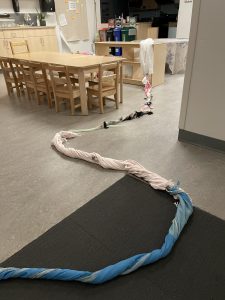
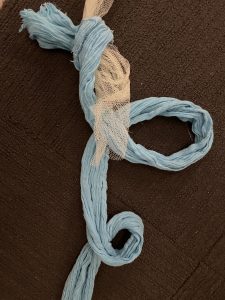
While watching the group explore the room as it was offered, I noticed very little hesitation on where to “begin” with the scarves. The children that arrived first moved the scarves around the room to where they desired. Giving more movement and life to the scarves. I heard I____ say to Narda “don’t step on the scarves!”, as he was concerned for the care of them. 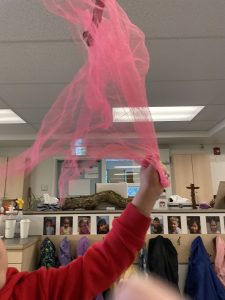
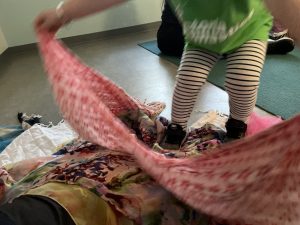
I found it fascinating how quickly the scarves moved into the “Big Body Movement Room”, where they often live on a day-to-day basis. As if they were returning to home base. 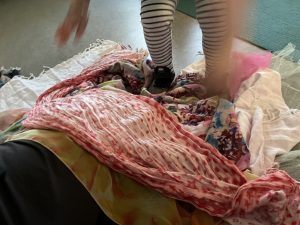
I loved the atmosphere that the sun created as it peered into the room, it created a warm and inviting space. 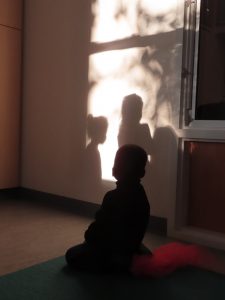
The fascination with the shadows on the wall was really interesting to observe, especially J____ as he appeared to be mesmerized.
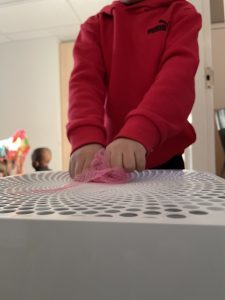
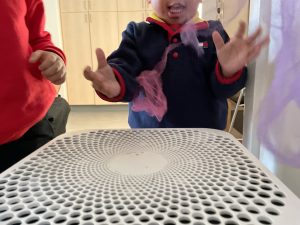
The use of the air purifier was wonderful to watch because the air added beautiful movement to the scarves. 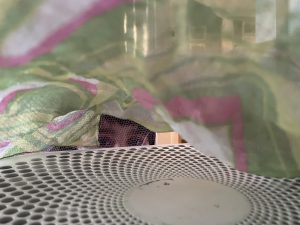
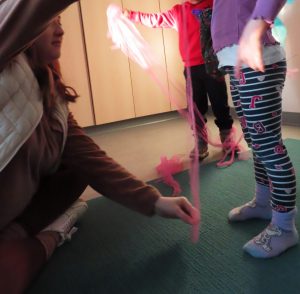
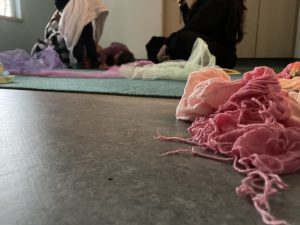
I heard some children talk about wrapping me up, and Sadaf said something along the lines of “wrapping a present”. Which I thought was sweet as they were so delicately and thoughtfully wrapping me up with the scarves. I also want to acknowledge how amazing it was that the children stayed all together in the room for over 1 hour, happily playing with each other and the scarves.
The [big body movement room] is not merely a background to children’s experimentations or a container for art explorations but an emergent space itself always in the making…It is not simply about arranging an artistic space or filling it with art materials, rather composing it so that there is an “invitation to realize projects not possible under existing conditions.” Thus, the work becomes an experiment, a desire to produce difference and a search for “unexplored horizons.”
…The fabric makes visible the children’s lines of movements and exchanges. And while the fabric draws us all together in the tangles of connections, the nonconforming and slippery nature of the fabric actives a particular quality of being together. The fabric takes shape, but only temporarily because it cannot, on its own, hold a form…Children, educators, [program manager and pedagogist], fabric [light and air] are in moving correspondence together, and we give attention to what is being made and produced in the middle of this. (Kind & Argent, 2019, pp. 35-38)
What is Campus Kodos?
Campus Kudos celebrates and acknowledges the achievements and accomplishments of our talented and hard-working faculty, staff and students.
President Kevin Hall will recognize the people receiving Campus Kudos at informal celebration events throughout the academic year.
Kudos are shared with our campus community so we can all learn more about the great things happening at UVic and the people that make up this institution.
This year Uvic Childcare was nominated for Campus Kodos, the nomination was done by one our parents from Cedar Place!
thank you to everyone who made all of our commitments possible last year.
Please see below:
https://www.uvic.ca/faculty-staff/pay-benefits/recognition-and-service/campus-kudos/index.php
Kim Ainsworth, Sadaf Soheilsayar, and Michelle Mason – Child Care Services Administrative Team
“Collective thinking is not “thinking the same” as others. Rather, when we engage in collective thinking, we bring our own ideas into conversation with the ideas of others (e.g. artists, poets, philosophers, educationalists and so on) whose perspectives and experiences might be wildly different than our own. Even if people come from similar backgrounds, we may approach problems or tensions from different angles. This is why collective thinking-or thinking with others-can be a powerful way to question our habits, consider alternatives and create new ways of thinking, doing, and being together.” (Smith, Mann, Jeong, Monpetit, Pacini-Ketchabaw, 2024, p. 1)
Reference:
Smith, T., Hann, C., Jeong, M., Montpetit, M., Pacini-Ketchabaw, V. (2024). Catalogue of Wanderings: Wandering With/In Conversations with Young Children, (Volume 2). ECPN.