Campus Kodos – Uvic Childcare!

What is Campus Kodos?

Campus Kudos celebrates and acknowledges the achievements and accomplishments of our talented and hard-working faculty, staff and students.

President Kevin Hall will recognize the people receiving Campus Kudos at informal celebration events throughout the academic year.

Kudos are shared with our campus community so we can all learn more about the great things happening at UVic and the people that make up this institution.

This year Uvic Childcare was nominated for Campus Kodos, the nomination was done by one our parents from Cedar Place!

thank you to everyone who made all of our commitments possible last year.

Please see below:

https://www.uvic.ca/faculty-staff/pay-benefits/recognition-and-service/campus-kudos/index.php

Kim Ainsworth, Sadaf Soheilsayar, and Michelle Mason – Child Care Services Administrative Team

  • Successfully oversaw the opening of the new Queenswood Child Care centre, including staff hiring, and outfitting two new centres.
  • Their work ensures affordable, high-quality childcare and they are committed to fostering a strong sense of community and belonging.

Listening At Juniper Place

Hello from Juniper Place.

We would like to say thank you to everyone for making last weeks Pro Day so wonderful and engaging. At Juniper Place, we are excited to be thinking with Listening this year. Listening is entangled in all that we do and has been particularly important to us over the past couple of months as we adjust to a new year, new energies, and new ways of being at Juniper Place. We would like to offer a few of the questions, thoughts and ideas that we are starting out with:

We have been thinking deeply about what it means to slow down, to be present, and to Listen.

We are a community and we believe we must seek connection, have an openness to truly  know one another (more-than-human and human) and listen with our whole self.

Listening at Juniper Place is grounded in acts of feeling.

We are asking out selves:

What engagements, connections, experiences, and ways of being in the world do we open ourselves to when we expand our conceptualization of listening beyond the simple act of hearing?

  • How do we listen to each other, respecting each others knowledge, experiences and ways of being in the world beyond what is simply audible?
  • How can we get to know and feel one another?
  • How do we listen with the more-than-human world?

We are also considering what is needed to foster an environment of Listening:

  • Willingness to reconsider what we ‘know’
  • Openness and self reflection
  • Curiosity
  • Desire to connect
  • Paying Attention
  • feeling/empathy

A few thoughts we are thinking with…

Dame Evelyn Glennie (2024),

“Listening is the glue to humanity…[It’s] the thing that creates a bridge between one person and another, whether that is the spoken word, the written word, or whether there are no words, it’s that presence. And so we always think that in order to listen, it has to come from a sound, so we must hear something. But actually listening, really, is about paying attention. It is about literally being in that present moment.  .“ (Dame Evelyn Glennie, 2024)

Carla Rinaldi (2001) presents a definition of the term Listening:

“Listening as sensitivity to the patterns that connect, to that which connects us to others; abandoning ourselves to the conviction that our understanding and our own being are but small parts of a broader, integrated knowledge that holds the universe together.

Robin Wall Kimmerer (2013)

“Paying attention is a form of reciprocity with the living world, receiving the gifts with open eyes and open heart.”

Thanks for reading! We look forward to exchanging ideas as the year unfolds.

Juniper Place


Salal Place; traces

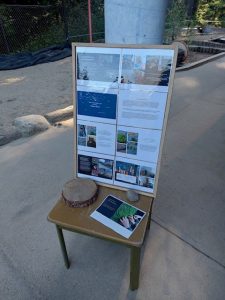
I’ve been having some conversations about how we can share our work with families outside of a newsletter, so I wanted to share what Salal Place has set up in their yard using the back of a white board.

What they are sharing now is the work they presented at our first Pedagogical Seminar night.

Salal Place: Slowing Down

__________________

Salal Place has been thinking with the question, What conditions
are needed to share perspective on matters of care, concern and curiosity
that demand otherwise of Salal Place? We considered resisting the push to
be somewhere else other than this time. How do we slow in this moment and
stay with the movements and relationships that are underway in Salal? What
happens when we see time as not something to be consumed, but as
something to stay with?

Thank you Salal Place educators!

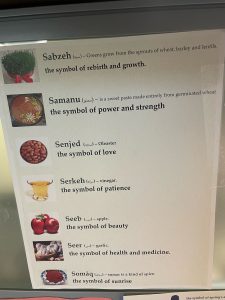
Nowrouz Mubarak! (Happy Persian New Year)

Nowrouz Mubarak!


we are going into the year 1403

Nowruz is a combination of Persian words نو now – meaning “new” – and روز ruz – meaning “day“.

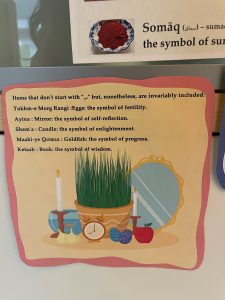
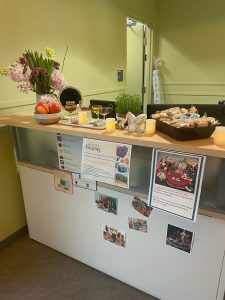
To celebrate the start of the solar new year family members gather around a ‘haft-sin’ which is a table consisting of seven symbolic things taken from nature and their names begin with the letter ‘S’ in Farsi!

The arrangement this year was put together by a family at Cedar Place with homemade sweets.

Interview with George – Hannah

Interview with George

As some of you know I live in Lam Circle and George the Peacock is often seen near the playground in front of my house. One night after the neighbourhood children had all gone in for the evening, I saw him outside, so I decided to pop out and say hi. I was quite surprised when he said hi back, so I decided to ask him if we could sit down for an interview sometime. He thought that would be lovely. I recorded it to share with you all.

Hannah:  Hi George, I’m so glad we got this chance to talk!

George:  I am too! There have been a lot of odd things written about me lately. Someone dropped a newspaper with a picture of me on the cover. I read it, and I feel it didn’t really represent me properly.

H:  Yes, I saw that. What would you like to tell people?

G:  Well first of all, I want to make sure that everyone knows about my amazing feathers. I do like to show them off, because they’re beautiful, but lately I have often been showing them to indicate that I’m feeling threatened (Beauty of Birds, 2022).

H:  That’s good to know. I’ve seen you around Lam Circle a fair bit, and I often see you fanning your feathers. Are you okay?

G:  Some of those children are not very kind to me. One of them was even trying to touch my feathers! I did not like that at all. I didn’t attack him, but I seriously considered it. I am very uncomfortable with people touching me. Especially the beautiful feathers on my train. However, the thing that makes me most uncomfortable is when there are other peacocks in my space. I have my territory and that’s where I like to be. I don’t like it when other peacocks are in my territory (Knox, 2021).

H:  Oh really? Have you had any issues with that on campus?

G:  Well. One time I was near a building on campus and I saw a peacock inside! I immediately fanned my feathers and went over to investigate because people never let me go inside. Why should I be treated differently than this other peacock? As I got closer, I could see that he was approaching me as well. Suddenly the wall moved and he was gone! I went in to follow him, but I didn’t see him anywhere. There was a sound behind me so I spun around and there he was! Outside! How did he get past me? I went closer, and again he approached me. The wall moved and he disappeared again! So I went back out in search of him. Again, I heard the same sound behind me, and when I turned he was there! Inside! I attempted to follow him many times, but he kept getting past me! It was very confusing. Eventually I gave up and left (Akyurek, M., personal communication, July 8, 2023).*

H:  So… George… I’ve read that peacocks sometimes mistake their reflections for another peacock (Knox, 2021). Do you think this may be what happened that day?

G:  (After a lengthy pause) No, you’re definitely wrong.

H:  Are you sure?

G:  Yes. I’m very sure.

H:  Okay, well let’s change the topic for a while. You visit the UVic Child Care Services yards sometimes. Why? There are a lot of children there, and they tend to be rather noisy.

G:  I agree, the children are a little loud, but they do tend to be very respectful of my space, and they have a lot of healthy plants and bugs for me to eat in their yards. The other children near the houses try to feed me, but I often feel a little sick after I eat their food.

H:  I’m glad you feel the children at the child care centres are so respectful. Part of our Early Learning Framework (2019) is all about learning to live respectfully with our community, including our more-than-human friends, like you, who share this land with us.

G:  That’s great to hear. Thanks for teaching them to be kind to me. I’m really glad that’s part of your philosophy.

H:  Me too. So George, I’ve heard that the university has considered re-homing you.

G:  Re-homing? What’s that? I have a home!

H:  It’s when people decide to move an animal to a new home or territory. There are many different reasons it might happen.

G:  But why though??!!?!?!? I live here!

H:  I know George, but some people worry that the children could get hurt. Or that you could get hurt by a child.

G:  I wouldn’t hurt a child! Not on purpose! Sometimes they scare me, so I follow my instincts and try to intimidate them by fanning my feathers, and sometimes making sounds so they know I don’t like it when they’re close to me. They need to notice what I’m doing and step back!

H:  I know, and animal control agrees that you shouldn’t have to move away if you aren’t posing a threat to anyone (Link, 2023). I think it’s more the humans that are posing a threat to you, than you posing a threat to us.

G:  IT’S TRUE!!!!!! DON’T MAKE ME LEAVE! I LIVE HERE!!! (Loud squawking ensues)

H: And some people worry that you could accidentally attract a cougar to the campus (Link, 2023).

G:  A COUGAR????? WHERE???!?!?!? (He fans his feathers, starts turning around in circles, and continues squawking)

H:  George, calm down. (Squawking continues) GEORGE!!!! GET AHOLD OF YOURSELF! THERE IS NO COUGAR!!!

G:  What??? Are you sure???

H:  Yes, I’m sure.

G:  Oh… Okay… (stops and folds his feathers down) You scared me! I really don’t like cougars!

H:  Sorry about that. I should have phrased that differently.

G:  That’s for sure! I think I need to rest now. That got really intense for me just now.

H:  I’m sorry George. I’ve upset you. I hope you can get some sleep tonight.

G:  If I have nightmares about cougars, I’ll be standing outside your bedroom window to yell at you about it.

H:  That is totally fair. Goodnight George.

G:  You better hope it’s good.

And with that he turned and walked off into the night. I hope I didn’t upset him too much. He already has enough to be upset about with the neighbourhood kids following him around all the time. Hopefully he will continue to be a respected member of our community. Everyone loves him and it would be a shame if he had to leave.

*The story George related about the other peacock has been verified by a friend of mine. One day he got very confused by some automatic sliding glass doors on campus. He went in and out for quite some time as my friend watched from her office window.

Rererences

British Columbia Ministry of Education, Ministry of Children and Family Development, and Ministry of Health. (2019). British Columbia Early Learning Framework. https://www2.gov.bc.ca/assets/gov/education/early-learning/teach/earlylearning/early_learning_framework.pdf

Beauty of Birds. (2022, September 18). Why do peacocks spread their feathers (or train)? Beauty of birds. https://beautyofbirds.com/why-do-peacocks-spread-their-feathers/

Knox, J. (2021, July 18). Jack Knox: Polarizing Beacon Hill Park peacocks proliferate, puzzle. Times colonist. https://www.timescolonist.com/local-news/jack-knox-polarizing-beacon-hill-park-peacocks-proliferate-puzzle-4690758

Link, H. (2023, January 26). Students flock to Instagram to follow the beloved UVic peacock. Martlet. https://martlet.ca/uvic-students-flock-to-instagram-to-follow-beloved-peacock/
What’s “good” got to do with it? – Hannah

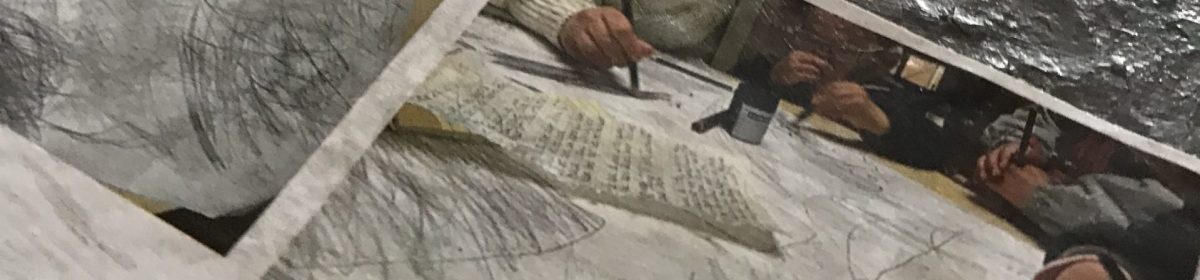
What’s “good” got to do with it?

Every so often a quote from Fred Rogers comes up in my Facebook newsfeed. In a 1981 episode of Mister Rogers’ Neighbourhood (PBS, n.d.), Rogers is colouring and says to the audience, “I’m not very good at it, but it doesn’t matter, it’s just the fun of doing it that’s important” (InstantTrain, 2021, 0:26). This quote resonated with me because I really enjoy doing a lot of things that I’m not necessarily very “good” at.

We tend to have this idea in western culture that we’re only good at something if we can commodify it, or do it at a professional level. I’m a decent musician. Not good enough to make a living at it, but I still find musical things to do because I enjoy it. Could I be a professional painter? Probably not, but I still enjoy creating art.

I think this narrow definition of what it means to be good at an activity is something that we, as ECEs, are perfectly situated to change for future generations. I have worked with children over the years who have decided that they don’t like doing something because they don’t think they’re good enough at it. One of the principles in BC’s Early Learning Framework (ELF) says that children are strong and capable, so part of our job as educators is to facilitate learning that instills in the child a sense of self-confidence (ELF, 2019). Encouraging children to do things just for the enjoyment of doing it teaches them that they don’t have to be good at everything. You can still have a lot of fun doing something that you’re average at. I know I do.

The ELF also reminds us to be aware of what our images of children and childhood are (2019). We all have different experiences which shape how we work with children. We should also keep in mind that different cultures prioritize different things at different ages, and we must account for that in our interactions with children (James, 1998). Children will have varying levels of ability based on cultural differences and what skills/activities families incorporate into daily routines.

In the childcare setting, I must disagree with Rogers when he says “I’m not very good at it” while working with children. Many of the things we do with children, like art, are so subjective that it’s impossible to evaluate whether it’s good or not. Who decided what “good” is?

If we are creating art with a child and we tell them “I’m not very good at it,” I feel it could undermine their self-confidence a little. Due to our fine motor development, we are likely to be more able to draw a horse that looks like a horse than a young child will be. If I say that I’m not good at drawing a horse, but my horse looks more realistic than the child’s, they may feel bad about their skill level.

I believe that while working with children we could say something more along the lines of “I’m not sure how to do it, but I enjoy trying to figure it out,” or “mine isn’t the same as my friend’s, but I’m still having fun making it.” If a child says “Hannah, your horse doesn’t look like a horse,” I would blow it off and just say, “Oh well. I’m having fun making it,” because Rogers was right when he said, “it’s the fun of doing that’s important.”


References

British Columbia Ministry of Education, Ministry of Children and Family Development, and Ministry of Health. (2019). British Columbia Early Learning Framework. https://www2.gov.bc.ca/assets/gov/education/early-learning/teach/earlylearning/early_learning_framework.pdf

InstantTrain. (2021, March 24). Drawing (subtitled) – Mister Rogers’ Neighborhood [Video]. YouTube. https://www.youtube.com/watch?v=t2zJVZsXW3M

James, A. (1998). From the child’s point of view: Issues in the social construction of childhood. In Panter-Brick (Ed.), Biosocial perspectives on children (pp. 45-65). Cambridge University Press.

PBS. (n.d.). How people make crayons. Mister Rogers’ Neighborhood. https://ww.pbs.org/video/mister-rogers-neighborhood-competition-how-people-make-crayons/

Caterpillars and land-based learning – Hannah Wilkinson

Lately I’ve noticed, as I’m sure many of you have, that the children are very interested in caterpillars. I’ve also been told we had a few tents in Arbutus that needed to be dealt with. Or did they? I didn’t know much about tent caterpillars, so I decided to do a little research. I was curious to see how much damage they could do, and what their tents look like. I learned that they can either do a lot of damage, or no damage, and that they are an important part of our ecosystem.

There is currently a tent caterpillar “outbreak” on the island, so I wanted to find out what that means, and what we can do about it. According to zoologist Judy Myers we usually don’t have to do anything (Dickson, 2023). Fruit trees might not grow much fruit after tent caterpillar activity, so if you’re on a fruit farm you probably want to remove them, but otherwise, they typically don’t do much long-term damage at all (Dickson, 2023). Although in large enough groups they can take the leaves off an entire tree, healthy trees that lose half their leaves will typically survive and grow new leaves by the end of the summer (Sadof, 2018). Tent caterpillars only have one generation per year, so a few weeks after making themselves known, they go into their cocoons, and the tents fall off the trees (Lofgren, 2021).

When we find a tent, we should assess the health of the tree and the developmental stages of the nearby children before we decide if we need to remove the tent. We need to be aware of the environment around us, and how everything is connected. Leaving the caterpillars where they are encourages greater biodiversity in our yard, as the caterpillars will attract small birds, lizards, and other small natural predators. Their excrement is also a good fertilizer for our plants, some of which grow food. That being said, if children eat the caterpillars the hairs could injure their intestinal tract (Lofgren, 2021).

BC’s Early Learning Framework (ELF) (2019) outlines nine principles of learning, one of which includes building a (re)connection to the land (p. 21). The First Peoples Principles of Learning outlined in the ELF also states that learning should support “the well-being of the self, the family, the community, the land, the spirits, and the ancestors” (p. 14). We, as humans, are interdependent on our more-that-human relations with whom we share this land (Styres, 2011), so it is important to consider what will happen if we remove something unnecessarily.

The ELF also discusses the early learning philosophy of the environment as the third teacher, referring to the classroom and yard (p. 22). In Indigenous philosophy, we often refer to land as the first teacher (Styres, 2011). Sandra Styres uses Bowlby’s attachment theory as an analogy to explain how the land is thought of as the first teacher. The land can be thought of as the primary caregiver, which the learner enters “to explore and gain knowledge and understanding of how to be in relation to land” (p. 722). As the learner strengthens their connection to land through lived experiences, the land becomes the primary teacher/relationship (Styres, 2011).

While the tents made by tent caterpillars can become unsightly, and caterpillar activity can be concerning, they aren’t as destructive as I though they would be. Next year, the tent caterpillar activity should be much lower, so perhaps if we find a tent in a healthy tree, we should consider leaving it up.


References

British Columbia Ministry of Education, Ministry of Children and Family Development, and Ministry of Health. (2019). British Columbia Early Learning Framework. https://www2.gov.bc.ca/assets/gov/education/early-learning/teach/earlylearning/early_learning_framework.pdf

Dickson, C, (2023, May 24). There’s a tent caterpillar outbreak on Vancouver Island – but no need to panic, zoologist says. CBC news. https://www.cbc.ca/news/canada/british-columbia/tent-caterpillar-outbreak-vancouver-island-1.6852018

Lofgren, K. (2021, June 30). How to eradicate tent caterpillars (and whether you should). Garderner’s path. https://gardenerspath.com/how-to/disease-and-pests/tent-caterpillars/

Sadof, C. (2018, July 17). Will my trees recover after losing their leaves? Purdue University landscape report. https://www.purduelandscapereport.org/article/will-my-trees-recover-after-losing-their-leaves/

Styres, S. D. (2011). Land as first teacher: A philosophical journeying. Reflective Practice, 12(6), 717-731. https://doi.org/10.1080/14623943.2011.601083

Sound – Arbutus Place

In Arbutus, Narda, the educators, and the children have been exploring the sights and sounds of our more-than-human relations within, and surrounding, Yard. A group of the children had previously gone on a nature walk where they listened to the sounds around them, and created art based on those sounds. After the art had been displayed in the atrium, Narda, Sadaf, and I took a group of children to go look at it and discuss it. Some of the children had been on the walk and created art, others had not.

As we discussed the art with the children, we were thinking about what the best way would be to communicate what the children were painting for this project to people viewing the art. We thought, and the children agreed, that it would be helpful to have the audio recording of the sounds the children heard available to people who were looking at the art. Narda asked the children how they thought we could tell people about our art, and one child said, “you have to show them.”

After the children returned to Yard, Narda, Sadaf, and I discussed how we could follow this child’s recommendation of showing the art process to others. Yes, we can find a way to provide the audio recording to the viewer, but the recording would not accurately represent what each person heard, and it cannot fully convey the atmosphere of the space the children were in, and the energy they felt.

Talking about how to show work including sound reminded me that you can see and feel sound. Sounds are created by tiny vibrations in the air. Our eardrum vibrates in response to these vibrations in the air, or soundwaves, and that’s what allows us to hear (Butcher, 2022). When you look at a large speaker, you can see the cone of the speaker vibrate as sound passes across it. You can also see these waves by looking at a magnification of a record, or by uploading a recording into a computer program that converts it into an image, or waveform. As a musician, when I sing, I often know if I’m close to the right pitch based on where in my body I feel the vibrations of the note. I feel lower pitches in my chest and as I sing increasingly higher notes, I can feel that vibration starting from a higher physical location in my body.

These physical and visual experiences of sound can help us learn about sound and the world around us with our whole bodies as opposed to just our ears. One of the First Peoples Principles of Learning in the BC Early Learning Framework (ELF) is that learning is holistic (p. 14). The ELF elaborates by explaining that “a holistic approach recognizes that all areas of learning: physical, social, linguistic, visual, auditory, and intellectual are closely interrelated and occur simultaneously” (p. 26). The children who created the art were developing their fine motor skills, visual acuity, coordination, and were learning to be attentive to the sounds in their environment. They were learning to interpret those sounds and consider other ways of representing them. By discussing the art, sights, and sounds around them, they were developing their linguistic skills. If we bring in an image or video of a waveform, the children can connect the sounds they hear with the visual representation of them. Bringing in speakers or instruments and playing low notes on them can help the children connect the sound to the physical sensation of the sound. Low notes will work best because they have low frequency waves which tend to be easier to see and feel (West Music Company, 2017).

Using activities involving the physical sensation and visual representation of sound can also help to foster an environment of inclusion. If we have a child in our program who is hard of hearing or deaf, how can we include them when we’re engaging in a sound-based inquiry? Deaf percussionist Evelyn Glennie explains in her TED Talk on listening (2003) that sound/music is an experience. She experiences sound with her whole body through touch, sight, and hearing. We all do, but she is just much more aware of it. We don’t simply hear a thunderstorm, we experience it. We don’t just hear music, we experience it (Glennie, 2003). In Arbutus, we don’t just hear the sounds of Yard and the surrounding area, we live within Yard. For hours every day, we experience life together with our more-than-human relations in, and around, Yard. There are so many ways we can experience and interpret the sounds around us if we just take a minute to listen. By expanding our grasp on the holistic nature of sound, we, along with the children in our care, can learn to experience another aspect of Yard, and the world around us.


References

British Columbia Ministry of Education, Ministry of Children and Family Development, and Ministry of Health. (2019). British Columbia Early Learning Framework. https://www2.gov.bc.ca/assets/gov/education/early-learning/teach/earlylearning/early_learning_framework.pdf

Butcher, M. (2022, February 8). How does vinyl work? London sound academy. https://www.londonsoundacademy.com/blog/how-does-vinyl-work

Glennie, E. (2003). How to truly listen [Video]. TED. https://www.ted.com/talks/evelyn_glennie_how_to_truly_listen

West Music Company. (2017, October 2). It’s science! Basic acoustics: Frequency, wavelength & pitch. West Music. https://content.westmusic.com/its-science-basic-acoustics-frequency-wavelength-pitch/