ECEBC’s Statement of Inclusion

ECEBCs_Statement_of_Inclusion_2024

There’s been a lot of discussion and participation by some of you over the past year about Inclusion. ECEBC has recently put out a position paper on this very topic. I’ve uploaded for your convenience to read, just click link above.

Opening statement from ECEBC:

We are grateful for the guidance, collaboration, and comments provided by the many stakeholders who participated in this creation.. This position paper is a visionary document. This position paper joins families, activists, and scholars in asserting that inclusion is an urgent political concern in early childhood and the broader global community. ECEBC acknowledges that an inclusive society must first disrupt dominant and social constructions of what it means to be human that reflect idealized images (Kafher, 2013). For inclusion to thrive, we must first refuse predetermined hierarchies based on ability, body shape and form, chromosome composition, gender, race and other forms of human categorization.
 

What Toes Know (Garry Oak Place blog)

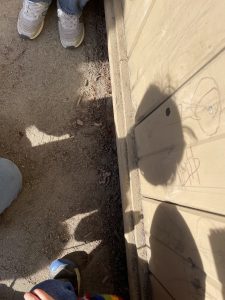
Bare feet at Garry Oak Place (Click here for Feet images & musings:))

How did it start?

When Gary Oak Place started, we adopted from other centers, the rule of we can walk bare feet on the grass and sand but need shoes to walk around the rest of the yard. After observing the children’s relationships with shoes, feet, each other, and others, we were curious to see what would happen if we allowed bare feet all over the yard. We decided to document our pedagogical inquiry for this wonderful moment.

Our Curiosities

Do they perceive the change of seasons differently with bare feet?

How might we experience the change of seasons through our feet?

  • On hot sunny days or cool rainy days

How do children engage with yard and materials? Does it change if they are bare feet?

  • With painting, sand, woodchips, grass…

How might children’s relationships differ? With bugs, with friends, with plants…

What opportunities arise when they are bare feet? For friendships or for nature?

  • Touching toes each other, helping socks and shoes…

Are there limits to roadblocks to being bare feet?

  • Bikes, tires…

How do children engage with bare feet outside of Garry Oak?

  • At beach, park, yard, at home…

What kind of medicine are they receiving from the earth?

  • Onion on feet would make fever go down, pressure points on feet (acupuncture)

Lee Maracle: Quote of the week

I wonder about language with its raw frayed fringes delicately trying to express spirit
as each word drips from lips to rest in blank spaces between us

—Lee Maracle (Stó:lō), Talking to the Diaspora (in Robinson, 2020, p. 77)


Reference

Robinson, D. (2020). Hungry Listening: Resonant Theory for Indigenous Sound  Studies. University of Minnesota Press.

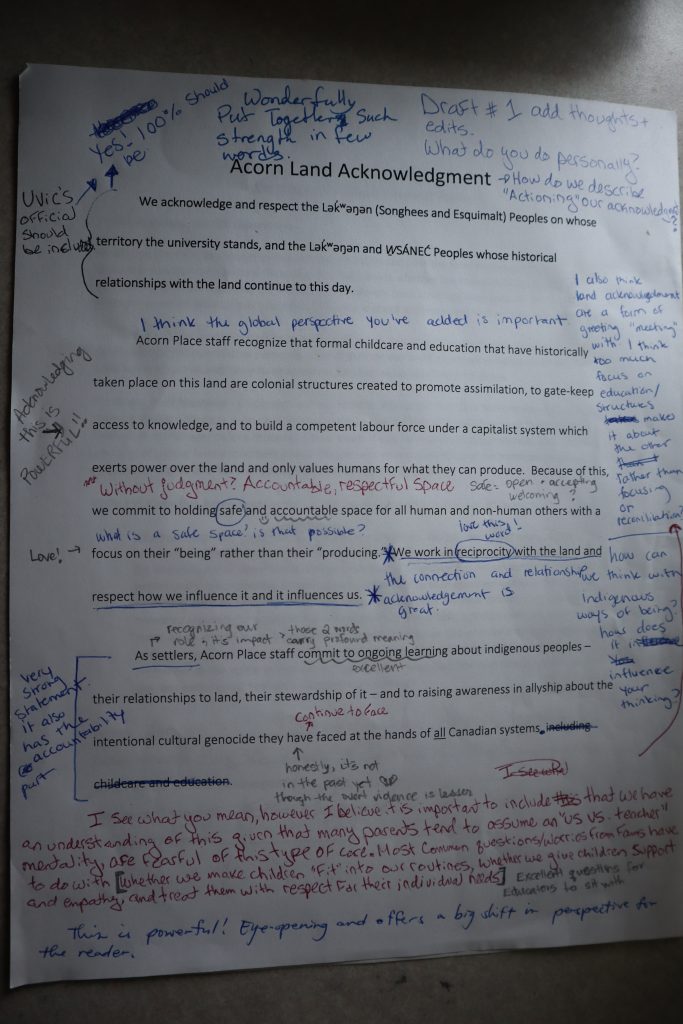
Acorn’s draft land acknowledgment

As I work through editing our draft land acknowledgment I find myself so pleased at its messiness.  Something about how the handwriting hugs the print and brings so much personality to the page.

The image exemplifies collaboration.  I love its liveliness – scribbles, underlines, questions, and redactions.

Thank you so much to Sadaf, Michelle O., and David for your feedback (sorry if I missed anyone, make yourselves known in the comments).

Please add your feedback below if anything strikes you!