


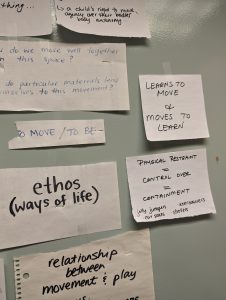

This thread of inquiry was born from a frustration in the ability to articulate what happens at Acorn Place. The pedagogy of care and the intricate relationality between caregiver and infant. The complexities of how a relationship can create affect within a human body, or within a physical space. At Acorn Place, it is through both grandest and subtlest of gestures that we are living well together; seemingly impossible to describe with words. How do we think with movement as a language? What complexities are unfolding through the movement’ing of the beings in our space—both human beings and more than human beings. What materials lend themselves to this particular form of movement languaging?
I am reminded of Angie’s thoughts on the intersection of dance and relationship in her role co-constructed as both early childhood educator and formally trained dancer, using her relationship with dance and movement to “commemorate the time it takes to learn and grow with more-than-human thinking.” (https://ecpn.ca/a-pedagogical-edge-to-dance-on/). What memories and narratives are we making and commemorating in our relationships with the children in our care?
How does our movement patterns communicate care and our commitments to it?
In the crafting of our ethos statement, there was (and continues to be) a lot of conversation about the “micro moments” at Acorn Place, and “attuning ourselves to the subtleties” that present themselves, and making the choice to “move [sic] with the rhythms, frictions and flows of the day” (Acorn Place ethos) in our explorations of what it means to live well together.
Developmentalism tells us that verbal language is supreme, valuing this method of communication over everything else. Body language is seemingly obliterated; with movement only being a form of measurement within a trajectory towards, or away from, the predetermined image of the ‘optimal child’. And yet, in pushing against this, this is where we find the magic at Acorn Place.
To move is to live, and to live is to be.
Thank you Acorn Place educators! this is such a great way to see what is happening in your program.
I appreciate being able to visually see how you are all thinking together, I can acknowledge this process is not easy but it is still happening. the doing is do-ing!
I am curious to hear more about the what frustrations are behind articulating what is happening at Acorn Place? where does the frustration come from? are we able to move away from the frustration, if so what other stories are we able to tell?
I appreciate your question “What materials lend themselves to this particular form of movement languaging?” as I was reading this sentence it almost felt like I could envision the question. I closed my eyes and could see Acorn Place children moving through the space and be involved in beautiful moments with the space at the same time as someone else who is also exploring the space in multiple different ways. so many things happening all at once!
how do we work with our relationships to materials? what materials do we attend to and what materials do we exclude? what stories do materials hold?
I appreciate the time and care it took to write this piece in relation with what is always ongoing at Acorn Place.
I think the frustrations come from the difficulty in articulating. It is challenging to find the words that are powerful enough to describe what is happening. Describing a feeling, or a sense, can be tricky! That being said, I feel that those tensi0ns only speak to the commitment within this space. We all feel a profound sense of responsibility to advocate for this space and how we live within it together.
I’m interested to see how our inquiries with paint lend themselves to movement’ing at Acorn. How do children use this ever changing medium to tell stories?