Motivation

• Vehicles and infrastructure share the sensed information and knowledge (model)
- Long-range information collected and distributed intelligence to enhance safety and efficiency
• Vehicles form a network dynamically
- Platooning to avoid traffic jam, save energy and reduce pollution
• On-demand intelligent transportation services
- Improve vehicle utilization and save parking space
V2X protocol design and optimization
Time/location-critical reliability: Safety messages should be delivered before location-dependent deadline [1]

DSRC/IEEE 802.11p: Cannot deal with the hidden terminal and congestion collapse; high collision prob. lead to low reliability and efficiency; No feedback for beacon broadcasting, blind retransmission (repeat) leads to low efficiency [2].
C-V2X Standard: Reuse of DSRC/C-ITS established service and app layers; reuse of existing security and transport layers; continuous enhancements to the radio/lower layers:
- PHY: Demodulation reference signal (DMRS) symbols to handle high Doppler with relative speeds of up to 500km/h and at high frequency (5.9GHz ITS band)
- MAC: semi-persistent transmission (SPS), scheduling in a stand-alone fashion in each user equipment (UE)
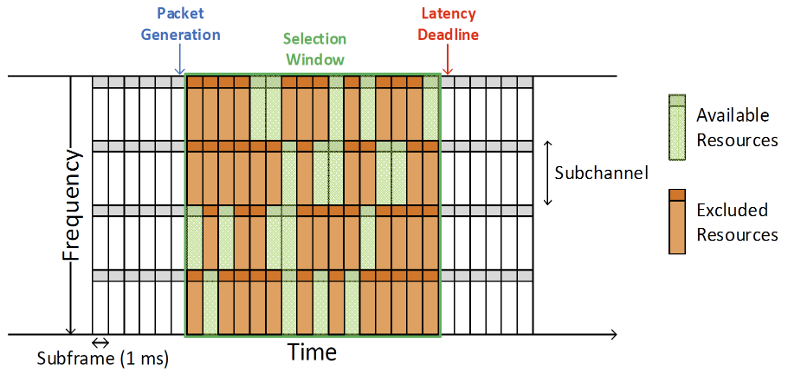
Problems with SPS:
Reliability
- Hidden-terminal and high mobility => conflicted reservation
- Failed reservation leads to high collision and low reliability
Scalability
- Congested network may have thousands of vehicles per km2
- Heavy mutual interference and collisions
Efficiency
- Lack of feedback for beacon broadcasting
- Blind retransmissions lead to more collisions and low efficiency
How communication impairments affect control?


communication delay < 200 ms vs. communication delay < 20 ms
When all messages can be exchanged reliably within 20ms, all followers can maintain their speeds to be very close to the header; when the reliability can only be achieved within 200ms, the velocities of the followers have high variations. Clearly, the reduction of communication delay for reliable message exchange can be directly converted to the reduction of velocity variation and the space between the vehicles [4,5].
How to minimize SPS reservation collisions?

Distributed and Adaptive Reservation Protocol for Beaconing [6]
How to recover transmission errors?

Collaborative Retransmissions with Network Coding [7]
How to ensure reliability and timeliness?

Performance Analysis and Optimization for SPS [8]

Resource Reservation Coordination [9]
Intelligent network protocols for connected automation [10]

[1] Y. Zhuang, J. Pan, Y. Luo, and L. Cai, “Time and Location-Critical Emergency Message Dissemination for Vehicular Ad-Hoc Networks,” IEEE JSAC, special issue on Vehicular and Communications and Networks, vol. 29, issue 1, pp. 187-196, Jan. 2011.
[2] Y. Ni, L. Cai, J. He, A. Vinel, Y. Li, H. Mosavat-Jahromi, and J. Pan, “Toward Reliable and Scalable Internet-of-Vehicles: Performance Analysis and Resource Management,” Proceedings of The IEEE, vol. 108, no. 2, pp. 324-340, Feb. 2020.
[3] X. Gu, et al, “Performance analysis on access collision in semi-persistent scheduling of C-V2X mode 4,” IEEE VTC2021-Fall (virtual), Oct. 2021.
[4] C. Zhao, L. Cai, C. Peng, “Stability Analysis of Vehicle Platooning with Limited Communication Range and Random Packet Losses,” IEEE Internet of Things Journal, 8(1):262-277, Jan. 2021.
[5] C. Zhao, X. Duan, L. Cai, and P. Cheng, “Vehicle Platooning with Non-ideal Communication Networks,” IEEE Trans. on Vehicular Technology, 70(1):18-32, Jan. 2021.
[6] H. Mosavat-Jahromi, Y. Li, Y. Ni and L. Cai, “Distributed and Adaptive Reservation MAC Protocol for Beaconing in Vehicular Networks,” in IEEE Trans. on Mobile Computing, 20(10):2936-2948, Oct. 2021. doi: 10.1109/TMC.2020.2992045.
[7] H. Mosavat-Jahromi, Y. Li, L. Cai, and L. Lu, “NC–MAC: A Distributed MAC Protocol for Reliable Beacon Broadcasting in V2X,” IEEE Trans. on Vehicular Technology, 70(6):6044-6057, June 2021.
[8] X. Gu, J. Peng, L. Cai, Y. Cheng, X. Zhang, W. Liu, Z. Huang, “Performance Analysis and Optimization for Semi-Persistent Scheduling in C-V2X,” IEEE Trans. on Vehicular Technology, vol. 72, no. 4, pp. 4628-4642, Apr. 2023.
[9] X. Gu, J. Peng, L. Cai, W. Liu, X. Zhang, Z. Huang, “Resource Reservation Coordination for Vehicle Platooning in C-V2X Networks,” IEEE Trans. on Wireless Communications, vol. 23, no. 6, pp. 5515-5528, Jun. 2024.
[10] L. Cai, et. al “Self-Evolving and Transformative (SET) Protocol Architecture for 6G,” IEEE Wireless Communi. Magazine, 2023.