Category Archives: Blog Posts

Building My Personal Learning Network Through Social Media

Photo via Beverly Clarke on Nexus Education

PLN Spaces Through Social Media

I personally use a variety of social media platforms to develop my Personal Learning Network (PLN). The ones I use most frequently are Instagram and Reddit, and I sometimes use LinkedIn as well. I’ve found Instagram really helpful in meeting others in the HINF (Health Information) program as a lot of students have their major in their bio and I also follow the HINF course union Instagram which frequently posts about seminars and events they host. On Reddit, I follow the UVic subreddit where students post a variety of questions ranging from course selection and professor recommendations to housing tips and mental health resources. I actively try to participate in this community by posting “AMA” posts about HINF, which are “Ask Me Anything” threads for any prospective students entering the HINF program and are looking for advice! I’ve met a couple friends this way and it’s helped build my PLN by fostering connections with peers who share similar academic interests. These interactions have also allowed me to reflect on my own experiences, offer support to others, and feel more engaged with the UVic student community. LinkedIn makes it really easy to follow and connect with people in the Health Informatics field as I am able to see who is a UVic alumni of the HINF program and what they are currently doing with their degree.
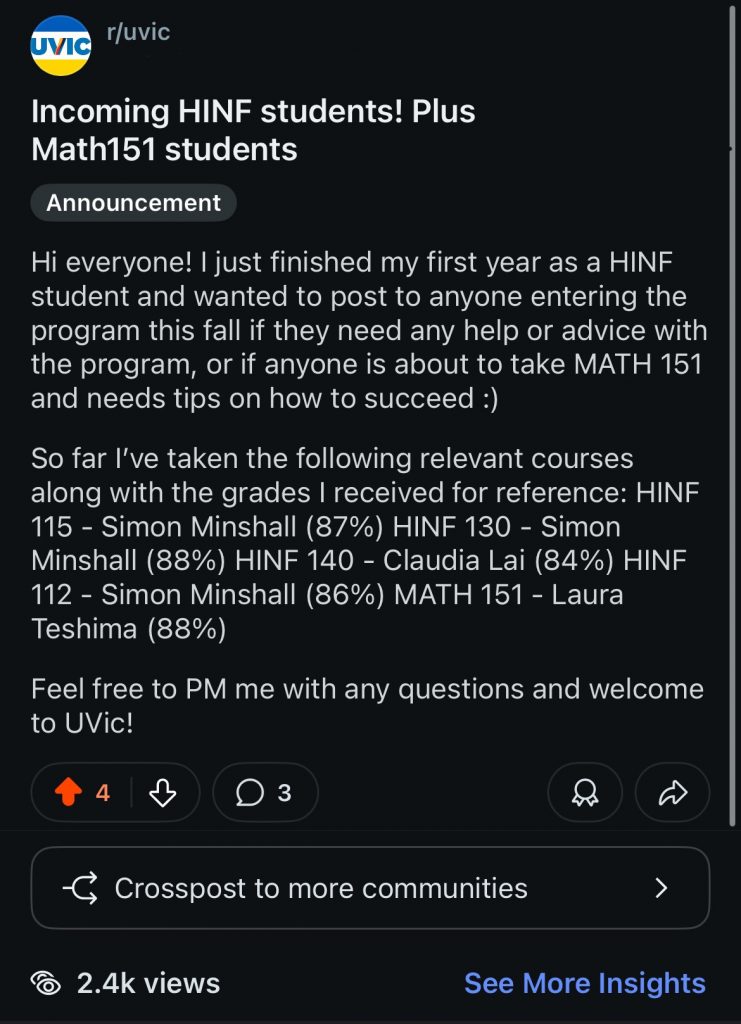
screenshot of my reddit post where I invite prospective HINF students to ask me any questions about the program.
Screenshot of my own Reddit post in the UVic subreddit via Melissa Liao

Privacy, Ethics, and Security in Digital Spaces

I try to be careful with what I post online because I understand the importance of protecting your own personal information and also the importance of having respectful online interactions. For starters, even though my accounts are public I don’t post anything that tags my location and I make an effort to avoid sharing any identifiable details like my workplace or phone number. To secure my accounts, I make sure I have two-factor authentication turned on when given the choice and I try to not reuse passwords. I also try to think critically before engaging in discussions (like making sure I don’t spread misinformation) and I make sure that my comments are respectful and constructive. I believe that creating a safe and trustworthy digital environment starts with being mindful of how we present ourselves and how we treat others online. This is especially important in educational and professional PLN spaces as we should strive to make a space where everyone feels comfortable expressing themselves and learning from others.

I’ve included a short YouTube video below that I found very helpful as it gives a quick overview of what a PLN space is on social media and it offers tips on how to get started!

Inclusivity and UDL in PLNs

Ensuring that my PLN is inclusive is another important goal for me as I want to ensure that I am learning from individuals with different backgrounds and experiences. To build inclusivity, I intentionally follow creators from diverse communities, especially those who offer perspectives that differ from my own. Doing so also encourages me to reflect on and expand my understanding of the world. Because I’ve grown up in a very multicultural country like Canada, I want to showcase that same diversity in my online learning spaces.

When I reflect on the Universal Design for Learning (UDL) principles and how they can support inclusivity in digital learning spaces, I think about how they emphasize flexibility and accessibility for all types of learners. Multiple Means of Engagement focuses on creating different opportunities for students to get involved in their learning. In digital learning, this could look like online quizzes, discussion forums, polls, or interactive activities that encourage participation in various ways. Some students learn best when they can have a discussion with their peers while others may not feel the same way, so it’s important to cater to all learner needs. Multiple Means of Representation focuses on presenting content in a variety of formats to support understanding for all learners. In digital learning, this could look like making sure course materials have accessibility features like alt text and headings, and that videos have transcripts or closed captioning available. Multiple Means of Action and Expression focuses on providing students with different options to demonstrate their learning. In digital learning, this could look like having an online oral presentation rather than a traditional written midterm and final. By applying UDL principles, we can design digital learning spaces that are more welcoming, inclusive, and supportive of all diverse learning needs.

Chapters 1.4-1.6 of the online textbook from the University of Saskatchewan I’ve linked below provide a clear overview of the three UDL principles. I found them extremely helpful in developing my understanding and I encourage you to give them a read!

https://www.saskoer.ca/universaldesignforlearning/chapter/udl-principle-1-design-multiple-means-of-engagement/

Challenges and Importance of Diversity in Digital Learning

Photo via John Laskaris on Talent LMS

Diversity in digital learning spaces is important because it ensures that all learners feel seen, heard, and valued regardless of their cultural, socioeconomic, or educational background. When digital learning spaces lack diversity, they risk overlooking learners whose perspectives and experiences also deserve to be included. To promote a more inclusive digital environment where all voices are represented and respected, we can:

  • Engage respectfully in discussions by listening to others with an open mind
  • Use inclusive language that avoids stereotypes and is respectful of all groups
  • Be open to feedback and be willing to learn from others

I also found this post that lists a few other great ways to promote a more inclusive digital environment. Please consider giving it a read!

https://elearningindustry.com/breaking-barriers-inclusivity-and-diversity-in-online-education
My Digital Identity and Online Presence

Photo via Soundarya Jayaraman on learn.g2.com

Digital Identity: Personal vs. Professional

As we continue to learn about digital spaces online, I’ve taken the time to reflect on my own digital identity and how I present myself online. For my personal digital identity, my accounts are public and use my full name but I don’t post anything I wouldn’t want someone linking back to me. I’m very cognizant of the fact that if someone searches up my name they’ll come across things I’ve posted before. I often post the places I’ve been to on vacation, or my friends that I hangout with often. Currently, I don’t have much of a professional digital activity as I haven’t taken the time to develop one yet. I have a LinkedIn account but I only have my school and program of study listed on it. Once I progress more in my professional and academic career I’ll have more to put on there, but right now I have nothing worthwhile to mention on my profile. I believe it’s important to keep these aspects separate because something I might want my friends seeing on my personal profiles could be completely different from what I want a future employer seeing.

Digital Visitor and Resident Map

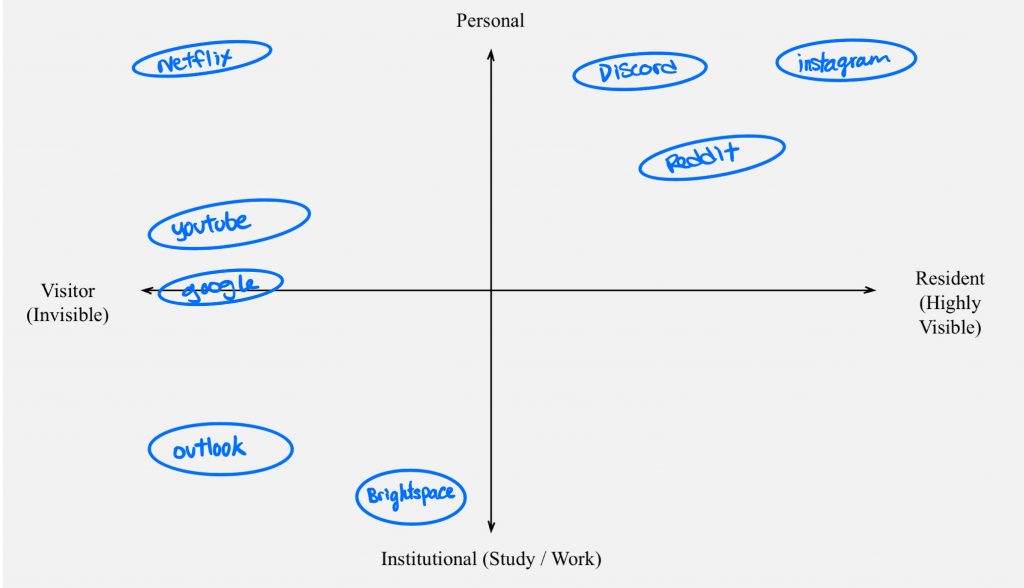
digital resident and visitor map sorting the different online platforms I use.

I consider myself a digital resident of Discord, Instagram, and Reddit in the personal aspect of my life as as I frequently use these platforms to communicate with friends, stay updated on various topics I’m interested in, and engage in online communities that discuss activities I enjoy (like Valorant). I would consider these profiles highly visible as I have my name attached to them and can be found easily. In contrast, I would consider myself a visitor to a site like Google as I don’t engage with it often beyond quickly looking something up, and I don’t leave a lasting presence on others by doing that. I would say I use Google equally as much in my personal life as well as my institutional life. Creating my own digital map helped me more clearly distinguish the role each of these platforms have in different areas of my life. Additionally, I’ve noticed that this map can change over time depending on what I’m doing at school. For example, during exam season I may spend more time on Brightspace and other institutional platforms and less time on personal platforms, causing my presence to diminish.

Theories of Personalized Learning

Rather than focusing on transferring facts to a learner, Constructivist instruction encourages the application of concepts to solve real-world problems. Learning is seen as an active process in which students construct knowledge through inquiry and collaboration with their peers. I really enjoy this theory of personalized learning as it emphasizes the use of project-based learning activities, group work, and encourages students to ask questions, investigate, and draw conclusions from their findings. This makes the learning process more interactive and relevant, and I find myself feeling much more in control of my learning. I’ve found that when this approach is used, I feel much more connected to what I’m learning and more motivated to pursue my academic goals. I also like that the Constructivist approach encourages the development of collaboration and communication skills, as students often need to work in teams and share different perspectives.

I’ve attached a video explaining Constructivism below that goes more in depth with how it works in an educational setting. I found this video very useful when doing my research on what Constructivism is. Enjoy!

Privacy, Surveillance, and Digital Footprint Awareness

Lastly, this module reminded me of the importance of being aware of the digital footprint I leave behind. Every time I post to one of my social media accounts or leave a comment on a video I found funny, I am actively adding to my digital footprint. To protect my own privacy and accounts, I try to make strong passwords and avoid using the same password across platforms. It’s concerning how easily our data can be tracked or misused, so I’ve also started using ad blockers to block malicious pop-ups. While writing this post and thinking about the current steps I take to maintain my online safety, I found this helpful video listing other tips that may benefit others as well.

It is incredibly important to be aware of privacy and surveillance online, and developing good digital habits like the ones listed in the video above can ensure that you protect your personal information and navigate online spaces more safely and responsibly.

My Reflections on Social Media and Digital Literacy

Photo by Mariia Shalabaieva on Unsplash

Social Media and Its Role in Education

Social media has been helpful in keeping connections with others as I have a lot of friends that no longer live in Victoria. If it weren’t for social media, it would be much harder to stay in touch with everyone. It’s also nice that social media allows me to keep tabs on what my friends are getting up to without necessarily needing to text every single day. In education, I believe that social media has its place to make learning more engaging, but it’s important that it is used appropriately. For example, to make learning more engaging, teachers could make TikTok’s about topics they’re teaching or make references to certain niche memes that their students would understand and relate to. This would add a fun element to learning and make students feel more excited about learning. The benefits of using social media for educational purposes is that it allows students to access a broad range of accounts that post educational content. This can enhance their learning and allow them to participate in different online discussions as well. However, there are also challenges that come with using social media for educational purposes. Misinformation is rampant on social media and it’s important to equip students with the digital literacy skills required to discern credible sources from false or misleading content, so they can engage with information critically and make informed decisions. When these digital literacy skills are paired with critical thinking, social media can become a powerful tool in education.

Personalized Learning and Digital Literacies

Personalized learning keeps me motivated because it allows me to use the resources that best suit my learning style. I often use YouTube for visual explanations of concepts and sometimes I need to replay certain parts of the video repeatedly before it finally clicks in my mind. Digital literacy is important in today’s world because as I mentioned earlier, misinformation is very prevalent online. As I’ve progress through my studies at UVic, I’ve become more confident in my ability to evaluate information online. Learning how to spot credible sources, understand bias, and research different sources has been a key part in my education thus far.

Student studies on her laptop at a library with books.
Photo by Zoshua Colah on Unsplash

Digital Identity and Online Presence

For my digital identity and online presence, I try to be mindful of my digital footprint and how I present myself across different platforms. I separate my personal and professional/academic profiles accordingly and I am very intentional in how I maintain my online image. This is especially important as I prepare for potential job opportunities where employers may be running background checks on me.

Navigating and Using Online Platforms Ethically

In terms of navigating and using online platforms ethically, I believe it’s important to be thoughtful with the posts you make and the comments you leave on people’s content. I’ve noticed that people tend to be bolder with what they have to say when they interact with content online because they feel more anonymous behind their screens. We need to remember that the people we see online are real people with real feelings and that our words have an impact on these people. By practicing the ethnical consumption of media online, we can help make these platforms more inclusive and safer for everyone.