Photo via Soundarya Jayaraman on learn.g2.com
Digital Identity: Personal vs. Professional
As we continue to learn about digital spaces online, I’ve taken the time to reflect on my own digital identity and how I present myself online. For my personal digital identity, my accounts are public and use my full name but I don’t post anything I wouldn’t want someone linking back to me. I’m very cognizant of the fact that if someone searches up my name they’ll come across things I’ve posted before. I often post the places I’ve been to on vacation, or my friends that I hangout with often. Currently, I don’t have much of a professional digital activity as I haven’t taken the time to develop one yet. I have a LinkedIn account but I only have my school and program of study listed on it. Once I progress more in my professional and academic career I’ll have more to put on there, but right now I have nothing worthwhile to mention on my profile. I believe it’s important to keep these aspects separate because something I might want my friends seeing on my personal profiles could be completely different from what I want a future employer seeing.
Digital Visitor and Resident Map
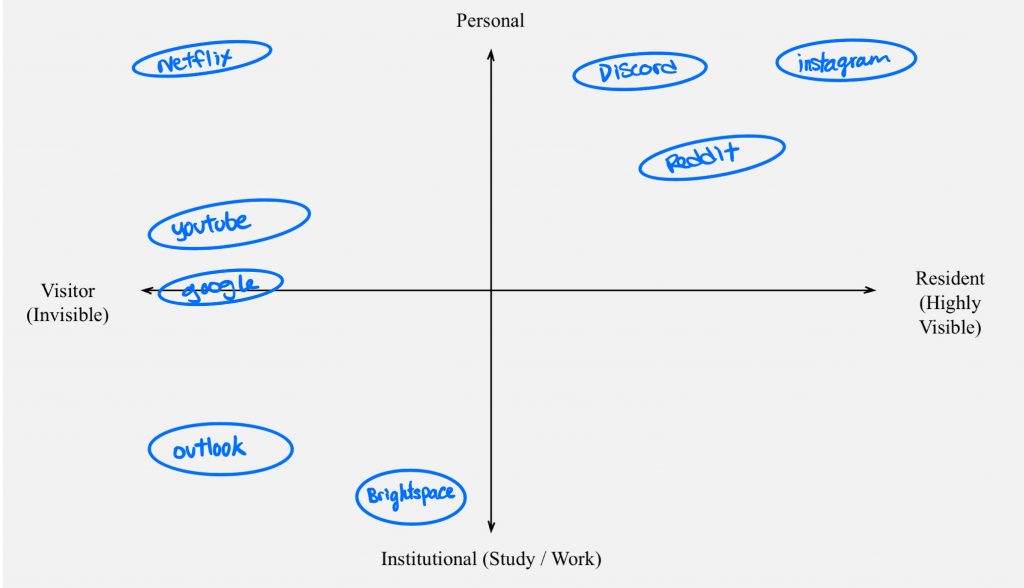
I consider myself a digital resident of Discord, Instagram, and Reddit in the personal aspect of my life as as I frequently use these platforms to communicate with friends, stay updated on various topics I’m interested in, and engage in online communities that discuss activities I enjoy (like Valorant). I would consider these profiles highly visible as I have my name attached to them and can be found easily. In contrast, I would consider myself a visitor to a site like Google as I don’t engage with it often beyond quickly looking something up, and I don’t leave a lasting presence on others by doing that. I would say I use Google equally as much in my personal life as well as my institutional life. Creating my own digital map helped me more clearly distinguish the role each of these platforms have in different areas of my life. Additionally, I’ve noticed that this map can change over time depending on what I’m doing at school. For example, during exam season I may spend more time on Brightspace and other institutional platforms and less time on personal platforms, causing my presence to diminish.
Theories of Personalized Learning
Rather than focusing on transferring facts to a learner, Constructivist instruction encourages the application of concepts to solve real-world problems. Learning is seen as an active process in which students construct knowledge through inquiry and collaboration with their peers. I really enjoy this theory of personalized learning as it emphasizes the use of project-based learning activities, group work, and encourages students to ask questions, investigate, and draw conclusions from their findings. This makes the learning process more interactive and relevant, and I find myself feeling much more in control of my learning. I’ve found that when this approach is used, I feel much more connected to what I’m learning and more motivated to pursue my academic goals. I also like that the Constructivist approach encourages the development of collaboration and communication skills, as students often need to work in teams and share different perspectives.
I’ve attached a video explaining Constructivism below that goes more in depth with how it works in an educational setting. I found this video very useful when doing my research on what Constructivism is. Enjoy!
Privacy, Surveillance, and Digital Footprint Awareness
Lastly, this module reminded me of the importance of being aware of the digital footprint I leave behind. Every time I post to one of my social media accounts or leave a comment on a video I found funny, I am actively adding to my digital footprint. To protect my own privacy and accounts, I try to make strong passwords and avoid using the same password across platforms. It’s concerning how easily our data can be tracked or misused, so I’ve also started using ad blockers to block malicious pop-ups. While writing this post and thinking about the current steps I take to maintain my online safety, I found this helpful video listing other tips that may benefit others as well.
It is incredibly important to be aware of privacy and surveillance online, and developing good digital habits like the ones listed in the video above can ensure that you protect your personal information and navigate online spaces more safely and responsibly.
Hi Melissa!
Thanks for sharing! I appreciate how you are able to distinguish so clearly between professional and personal digital identity. I think that even just you recognizing that you feel like you don’t have anything worth sharing in a professional space is professional in itself! I also really like that you acknowledged under your resident map that your social media platform use varies depending on the time of year. I wonder if there is a creative way to display that on the map? Additionally, you make a great point that you need to use different passwords for different sites as so many people would be tempted to use the same one for various platforms for convenience/memory sake. How do you think teaching these kinds of habits could be implemented in education systems?
Thanks again for sharing!
Hi Melissa,
Thank you for your post! It was great to see how clearly you’ve thought about your digital identity and online presence. I related into your point about keeping personal and professionals spaces separate. I also use LinkedIn mostly as a placeholder right now, but your post reminded me how important it is to build that presence over time.
I also really liked your digital map example it’s very interesting how platform use shifts depending on what is going on in life, like during exam season. Have you found that certain platforms help you more with focus or productivity when school gets busy? Great post!