Birka B2 Progress Report 2

Recap


During my last progress report I talked about the inspiration behind my tablet weaving project and discussed the process of creating a warp and setting up to weave. Now I have had a chance to complete some weaving and I’m here to talk about it!


Getting Started


To start weaving I tied two knots in one end of my warp to provide myself with a sturdy loop I could wrap around a door or dresser handle to hold my project in place. I ended up primarily weaving off of a handle on my dining room table as I was then able to keep my weaving chart on the tabletop for easy access.

Starting the weave was more challenging than anticipated for a few reasons.

Firstly, I automatically noticed that the knot I had used to secure the warp was affecting the thickness of the fabric as the threads were being held together by the knot. Consequently, The fabric I was creating was narrow, thick, and stiff.

I also noticed that the pattern was not showing up as pictured. At first I figured that this was because of the issues caused by the knot so I continued weaving hoping the threads would begin to straighten themselves out.

This image shows the beginning of a tablet woven band which is being woven in cream and brown. The weaving is attached to a red table and is tight and messy with no clear pattern.
This image shows the beginning of my tablet weaving. In this image you can see the knot which was used to attach the weaving to a base as well as the first few rows of weaving.

Weaving


As I went on it became clear that I had a mistake in my warp as the pattern was still not clear.

I checked my threading time and time again making small changes here and there in hopes of fixing the problem but nothing seemed to work. That is until I finally realized my most crucial mistake. It seemed as though I had mixed up my s and z threading. That is the direction that the yarn is threaded into the tablets, as seen in the photo below.

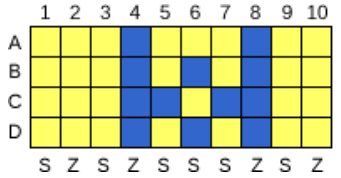
This diagram shows the difference between s and z threading in which the threads enter on the left for s threading and the right for z threading.
This diagram shows the difference between s and z threading.

Although I am sure I had originally threaded my warp correctly I think all the fiddling messed something up so I was forced to flip my cards. I also had a few cards that needed to be adjusted forwards or backwards to ensure I had proper threading. This is why, as you will see in my photos, the marks on my tablets do not match up entirely, as those are the cards that had to be shifted.

This image shows the orientation of my tablet weaving cards after the threading was fixed. 20 wood and paper tablets are being held in the center of the frame with mismatched dots on the edges.
This image shows the orientation of my tablet weaving cards after the threading was fixed.

After all that hassle I thought I had fixed the problem and began weaving again. The width and texture was improving but my pattern still remained unclear. That is until I looked at the back. It wasn’t exactly my pattern but something was showing up and I could tell it was a start.

In this image I am holding my weaving in my hand. The weaving is messy and a pattern is only beginning to show at the bottom of the page.
This image shows the beginning of my weaving. At the very bottom you can see how the pattern was beginning to gain clarity after I finished flipping the cards.

Realizing that for some reason my weaving was showing up on the bottom even though my cards were threaded properly I decided to try weaving in reverse, or at least moving my cards in the opposite direction of that instructed on my pattern.

It was surprisingly nerve wracking weaving without seeing what I was doing. Only hoping that it would work. But In the end I was pleasantly surprised. The pattern was there and it looked better than I could have imagined!
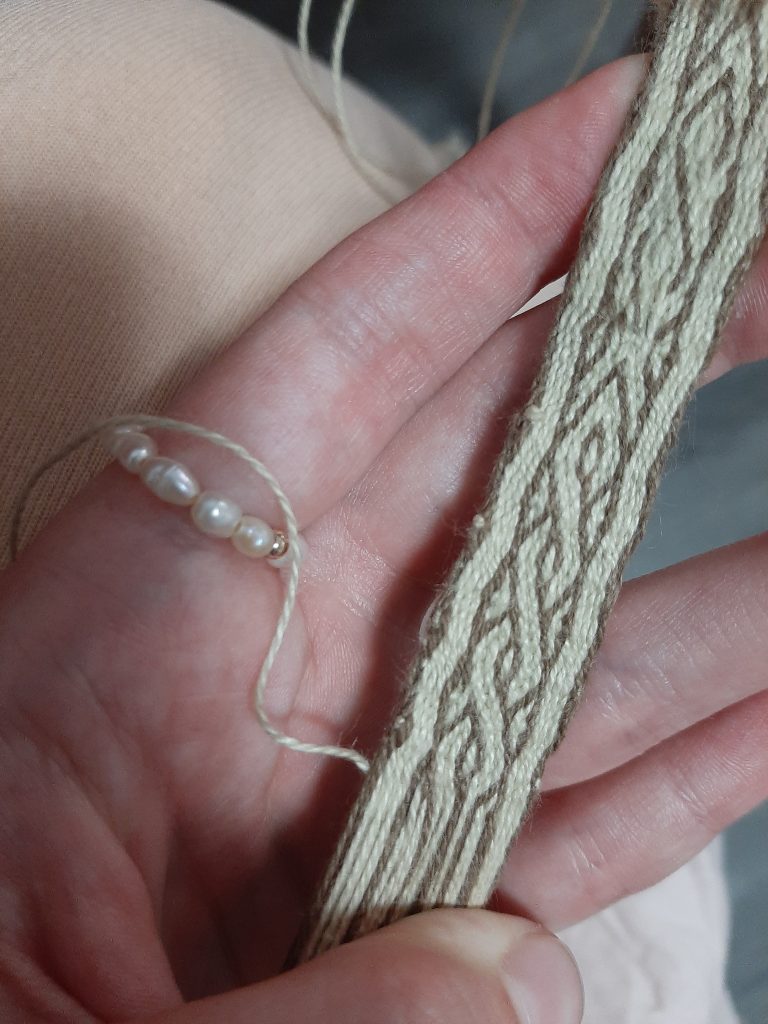
In this image I am holding my weaving. At the top of the band you can see a clear pattern that is not quite what I was aiming for but at the bottom you can see the completed pattern.
At the top of this image you can see the pattern that I achieved after flipping my cards to the correct threading orientation and at the bottom you can see the final pattern I achieved once I started working my cards in the opposite direction.

Conclusion


Since then I’ve continued my weaving. Although I’m still working upside down (I don’t want to chance it) the weave is only getting better and better. I’m getting faster too. At this point it takes me 40 minutes to an hour to complete the whole pattern repeat and It’s becoming easier to remember what steps come next. Although some days weaving is still frustrating, like when I forgot to add a thread or the tension is off, I am finding it more and more relaxing. I’ve been working on it so much I am almost out of warp!

This image shows me holding my woven band, showing off the completed section of the band which has a pattern made up of brown and cream thread.
In this image you can see the weaving I have completed so far.

Anyway, I can’t wait to see the final project so that I can reflect on what i’ve learnt.

Until next time,

Kierrah

Oseberg Narrow Band


Background


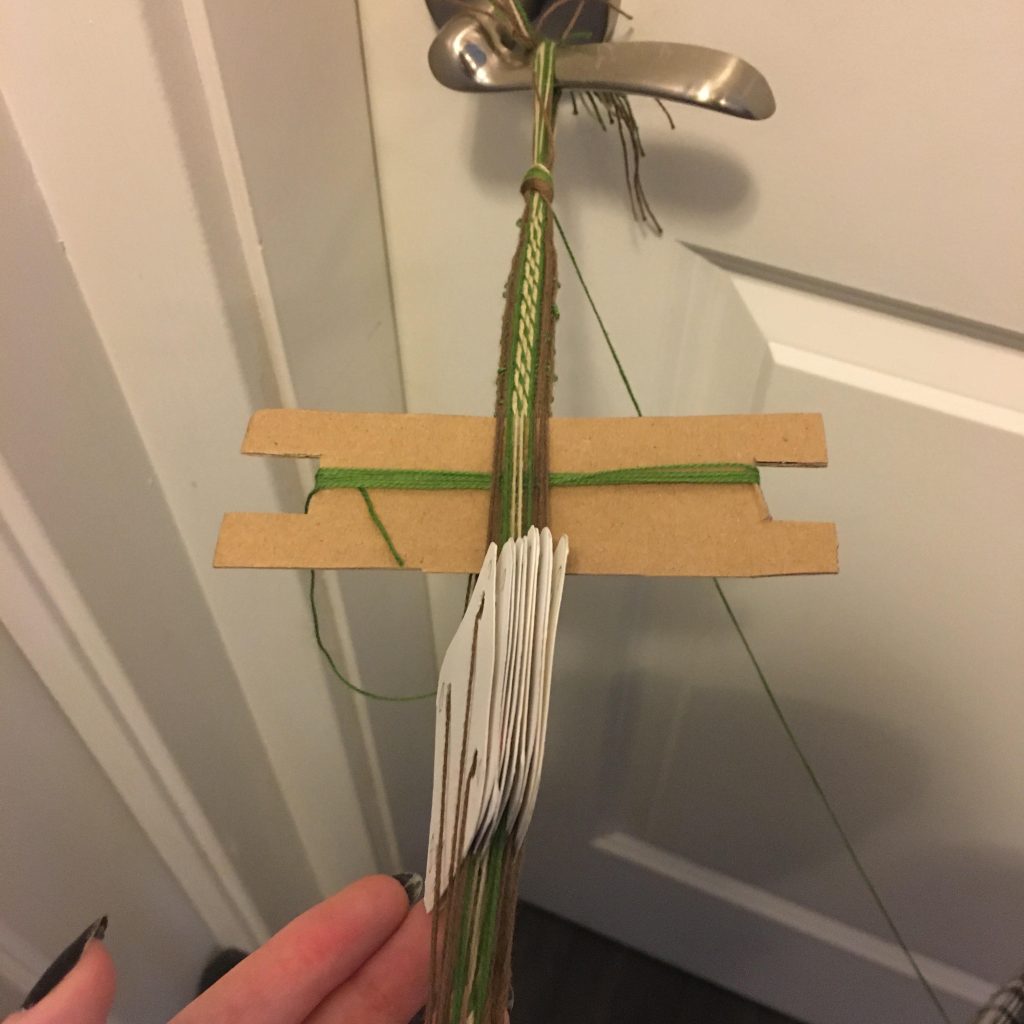
This image has a dark wooden background. On it, from top to bottom, is a black, leather belt, a spool of green thread tied to a cardboard shuttle, a orange mechanical pencil holding together white paper tablets, and green, beige, and brown threads coming from the tablets.
The supplies I used for my project. Tablets made from cardstock, a mechanical pencil used to hold tablets together when not in use, green thread for the weft and a cardboard shuttle, and a black leather belt to tie one end to.

My pattern for this project is the Oseberg Narrow band, from a Viking-age burial in Norway. I will be using cotton thread in brown, beige, and green, modifying the pattern slightly to give it a border in order to use all three colors.

This image shows a white background with a light yellow and blue woven band in the center. Below the band is two threads, one of the matching yellow and the other the blue from the band itself. Above the band is a ruler, showing 1-70 mm.
A reproduction of the Oseberg Narrow band. Image from Shelagh’s website.

Warping & Weaving


To begin my pattern I first had to warp my threads, meaning I had to measure, cut, then thread each piece through the tablets in the correct direction. To measure my thread I used the length of a table, and cut each thread the same length across it. I followed the amount of each color, with modification on the borders, based upon my pattern, and first organized the threads into bundles based upon the card they belonged to. This organization method worked out alright for me as my pattern was not too complicated.

Once I had every thread cut, I then had to thread them through their respective cards. I realized that I had been following an alternative pattern when cutting my threads, but it was quickly rectified as both ultimately required the same amount of each color. Next, I had to figure out the difference between S and Z threading.

The difference between S and Z threading took me a while to understand, but with the assistance of multiple google searches, I finally had all my threads sorted properly. However, my threads became very difficult to work with once warped. The longer end kept getting knotted, and it took me about 30 minutes to untangle them. This continued to be a problem as I started weaving, as at some point while I was attaching one end to a door handle, the threads had managed to flip. It took me quite awhile to fix this, sorting the ends into two bundles which then tied to my belt, but once I had I was able to begin weaving.

My pattern called for all my tablets to be turned the same way, which allowed for me to focus on my tension and keeping my cards organized. I didn’t anticipate how much thread I would need for the weft, so as pictured there is not enough currently on my shuttle. This is a problem that will have to be fixed at a later date, as my partners have already suggested how to fix this. I also didn’t understand how much I would have to pull the weft through, worried that it may unravel, so there are green bumps throughout the section I’ve done. I’m proud of how much I achieved in an hour of work, and while bumpy, the tension is good and the pattern is clear. I foresee this becoming cleaner as I continue, and hope that the end product will demonstrate my learning.


Thank you for reading! Until next time…

-Tika

Birka B2 Progress Report

Background


For this project I chose to reproduce the tablet woven Birka band B2 which originated from the archeological site, Birka, which is located on the Björkö Island in Lake Mälar, Sweden. The band in question dates to the 9th-10th centuries and was discovered in grave 824 In two separate pieces connected to two oval brooches.

Pattern


The pattern I used in the reproduction of this band was written by Shelagh Lewins and was made available for free download through her blog. The pattern utilizes a missing whole technique and in an attempt to replicate the motif present in the original brocade band.

This image depicts a reconstruction of the Birka B2 band, woven in red and yellow threads.
Image of the reproduced band produced by Shelagh Lewins with the use of the pattern she developed.

Creating the Warp


In order to begin weaving I first had to make up the warp as directed by the pattern. The warp is the direction of threads which will be threaded through the tablets and woven into.

On the left hand of the image there is an image of the tablet woven band designed after Birka B2. In the middle of the image there is a diagram outlining the weaving instructions. Finally, on the right side of the image there is a diagram outlining the warping pattern.
An image of the threading and weaving diagram as provided by Shelagh Lewins.

I began setting up my warp by picking my colors, ultimately deciding to solely use the brown and cream we had purchased as a group. Following the warping diagram from the right side of the image I cut my threads to my desired length prior to laying them out on a table. These were taped in place so that I could keep the threads organized.

As we set up our warps as a group on campus my warp needed to be transported home prior to being threaded through the tablets. To do this I chained my warp threads together to stop them from tangling.

In the middle of the image there is a group of fine brown and cream threads chained together to form an organized loop. resting atop the threads in a cone of cream yarn. These are both sitting on a colorful quilt.
This image showcases the warp which I will be using for this project as it was packaged for transportation alongside the thread which I will use for weft.

At this point I began threading my tablets, following the diagram from left to right, placing the threads in the designated holes on the tablets. Unfortunately, although my threads had been taped in the proper order and chained together in an effort to keep them organized it did take me a while to figure out how to thread my warp as a few of the threads seemed to have shifted positions. This meant I had to spend some time reorganizing my threads to get them back in the proper order.

This image shows three wooden tablet weaving cards in the process of being threaded with brown and cream cotton yarn.
This image shows three of the tablets being threaded with yarn.

Unfortunately, it also seems that throughout the transportation of my warp some of my threads were tangled, which meant I had to spend a great deal of time untangling the threads before I could begin weaving.

This image shows a hand holding 20 tablet weaving cards threaded with brown and cream threads.
This image shows the threaded warp after it was untangled.

Thankfully, after about 1-1.5 hours of work with a helping hand I was able to get my threads untangled and am now ready to start weaving!


Until next time,

Kierrah

Our Project


Tablet Weaving

Let’s start off with a brief introduction to what tablet-weaving actually is. Tablet-weaving produces patterned, decorative bands which can be used to decorate the edges of existing clothing, such as the ends of sleeves, or as selvedge edges for garments on standing looms. It’s a type of weaving that requires less space and resources than other traditional methods, such as a standing loom. Today, tablet weaving is performed by hobbyists and experimental archaeologists alike, and was a popular form of textile production throughout the medieval period.

Several tablet-woven bands. Image credit: Catherine, (2023) http://www.tabletweavingintheoryandpractice.co.uk/

Tablet weaving uses a set of tablets, or cards, that come in a variety of sizes. The tablets have four holes, one in each corner, which are labeled A, B, C, and D. The weft threads are threaded through these holes, and the turning of the cards creates the shed in which the warp threads are inserted. The patterns visible in tablet woven textiles are created both by the way the cards are threaded – that is, which colour of thread is put into which hole – and the way the cards are turned.

A set of tablets in the process of being theaded.

Tablet weaving can be done on a small loom, but the technique we are using is called the ‘back-strap’ method – where one end of the warp threads are attached to something like a door handle or the leg of a chair, and the other end is tied to a belt around the weaver’s waist.


The Process

The first step of our project is the first step of nearly any textile project: picking a pattern! There are many, many options out there, with varying ranges of size, colours, cards, and difficulty. In choosing our patterns we considered things like using patterns which were historical reproductions of extant tablet bands, how many colours of thread we wanted to use, and the number of cards.

An example of a tablet weaving pattern. Image credit: The Dutch Tailorette.

After you choose a pattern comes a step which can be very fun but also very hard if you are indecisive like us – picking our colours! 

After you choose your threads, make sure you have enough cards for your chosen pattern. If you don’t, extras can be made out of things like playing cards, thin cardboard, or cardstock, using a hole-punch to create the holes. 

Once the desired number of cards is obtained, the warp threads need to be cut to length and threaded into the cards following the pattern. Your warp threads can be any length, depending on how long you want your tablet-woven band to be. 

After that, it’s just following the pattern until the band is complete – essentially, until it’s as long as you want it to be! Once the bands are completed, we will reflect on how the project went as a group, including what we learned, what we might have done differently, and how our bands turned out. 


Our Questions

We have four major questions we hope to answer through the course of our project.

  1. What is it like to produce tablet-woven textiles and what does this tell us about textile production in the medieval ages?
  2. How much variety can tablet-weaving produce with the use of a similiar number of cards and a consistent colourway?
  3. Is the variety seen in tablet-weaving caused by different methods of warping or weaving?
  4. How does the level of knowledge/skills of the artisan affect the final product?

Supplies

Tablet weaving is a fairly accessible craft in that not that many supplies are needed, and it’s fairly easy to get the things you do need. Firstly, each of our group members will require a set of weaving tablets. We were lucky enough to be lent two sets of tablets already, so all we have to do is make another set (as well as some extras). In order to do this, we will utilize a piece of cardstock or thin cardboard – whichever is on hand –  and cut it to size, rounding the corners and punching a hole in each corner to match the existing paper tablets.

Each person will also require access to a belt, either from their wardrobe or made out of a piece of lacing – really anything you can tie around your waist and then fasten your warp threads to will do. Each member will also need access to a shuttle for weaving, which can be made out of cardstock or popsicle sticks depending on the materials available to the group.

Finally, the group will need access to two to three colors of yarn for weaving. Weaving yarn can be purchased locally from Knotty by Nature Fibre Arts for $14-$16 dollars a cone. As a group, we decided to forgo complete historical accuracy for materials more easily accessible and cost-efficient, and therefore decided on using cotton thread. Overall, supplies should cost approximately $30-$50 in total and are easily accessible locally.

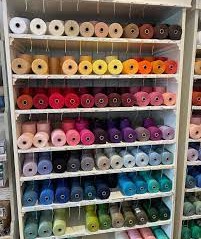
Shelf of weaving cotton at Knotty By Nature. Image Credit: https://www.instagram.com/p/Cy3rUifxPz9/

In Conclusion

In completing this project, we hope to gain a better understanding of what tablet-weaving may have felt like for medieval artisans, taking into consideration the conditions that may alter our modern experience of this craft.

In the course of reproducing a historical pattern, each member of the group will document their reconstruction, sharing update posts along the way that highlight their struggles and successes.

Experiential archaeology is as much about the journey as it is about the end result, so welcome aboard if you’re along for the ride! It should be a fun one.

Supplies

Gathering materials has been a crucial step in the creation of goods throughout history.


In order for us to begin work on our experimental archeology project we needed to start by gathering the necessary supplies.

Before we began our search we decided that there were a few factors which needed to be considered during our hunt for supplies. Firstly, It was important to everyone in our group that the materials were accessible. In this case, material accessibility meant that the materials were available locally, being easily accessible by bus, and that the materials were of a reasonable cost. Considering this, It was important to the group that as many of the necessary materials as possible were borrowed or made out of recycled material. Not only does this support the groups desire for accessibility, keeping costs low, this also ensures the projects sustainability, avoiding unnecessary consumption of materials which would be used for a single project. Considering our focus on accessibility and sustainability there were instances in which we chose to forgo complete historical accuracy. Instead we chose to focus on the functionality of our chosen materials, aiming for materials that would function like their historic counterparts, without feeling like it was strictly necessary to gather completely accurate materials. We felt that this was the right decision for this project as it is practically impossible to achieve complete historic accuracy, especially given the time constraints for this project.

Considering these factors we began our search for supplies.


Necessary Supplies

There were a few supplies which were necessary for us to gather before we began our project. These supplies included; weaving tablets, a shuttle, a belt, and, most importantly, 2-3 colors of yarn.


Weaving Tablets, Shuttles, and belts

We were able to gather a variety of weaving tablets for this project. Two of these sets were borrowed, one made out of wood, and the other out of paper, and a third set was constructed out of a thick sheet of cardstock. The shuttles were also constructed out of a piece of cardstock. Finally, the belts were similarly constructed out of recycled materials, being made of pieces of ribbon and lacing.

Wooden weaving tablets in the process of being threaded with a fine brown and cream yarn.

Weaving Material: The Yarn

The yarn was the most difficult of the supplies to gather as It was time consuming to find something suitable for our project which was available locally.

Beehive Wool Shop
Image of the interior of the Beehive Wool Shop in Victoria, BC, including a variety of colorful yarns. of the interior of

We started our search at the Beehive wool shop as they are located in downtown Victoria and provide a range of yarns made out of natural materials.

There were quite a few lovely options for wool, silk, and linen fibers which would have provided us with historically accurate materials for our project. This being said, the majority of these fibers were either too thick for weaving or extremely expensive. This is because this shop caters to knitters and crocheters, thus the products in store are not produced with weaving in mind. Considering this we were forced to look elsewhere for our yarn.

Knotty by Nature Fibre Arts
Image of the interior of the Knotty by Nature Fibre Arts store in Victoria, BC, including a variety of colorful cones of weaving yarns.

After some online research we found Knotty by Nature Fibre Arts was a local store that sold a variety of weaving yarns. Although the store seems to primarily house dyed wool roving, used for spinning, and knitting yarns there was a small collection of weaving yarn available, with the majority of the collection being 100% cotton. Although cotton is not particularly historically accurate we decided that this yarn fit our requirements best as it was still a natural fiber and was the right size for our project while also being in the right price point. Considering this, we met up at the store and picked out our colors as a group, picking out three matching yarns in a bright green and more neutral brown and beige.

The weaving yarns we chose as a group, being held by each group member.

Finally we were ready to weave!