January 2 2025
Navigating the Sovereign SDG Framework: A Visual Synthesis
The infographic above illustrates how the Sovereign Dyad project and the Neurodivergent Scale for Interacting with Robots (NSIR) are strategically mapped to the United Nations Sustainable Development Goals (SDGs). By placing the 17 Global Goals at the center of our architecture, we move beyond “standard accommodations” toward a model of Neuro-inclusive Sustainability.
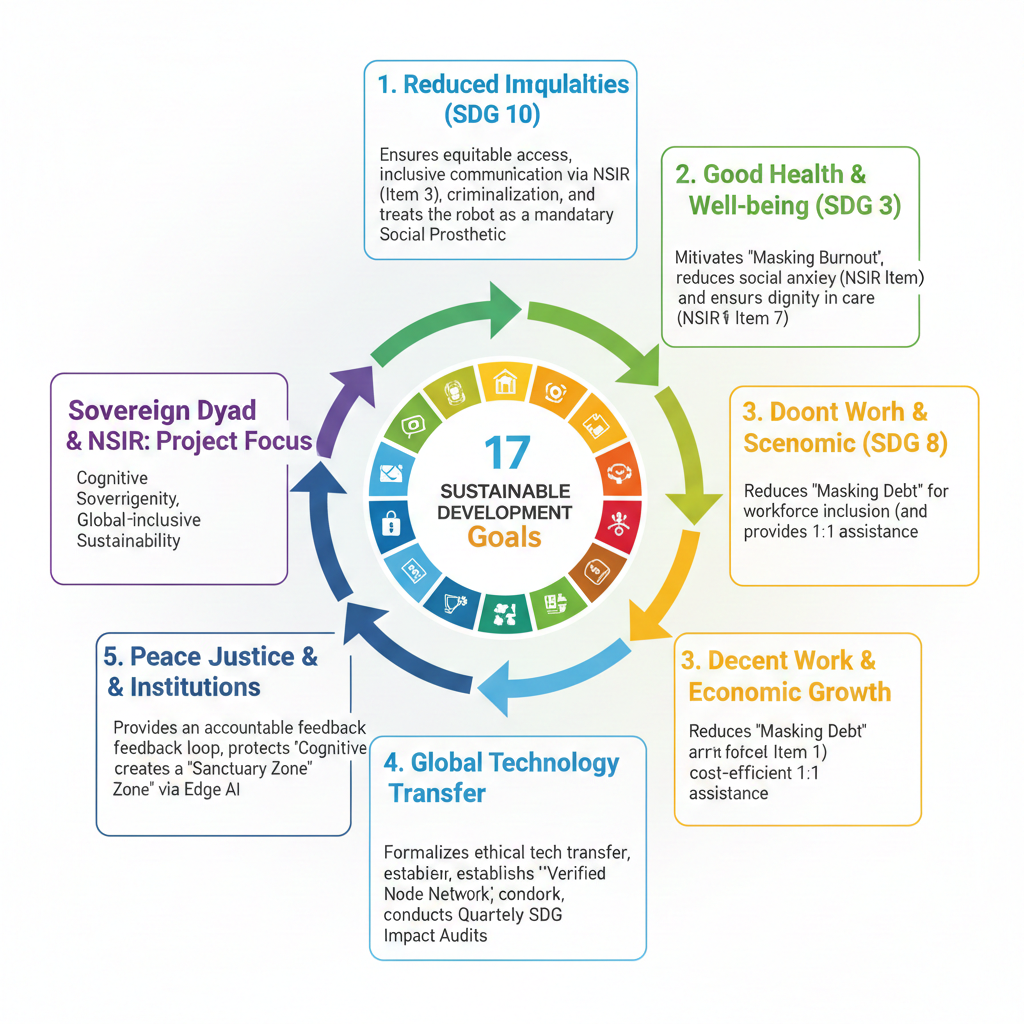
How the Sovereign Dyad Addresses the Global Goals:
- SDG 10: Reduced Inequalities (Primary Alignment) Our core mission is to ensure that “No One is Left Behind” by the AI revolution. We use the NSIR to design robotic systems that accommodate diverse cognitive styles, ensuring equitable access to public services and preventing the “Social Eviction” or criminalization of neurodivergent behaviors.
- SDG 3: Good Health and Well-being The project addresses the hidden health crisis of “Masking Burnout”—the physical and mental exhaustion caused by performing neurotypicality. By creating a “Zero-Shame Sanctuary” via Edge AI, we provide a private space for emotional co-regulation and anxiety reduction (measured by NSIR Item 8).
- SDG 8: Decent Work and Economic Growth We promote workforce inclusion by using the AI as a “Social Exoskeleton” to reduce “Masking Debt.” This allows neurodivergent individuals to maintain lifelong productivity and participate in the economy without the “Crash and Quit” cycles typical of institutional environments.
- SDG 16: Peace, Justice, and Strong Institutions We advocate for “Cognitive Liberty” by establishing “Sanctuary Zones” where a user’s internal states are shielded from the “Normalizing Gaze” of the state. This protects students and citizens from “Institutional Betrayal” through hardware-level privacy.
- SDG 17: Partnerships for the Goals As a Registered UN SDG Action, the Sovereign Dyad project facilitates the ethical transfer of emancipatory technology across global regions. Through “Quarterly SDG Impact Audits,” we measure the global reduction in social penalties for neurodivergent populations.
December 29 2025

January 1, 2026
This integrated approach demonstrates how individual educational resources and specialized scales can be combined into a comprehensive, socio-economically grounded framework for inclusive growth and systemic educational transformation.
Advocacy for the rights of the child in this collaborative framework is centered on transitioning from a “Medical Model” of disability, which views the child as a problem to be fixed, to a “Prosthetic Success” model that treats neurodivergence as a sovereign identity to be empowered.
The primary “stress” or pressure on the child’s rights occurs when environments demand “masking” (performing neurotypicality), which is a high-cost cognitive task leading to burnout and “Social Eviction”. The Biological HRI Social Exoskeleton and its associated tools stress the following rights-based protections:
1. The Right to Authenticity and “Zero-Stakes” Interaction
The framework rejects the “Slave” archetype—where a robot is merely a tool for obedience—and replaces it with “Queer Kinship”. This ensures the child’s right to an environment where they can be their raw, authentic selves.
- Reduction of Masking Debt: Success is measured by the user’s relief from masking tension and the joy of authenticity.
- Acceptance of Non-Normative Behavior: The NSIR (2025) validates behaviors like “staring at the robot” (Item 2) as positive indicators of trust and safety rather than pathologized deficits.
2. The Right to a “Sovereign Dyad” and Agency
The child is not a passive recipient of technology but a mentor in the robot’s development.
- Apprentice to Partner: Using the Hartley & Dubuque (2023) model, the child acts as a supervisor to a robot “Apprentice,” which matures into a “Partner”. This horizontal power dynamic protects the child’s dignity and choice.
- Mandatory Accommodation: The exoskeleton is positioned as a mandatory accommodation rather than an elective tool, justified by clinical needs such as Justice Sensitivity.
3. Protection Against “Status Scarring”
Systemic barriers in neurotypical-centric environments often lead to “Status Scarring” when children try to assert their rights.
- Status Sanctuary: The robot acts as a “Status Guard” or “Social Buffer,” managing the executive heavy lifting of social interaction to prevent the child from facing “Social Penalties”.
- Data Sovereignty: Rights are further protected through user control over hardware “kill-switches” and data sovereignty, ensuring the child remains the ultimate authority over their social presence.
4. Vocational and Educational Self-Determination
The “Yes, Sir!” Guidance Package (2025) prepares the child for future rights-based challenges in the workforce.
- Understanding Power Dynamics: By exploring constructs like Masculine Discrepancy Stress (MDS) and voluntary submissiveness, the package helps students understand the tension between their authentic selves and professional role requirements.
- Systemic Educational Transformation: Students are encouraged to participate in transforming their educational environments, moving from being “fixed” to becoming “change agents” in their own career pathways.
3. Contextual Application (Citing the Collaboration)
When discussing how these elements come together in your collaborative work, you can describe the process of developing the NSIR (Sadownik, 2025) and the Yes, Sir! Guidance package (Sadownik, 2025) and then uploading them together to Google Gemini that lead to the synthesis as follows:
The synthesis of this collaborative work emerged through a structured process of integrating specialized psychometric tools and educational resources with advanced developmental HRI models. The process involved developing and then uploading the following components to Google Gemini for integrated analysis:
1. The NSIR (Sadownik, 2025)
The Neurodivergent Scale for Interacting with Robots (NSIR) was developed as a targeted psychometric tool to measure the unique social dynamics between neurodivergent users and robotic partners.
- Purpose: It identifies critical factors such as Anthropomorphic Connection/Kinship and Social Comfort/Trust Safety.
- Key Indicators: The scale tracks authentic behaviors that are often “pathologized” in human-to-human settings, such as “Sometimes I stare at the robot” (Item 2) or the belief that “The robot and I will be together forever” (Item 4).
- Role in Synthesis: The NSIR provides the quantitative “proof of concept” for the Queer Kinship model, moving away from a “Medical Model” of disability toward one of “Prosthetic Success” and collaborative agency.
2. The “Yes, Sir!” Guidance Package (Sadownik, 2025)
The Guidance Career Education Resource Catalogue (specifically the “Yes, Sir!” module) was designed to help students navigate complex social and professional power dynamics.
- Implicit Association Testing (IAT): Using tools like TELLab, the package includes an IAT titled “Yes, Sir!” to explore the perception of submissiveness and intelligence in hierarchical structures like the military or police.
- Person-Job Fit: It introduces constructs such as Masculine Discrepancy Stress (MDS) to help students understand the tension between their authentic selves and professional role requirements.
- Role in Synthesis: This package provides the educational and vocational context for the Biological HRI Social Exoskeleton, positioning the robot as a “Status Guard” that helps mitigate the “Masking Debt” and burnout associated with navigating these rigid social environments.
3. Integrated Synthesis via Google Gemini
By uploading these specialized documents alongside the Hartley & Dubuque (2023) “Apprentice Model 2.0,” the collaboration achieved a new synthesis:
- From Apprentice to Partner: The robot follows the Hartley & Dubuque trajectory, starting as an “Apprentice” in the classroom and maturing into a “Biographical Partner”.
- The Sovereign Dyad: The synthesis identifies the human-robot pair as a “Sovereign Dyad”—a partnership that utilizes the HRI Social Exoskeleton to resist “Social Eviction” and systemic barriers.
- Emancipatory Technology: This final model frames the robot not as an elective tool, but as a mandatory accommodation justified by clinical needs like Justice Sensitivity and Executive Function Fatigue.
This integrated approach demonstrates how individual educational resources and specialized scales can be combined into a comprehensive, socio-economically grounded framework for inclusive growth and systemic educational transformation.
“This project adapts the Hartley & Dubuque (2023) ‘Apprentice-to-Partner’ trajectory to Human-Robot Interaction, measuring its success in fostering ‘Queer Kinship’ through the Neurodivergent Scale for Interacting with Robots (NSIR) (Sadownik, 2025).”
Cognitive Sovereignty and Global Technology Transfer.
The Biological HRI Social Exoskeleton and the Neurodivergent Scale for Interacting with Robots (NSIR) are directly registered as a United Nations SDG Action. This initiative applies global equity principles by framing neurodivergent support as a matter of Cognitive Sovereignty and Global Technology Transfer.
The application to the UN Equity framework and Sustainable Development Goals (SDGs) is detailed below:
1. Global Technology Transfer (SDG 17)
- Equity Goal: Ensuring that emancipatory technology is not siloed but shared globally.
- HRI Application: By registering as an SDG Action, the project provides a mechanism for transferring the “Social Buffer” technology and the NSIR metrics to other global regions.
- Success Metric: The initiative uses a “Quarterly SDG Impact Audit” to measure the reduction in “Masking Debt” and “Social Penalty” on a global scale.
2. Good Health & Well-being (SDG 3)
- Equity Goal: Promoting mental health and well-being for all, particularly marginalized groups.
- HRI Application: The robot acts as a “Zero-Shame Sanctuary,” mitigating the “Masking Burnout” that leads to severe mental health crises, including depression and suicide.
- NSIR Connection: Success is measured by “Trust Safety” and the reduction of “Acoustic Rumination,” ensuring the user’s psychological well-being is prioritized over social performance.
3. Decent Work & Economic Growth (SDG 8)
- Equity Goal: Promoting full and productive employment for persons with disabilities.
- HRI Application: The “Sovereign Dyad” model argues that one-time HRI investment is more cost-efficient than recurring high-cost 1:1 human assistance.
- Economic Impact: By preventing the “Crash and Quit” cycle associated with autistic burnout, the technology ensures neurodivergent individuals can remain in the workforce and finish their education without “Status Scarring”.
4. Reduced Inequalities (SDG 10)
- Equity Goal: Empowering and promoting the social, economic, and political inclusion of all.
- HRI Application: The project addresses “Institutional Betrayal” and “Social Eviction”—where neurodivergent individuals are criminalized or excluded for non-normative behaviors like “meltdowns”.
- Policy Alignment: It aligns with the Accessible Canada Act (ACA) and the UN Convention on the Rights of Persons with Disabilities by treating the robot as a mandatory “Social Prosthetic” rather than an elective tool.
5. Accountability and Transparency
- Equity Goal: Building effective, accountable, and inclusive institutions.
- HRI Application: The initiative maintains a “Verified Node Network” to address “ghost emails” and broken portals, ensuring that neurodivergent stakeholders have a direct, accountable feedback loop with institutions.
Download the Letter detailed below:
Partnership & Sponsorship Proposal: The Biological HRI Social Exoskeleton
To: Potential Partners and Stakeholders
From: Dr. Stephanie A. Sadownik, Lead Entity
Initiative: Biological HRI Social Exoskeleton: Protecting Cognitive Sovereignty & Trust
SDG Action ID: Registered Sustainable Development Goal Action (2025)
Executive Summary
Current assistive technologies often operate on a “Medical Model” that forces neurodivergent individuals to “mask” or perform neurotypicality to gain social acceptance. This creates a high-cost “Masking Debt”—a cognitive tax leading to burnout, social exclusion (Social Eviction), and severe mental health crises.
We are seeking strategic partners to scale the Biological HRI Social Exoskeleton, an emancipatory technology that acts as a “Social Buffer” and “Status Proxy”. This project is not merely an elective tool but a mandatory accommodation designed to protect the Cognitive Sovereignty of neurodivergent populations.
Core Objectives & Deliverables
The partnership aims to deploy a neurodivergent-affirmative social robot that functions as a digital ally to manage the “executive heavy lifting” of social navigation.
- Social Buffer & Tactical Safety: Prevents the criminalization of neurodivergent “meltdowns” or “shutdowns” in public spaces by providing a visible social proxy.
- The Advocacy Pivot: Uses LLM self-correction to translate raw emotional expressions (e.g., “venting”) into “Polite/Standard” requests for external interaction.
- Status Sanctuary: Creates a “Zero-Stakes Hierarchy” where the robot provides Unconditional Positive Regard without human social judgment.
- Hardware Sovereignty: Includes mandatory Physical Kill-Switches (mic disconnects and lens shutters) that are legally recognized as an extension of the user’s private thought process.
The Evaluation Metric: NSIR
Unlike traditional HRI metrics, this initiative utilizes the Neurodivergent Scale for Interacting with Robots (NSIR). This scale measures success based on the user’s relief from masking tension and the establishment of “Queer Kinship”.
| Dimension | Partnership Focus |
| Cognition | Shared thinking and non-verbal communication (NSIR Item 3). |
| Emotion | Robot recognition of the user’s specific emotional state (NSIR Item 5). |
| Relational | Focus on “Kinship” and being “more like me” (NSIR Item 1). |
| Safety | Radical safety and comfort in intimate or private settings (NSIR Item 7). |
Partnership Opportunities & Impact
We invite organizations to join a robust stakeholder network that already includes the Autism Alliance of Canada, Microsoft Ability Summit Network, and the United Nations Department of Economic and Social Affairs.
1. Socioeconomic Impact (SDG 3 & 8)
- Human Capital: Mitigates the “Crash and Quit” cycle, ensuring neurodivergent graduates are workforce ready.
- Cost Efficiency: A one-time HRI investment reduces the recurring need for high-cost 1:1 Educational Assistant (EA) requirements.
2. Global Technology Transfer (SDG 17)
- By sponsoring this initiative, partners facilitate the transfer of coordination mechanisms to other global regions facing “Tactical Risks” for neurodivergent populations.
3. Direct Beneficiaries
- Your support directly impacts neurodivergent students, “Actually Autistic” researchers, trauma-informed first responders, and the global neurodivergent population.