
About Me
Hello, my name is Simeng Zhang you can also call me Grace, and I am currently a 3rd year Visual Arts student at the University of Victoria.
Since I was a child, I have always loved to express myself through images and objects, and this interest has gradually become an important motivation for me to learn and grow. My interest in art began as a child doing paper art crafts with my mother. It evolved into a deeper exploration of photography, collage art, fashion and cultural expression. After I entered university, I gradually combined these interests with digital tools, especially on social media platforms to share my creations and connect with a wider community of viewers.
The Role of Social Media in Learning
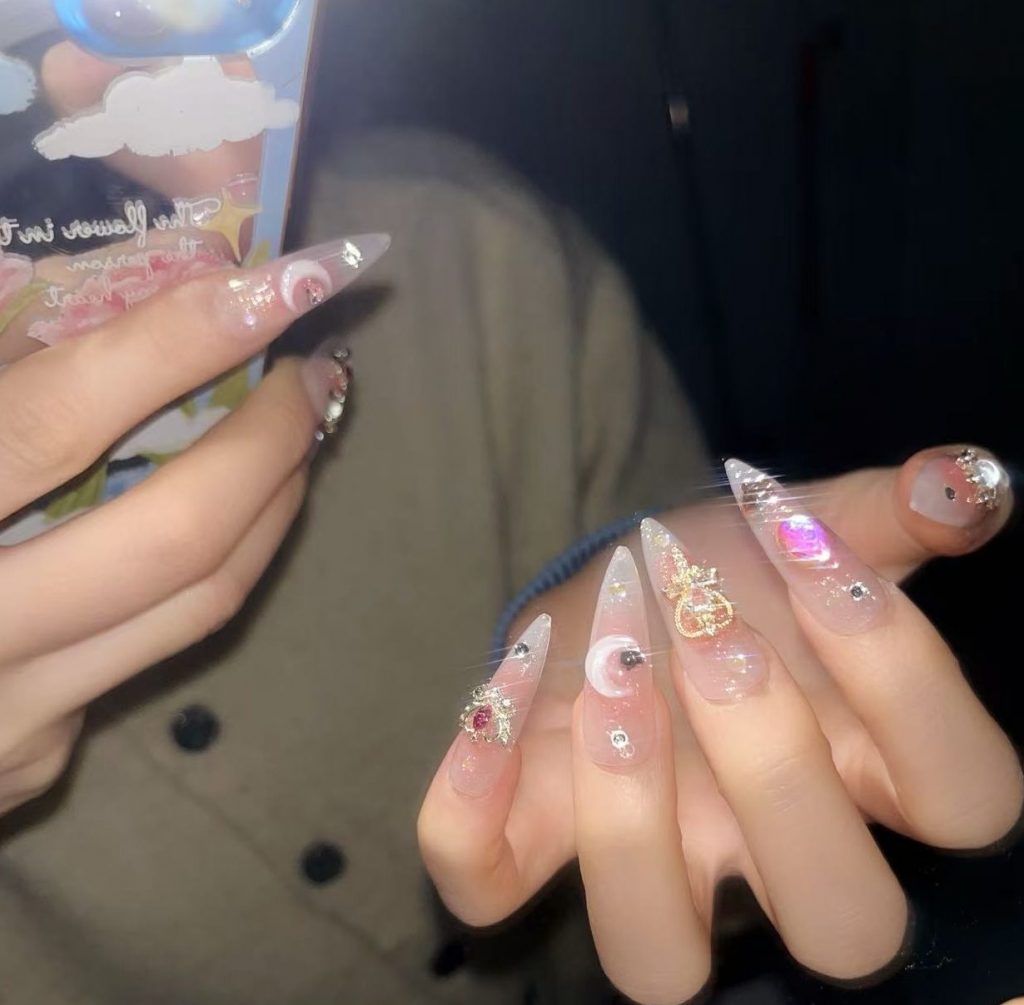
I was first introduced to social media through Instagram, where I shared my makeup, beading, handmade jewelry and nail art creations. At the time, I just thought these platforms were fun to showcase my interests and I could appreciate a lot of creativity from around the world. At first I just took photos with my phone and uploaded them, but later I would specialize in arranging the background, adjusting the light, and even learning about composition and color matching. Then I started to realize that even small daily creations can be given richer meaning and communication power through digital platforms.
“Labubu Dressup” Video
Eventually, I started to try posting videos about my nail art on TikTok. Then I posted a short video about “Pop Mart Labubu Dressup”. I bought different styles of clothes for Labubu, such as school style, uniqlo style, winter down outfit, etc. Then, made a short video about the costume change through editing and soundtrack. My friends found it very interesting and it was a very positive encouragement for me.
Through these platforms, I’ve met many creators with interests like my own. Some are art designers, some are professional illustrators, and some are content creators who share nail art and craft tutorials through short videos. We would leave each other messages in the comment section, and sometimes we would share our crafting process or tool sources in direct messages.
Benefits and Challenges of Social Media in Education
Social media has become my own “casual classroom” in some ways. I learned more than just to make videos or content, and also how to present creative ideas and communicate with people in visual language. Some content creators would even share their process documents and color matching inspiration boards, and I started learning about “visual notes,” “color theory,” and other content that I couldn’t access in the classroom. Learning when playing and sharing made me realize that learning is not limited to the classroom, but can also be an open and interactive process.
| Advantages | Challenges |
|---|---|
| ① Getting Multiple Inspirations | ① Easily distracted |
| ② Building a Global Community | ② Information overload |
| ③ Interactive Learning | ③ Privacy and comparison anxiety |
Although social media has the risk of inducing comparisons and distractions. But when used wisely, it does make learning more interactive and fun.
Personalized Learning and Digital Literacy

As a visually oriented learner, I find that the traditional “read + listen” approach is not effective enough for me. In the opposite case, when I can learn with images, videos, collages, or hands-on creativity, my focus and understanding are greatly enhanced. For example, in one of my coursework assignments, I made a collage using circular pieces of paper of different colors and textures to express the theme of “Memory and Place”. This personalized expression gave me a deeper understanding of the relationship between culture and personal experience.
After this experience, I started focusing on improving my digital literacy. In addition to knowing basic tools, I commonly use digital tools:
I am also learning how to evaluate the credibility of information sources and how to construct clear, professional expressions online. For example, in a photography course I once took at Camosun College, I was required to use D2L to upload my work and interactively critique it with my classmates, and all of these experiences have made me more familiar with how to learn efficiently and politely in a digital space.
Digital Identity and Online Profile
My digital identity is really an extension of my art practice. I will manage my presentation on social media lovingly, not just in terms of the work posted, but also in terms of how I express myself and interact with the written word. While I want to be real, I also want to show how professional I am in my beauty and creative field. For example, I will regularly update my Instagram page and think about the impact of each piece of content I post. I think maintaining a positive, credible online profile is important for both my future applications for related jobs and my personal artistic development.
As I use more and more platforms, from learning platform Brightspace, to collaboration tools like Google Drive and Discord, and social-based platforms like Instagram and TikTok. I have come to understand that different platforms have different rules and etiquette. Especially in group work, it is important to respect others’ expression, be timely, and label sources. These seemingly simple things are actually the basis for building a good collaborative relationship.
Check My Guideline for Directing the Digital Platform.
- Respect for copyright: cite the source when using material
- Constructive Feedback: Online comments must be clear, friendly and helpful.
- Privacy Protection: Regularly check platform permissions to avoid excessive disclosure of personal information.
Using digital platforms ethically is just about respecting others, but also about protecting yourself.
Conclusion
Thanks for reading my introduction! I’m looking forward to continuing to learn how to better express myself, connect with people, and explore more personalized and creative ways of learning in the digital era in the EDCI 338 course.