Responding to Peers’ Blog Post#3

Hello Chelsey,

Thank you for sharing this very informative blog post! I think you presented in a very clear way how you have consciously used social media to develop a Personal Learning Network (PLN), which has given me a deeper understanding of the positive uses of social media.

I particularly liked the following two points. The structure of the table in which you listed the connections between different learning objectives and social media platforms was very intuitive and well-organized, making it easy for me to understand how you specifically integrated PLNs with realistic objectives. Secondly, in the section on network security, you listed not only your own practices, but also relevant research and practical tools, which made me learn a lot of practical resources and methods.

I have a small suggestion. I noticed that you mentioned avoiding a “Western perspective” and I was wondering if you could give a specific example of how you choose content creators from multicultural backgrounds? That would make your point more concrete and clearer.

Overall, this was an informative and insightful blog! Maybe review the grading criteria again to see if you still need to cite the source of the video or quote.

Hi Karen,

Thank you for sharing this clear and organized blog post! I especially like your clear three-step process in the “How to set up a PLN” section, which is very practical and suitable for beginners. Also, your table comparing formal and informal learning tools was very helpful and made it clearer to me how different platforms play a role in learning. I also like your overall layout, which is compact, and the accompanying images enhance the appeal of the content.

I wonder if you could give a specific example of how you interacted with a particular expert on a social media platform, it might make the section on “building a PLN online” more vivid and concrete.

Overall, this is a very informative and well-written essay, and you might want to review the Diversity and Inclusion requirement in the grading rubric to see if you can add some more details about how you incorporated multiple perspectives in your PLN. I look forward to your next post!

Hello Chad,

Thank you for sharing this insightful and well-written blog. First, I especially like your comparative analysis of the functions of Instagram and LinkedIn, which not only shows your understanding of the different platforms, but also how you strategically develop your PLN, and your clear explanation of the three principles of UDL, especially in the section of “Multiple modes of expression”, which makes me imagine an inclusive learning environment more concretely. In addition, your articulation of the three principles of UDL is very clear, especially in the section on “multiple modes of expression”, which makes me visualize inclusive learning environments.

I also really like the overall structure of your blog, with its tight logic and professional language. I wonder if you could have included a specific example of an interaction such as how you connected with an expert on LinkedIn that might have made your analysis more relevant and resonate with readers. You’ve already covered the topic of safety and inclusivity very well, maybe review the section that emphasizes “personal reflection” and see if you can add a sentence or two about the personal growth you’ve gained from your practice.

I look forward to reading more from you in the future!

Blog #3: Reflections on PLNs, Digital Security and Diverse Learning Spaces


In this module, I have studied the principles of UDL (Universal Design for Learning), the way to build a PLN (Personal Learning Network) through social media, and the importance of diversity and inclusion in digital learning.These topics are not just academic theories, they are also closely related to my daily learning and future career development.


PLN Spaces Through Social Media: How has my learning network grown?

Through the class I learned that PLNs are not just about “following people,” they are a network of active learning and interaction. My PLN was primarily created through LinkedIn, Pinterest, and Instagram:

LinkedIn – I follow experts in the field of design, as well as the official account of the beauty company Sephora and the content shared by its employees.They often post case studies on retail marketing trends and customer experience design, which gave me a new perspective on brand-customer interaction and inspired me to explore brand experience design in my coursework.


Pinterest – This is my go-to platform for visual inspiration.I have a huge collection of mood boards, including jewelry designs, color schemes and packaging ideas.This process has also helped me to understand that Pinterest is more than just an “image collection”, it’s also a way to learn and organize inspiration.

Instagram – I mainly follow design and creative related accounts, such as some illustrators and photographers whose work inspired me for my graphic design assignments in school.


In short, a PLN built with intent can lead to real-time feedback, resource exchange, and cross-disciplinary perspectives. I’ve also found that PLNs allow me to learn to sift through information without over-reliance on the same source and consciously seek out content from different cultures to avoid the algorithms trapping me in one information environment.


Privacy, Ethics, and Security in Digital Spaces: How to protect ourself online?

In class we mentioned, “If you don’t shape your PLN, the algorithm will shape it for you.”I think there’s a similar logic to managing privacy and security, if you don’t put up defenses, you’re letting someone else decide the fate of your data.

The measures I took:

  • Account security: turn on two-step verification, update passwords regularly and use different passwords for different platforms.
  • Information minimization: fill in only the necessary information when registering, and do not disclose home address or contact information.
  • Platform awareness: I will be aware of the platform’s data policy and know what is public and what will be tracked.

In addition to the methods I’ve mentioned, there are nine different methods mentioned inside this video that are even better.Showing us how to protect our information in the online environment.


On an ethical level, I follow basic rules such as citing sources, not spreading unconfirmed information, and being polite in my comments.I also think about the liability issues mentioned in class . It’s not just about “protecting myself,” but whether I’m creating a safe, trustworthy space for others. For example, when I see inappropriate comments in Discord groups, I report them or alert them, rather than ignore them. Because PLNs are built on trust, if participants don’t respect privacy and don’t act ethically, the learning space will easily become an “unsafe zone,” and the value of learning will be reduced.


Inclusivity and UDL in PLNs: How to make learning networks more inclusive?

Diversity ≠ Inclusivity.Diversity is only about “who is present”, inclusivity is about “whether these people are really heard and respected”.

When I build a PLN, I will consciously focus on creators from diverse backgrounds. I was also inspired by the idea of UDL.

UDL PrinciplesHow it works in my PLN
EngagementCombining video discussions (Zoom/YouTube) and text forums (Discord) to allow people with different habits to participate
RepresentationLearning materials are available in a variety of formats, including articles, graphics, and videos, to facilitate understanding by people with different languages and learning styles
Action/ExpressionEncourage the expression of ideas in a variety of forms, such as writing, illustrations or short videos, respecting different abilities and cultural backgrounds


Challenges and Importance of Diversity in Digital Learning: why is Diversity Important?

There are barriers to diversity in digital learning, such as:

  1. Technological equipment gaps: not everyone has high-speed internet or computers
  2. Language barriers: many resources are only available in English
  3. Algorithmic bias: platforms push similar content and ignore the voices of other cultures
Photo by Pikisuperstar on freepik

Why is diversity important?

  • Perspectives from different backgrounds complement blind spots and reduce bias.
  • A diverse learning network gives each learner a greater sense of belonging.
  • It helps us prepare for the diverse work environment of the real world.

What can I do?

  • When sharing resources, try to find bilingual or multilingual content, or add subtitles.
  • Support creators from disadvantaged groups. E.g., follow accounts of female programmers or non-native English-speaking designers).
  • Be intentional about inviting quieter members to speak during group discussions to ensure that “no one’s voice is ignored”.

Responding to Peers’ Blog Post#2

Hi Melissa,

I enjoyed reading your second blog. The content is very thought provoking and very well structured!

There were two areas I found particularly interesting. I liked your thoughts on personal and professional digital identities, and your mention of not posting anything you don’t want to be associated with yourself was a very practical reminder, and one that made me rethink the traces I’ve left on the web. Your explanation of the Constructivist theory of personalized learning is very vivid, especially your mention of making you feel more in control of your own learning, which makes the theory very real and resonant. Also, I really like the layout of your blog the chapters are clear and the inclusion of videos makes the content more interactive and easier to follow along with.

I do have one small thought though, I’m concerned that the blog is largely theoretical about constructivism, and I was wondering if you could add an example from your own real-life experience to illustrate how you’ve experienced this style of learning firsthand? This would make the theory more relevant to your learning experience.

Overall, your blog is clearly written and very readable. I learned a lot from it, thanks for sharing!

Hi Lyndsay,.

Really enjoyed reading your second blog, it was informative, clear and easy to understand!

There are two things I found interesting. You mentioned building a wall between LinkedIn and Instagram/TikTok to separate personal and professional digital identities, which is a great analogy and reminded me to think about my own sense of boundaries on different platforms. The fact that you write about using social media to learn psychology terms and being more motivated to learn when you have autonomy and control is a great illustration of how personalized learning theory really works in your life. Secondly, I also like the organization of your blog. The clear separation of each topic and the list of privacy tips in the “Digital Footprint” section make the content more useful.

However, I do have one small thought, I’m concerned that in the “Digital Visitor and Resident Maps” section you’re describing more about how the platform is used, and I was wondering if you could add a more specific example. For example, a time when you were more active in a learning community because you were a Digital Resident, or a time when you were challenged by your role as a Digital Visitor. This will make your eflection more personal and more likely to resonate with the reader.

Overall, this blog is very easy to read and offers a lot of practical advice, thank you for sharing!

Blog#2 Digital Identity and Learning Self-Reflection


In this module, I have developed a deeper understanding of the concepts of “digital identity”, “visitor and resident maps”, “personalized learning theory”, and “privacy and surveillance”. These topics are not just relevant to our daily lives, they also have a profound impact on how we learn, work and interact with others.

Digital Identity: Personal vs. Professional:

I have not really thought about how my online presence should be differentiated in the past, but after this course, I realized that it is important to draw a line between my personal and professional digital identities. On social media such as Instagram, I may share my daily life, hobbies or interactions with friends, which is my “personal image”. On LinkedIn, my school’s website, or portfolio platforms, I present myself in a more professional way, including my academic background, work experience, and demonstration of my skills, which is my “professional identity”.

  • To keep the boundary between the two, I have taken some specific steps:Separate social media: I have separate accounts, with my private account set to “friends only” and my professional account used to showcase my work and professional experience.
  • Content style distinction: On career platforms, I will avoid posting non-job related content to ensure that my expression is professional and in line with the job search objectives.
  • Regularly check privacy settings: I will regularly review each platform’s privacy policy and my account settings to avoid overexposure of personal information.
  • Uniform professional account naming: as Aaberg suggests, using consistent, clean, and easily searchable usernames (e.g., @YourName) for professional platforms (e.g., LinkedIn, portfolio sites, blogs, etc.) helps me establish a clear professional brand identity and is easier to find by potential employers or collaborators. This naming scheme gives my online presence more consistency and credibility.

I think this distinction is important because different audiences have different expectations. A potential employer will have more confidence in me if they see my serious and professional image, while my friends may be more concerned about the real side of my life. If there are no boundaries, the situation of “using the wrong platform to say the wrong thing” may arise, which may even affect my career development.


Digital Visitor and Resident Map:

By studying David White’s “Digital Visitors and Residents” theory, I started to use this concept to analyze my online behavior. I drew my own digital map and realized that my roles on different platforms were not the same:

Simeng’s Digital Visitor and Resident Map
Platformmy rolehow to use
GoogleVisitorQuickly check information, use without logging in
YouTubeResidentHave an account, subscribe to content, comment and interact
InstagramResidentShare daily life, social interaction
WeChatResidentShare daily life, social interaction
BrightspaceResident&visitorFor class, have an account, some interaction
LinkedInVistoirHave an account, rarely update or reach out to others

From this map, I summarized a table and realized that I am more of a “resident” user on many personal platforms, focusing more on private areas. In the future, I hope to be more of a “resident” on academic and professional platforms, actively making connections and participating in discussions, so that I can help build my professional network. At the same time, I think this map will slowly change as I move into society. I’ll spend less time on certain entertainment platforms and more time on professional development-related platforms such as LinkedIn or GitHub, and this shift will affect the way I interact online.


Theories of Personalized Learning:

Self-directed learning theory emphasizes bringing learning closer to personal interests and needs, and I have really benefited from this in my studies. For example, I was able to reflect on my real-life experiences in the blogging assignment for this course, a format that inspired more engagement than a traditional exam. I was able to express ideas in my preferred style of language, and I was also able to see my classmates’ writing and learn different perspectives from it. In addition, I like to supplement my classroom content on platforms such as YouTube, where I feel more in control and motivated to learn in a “self-directed” way. For example, in my academic writing class, I once struggled with a formatting problem that I didn’t have time to answer by emailing a request, so I watched a video online to find the solution.

These experiences have led me to believe that personalized learning will help me with my future career plans as well.  Personalized learning taught me to actively seek out resources instead of waiting passively for the others to explain. Also, It has fostered my habit of continuous learning, especially in areas where technology is constantly being updated (e.g. digital design or digital tools)

I hope to continue to improve myself in this way in my future studies or work.

Privacy, Surveillance, and Digital Footprint Awareness:
This part of the study was a bit of a “shock” to me. It turns out that our daily online behavior is constantly generating data that can be collected, analyzed and even sold by platforms. I realized that even liking a post or clicking on an advertisement are small actions that leave a digital footprint.


The following examples are behaviors that protect my privacy:

  1. Installation of ad-blocking plug-ins in browsers to reduce tracking behaviors
  2. Use different email addresses to register for different types of services to prevent being associated
  3. Clean up app and service accounts that are no longer in use on a scheduled period of time
  4. Enable two-step verification to safeguard account security

I’m also more careful about what to post and where to post . I used to share my travels and moods on public platforms, but now I prefer to post only in private groups or protected chats. The importance of focusing on privacy and surveillance is not just about the security of our personal information, it is about the control we have right over our identity. 


Summary
This module helped me to really start to see myself as a “digital identity owner”. From understanding my online behavior through visitor-resident mapping, to improving my motivation through personalized learning, to learning to be cautious about my privacy, I have felt a sense of self-awareness in the digital world. I hope that in the future, I can continue to consciously build my professional image while remaining sensitive to the changes in the digital world, and be both a free and responsible online citizen.

Responding to Peers’ Blog Post#1

Hi Chad,

Thanks for sharing your blog post, I really enjoyed reading it!

Here are a few points that I found particularly fascinating! First, I love the way you connect your personal learning journey with the use of digital tools like Mattermost and Discord. This gave me a clear understanding of how social media platforms can enhance real-time collaboration in academic settings. Second, I also appreciated your thoughtful reflection on digital identity. Your ideas about maintaining a consistent and respectful online presence stood out, especially in a course like EDCI 338 where blogging and public sharing are critical.

I’m concerned that this article doesn’t describe the benefits of social media for learning in enough detail, but I wondered if you could briefly describe a situation where these tools are ineffective, or where it’s difficult to focus or difficult to manage information overload?

Overall, this is a great post with lots of insights. Thanks again for sharing your experience!

Hi Amy,

I really enjoyed your content on this blog, it was both interesting and honest for me to read!

There were two areas in which I especially found interesting and inspiring. First, you mentioned that you chose to use YouTube for self-study when preparing for the IELTS Speaking exam, and this way of scheduling your study at your own pace fits in very well with the idea of personalized learning, and sounds both efficient and very appropriate for modern learning needs. Second, I was also impressed by your section on perfume appreciation. You combine your digital identity and interests very well, and make a point of keeping your reviews objective, a commitment to authenticity and accountability that I admire.

 I noticed that you presented the advantages and challenges of social media from personal experience, and I was wondering if you could have been more specific about the educative aspects of the article. For example, how does social media affect group work or classroom participation in a course?

All in all, your blog is very informative and honest and it’s a pleasure to read about your experiences you’ve shared!

Hello Daniel,

Thank you for sharing this blog, I read it with great engagement and learned a lot from it!

Your point about using TikTok and YouTube to supplement classroom knowledge is very true and resonates well. Your comment about understanding the same concept from different perspectives and examples is inspiring and really illustrates the unique value of social media in personalized learning. Second, by combining your own interest in soccer with the example of learning Persian, you very naturally show how social media can help us integrate learning into our daily lives and personal interests. This is written with particular liveliness and specificity. I also like the way your article is structured, with each paragraph having a clear theme, which makes it very clear to read.

I noticed that you emphasized the importance of identifying false information, and I was wondering if you could go further and give us a specific example of how you determine the authenticity of information? I think this would make your discussion of “digital literacy” more concrete and convincing!

Overall, this was a good, informative and articulate blog. Thank you for sharing!

Blog #1:My Learning Journey, Art, Social Media and the Digital World

About Me

Hello, my name is Simeng Zhang you can also call me Grace, and I am currently a 3rd year Visual Arts student at the University of Victoria.
Since I was a child, I have always loved to express myself through images and objects, and this interest has gradually become an important motivation for me to learn and grow. My interest in art began as a child doing paper art crafts with my mother. It evolved into a deeper exploration of photography, collage art, fashion and cultural expression. After I entered university, I gradually combined these interests with digital tools, especially on social media platforms to share my creations and connect with a wider community of viewers.
 

The Role of Social Media in Learning

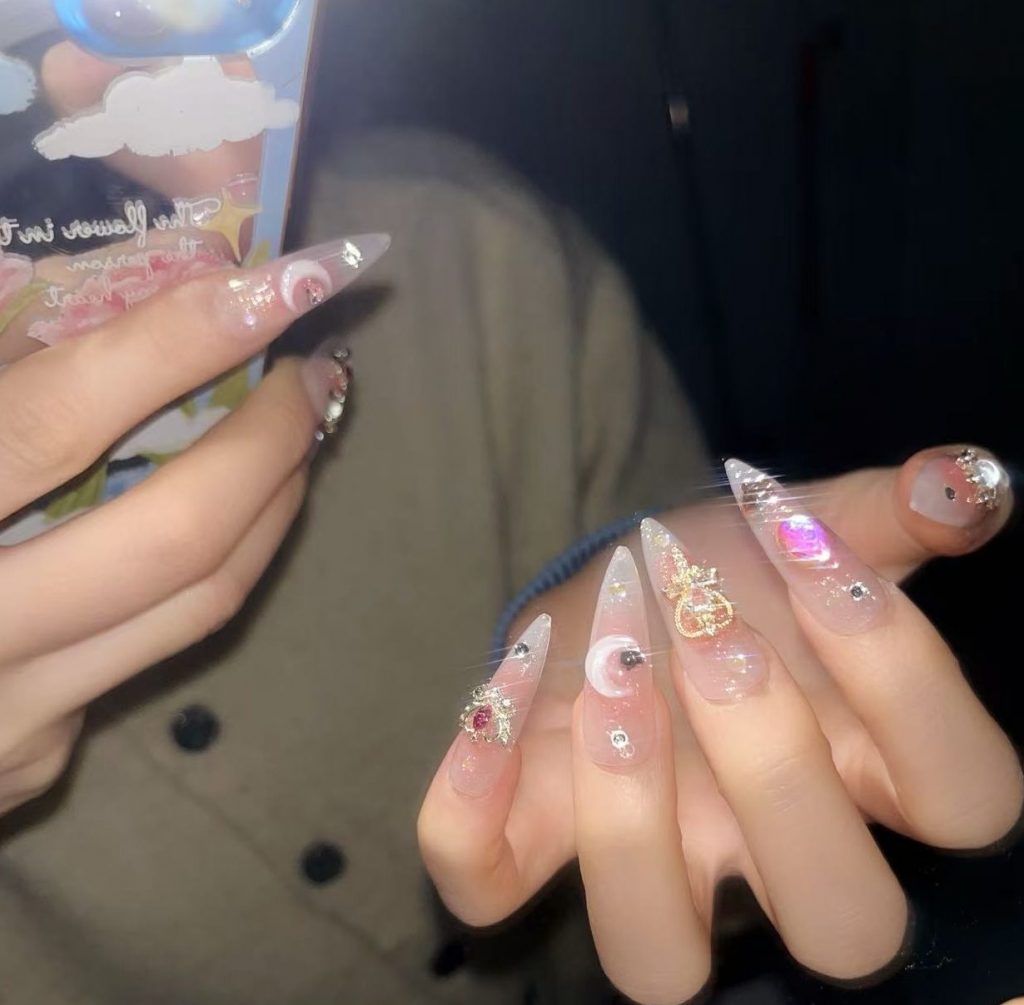
Nail art photos taken by myself

I was first introduced to social media through Instagram, where I shared my makeup, beading, handmade jewelry and nail art creations. At the time, I just thought these platforms were fun to showcase my interests and I could appreciate a lot of creativity from around the world. At first I just took photos with my phone and uploaded them, but later I would specialize in arranging the background, adjusting the light, and even learning about composition and color matching. Then I started to realize that even small daily creations can be given richer meaning and communication power through digital platforms.

“Labubu Dressup” Video

Eventually, I started to try posting videos about my nail art on TikTok. Then I posted a short video about “Pop Mart Labubu Dressup”. I bought different styles of clothes for Labubu, such as school style, uniqlo  style, winter down outfit, etc. Then, made a short video about the costume change through editing and soundtrack. My friends found it very interesting and it was a very positive encouragement for me.

Through these platforms, I’ve met many creators with interests like my own. Some are art designers, some are professional illustrators, and some are content creators who share nail art and craft tutorials through short videos. We would leave each other messages in the comment section, and sometimes we would share our crafting process or tool sources in direct messages.

Benefits and Challenges of Social Media in Education

Social media has become my own “casual classroom” in some ways. I learned more than just to make videos or content, and also how to present creative ideas and communicate with people in visual language. Some content creators would even share their process documents and color matching inspiration boards, and I started learning about “visual notes,” “color theory,” and other content that I couldn’t access in the classroom. Learning when playing and sharing made me realize that learning is not limited to the classroom, but can also be an open and interactive process.

AdvantagesChallenges
â‘  Getting Multiple Inspirationsâ‘  Easily distracted
② Building a Global Community② Information overload
③ Interactive Learning③ Privacy and comparison anxiety

Although social media has the risk of inducing comparisons and distractions. But when used wisely, it does make learning more interactive and fun.

Personalized Learning and Digital Literacy

My artwork “Memory and Place”

As a visually oriented learner, I find that the traditional “read + listen” approach is not effective enough for me. In the opposite case, when I can learn with images, videos, collages, or hands-on creativity, my focus and understanding are greatly enhanced. For example, in one of my coursework assignments, I made a collage using circular pieces of paper of different colors and textures to express the theme of “Memory and Place”. This personalized expression gave me a deeper understanding of the relationship between culture and personal experience.

After this experience, I started focusing on improving my digital literacy. In addition to knowing basic tools, I commonly use digital tools:

I am also learning how to evaluate the credibility of information sources and how to construct clear, professional expressions online. For example, in a photography course I once took at Camosun College, I was required to use D2L to upload my work and interactively critique it with my classmates, and all of these experiences have made me more familiar with how to learn efficiently and politely in a digital space.

Digital Identity and Online Profile

My digital identity is really an extension of my art practice. I will manage my presentation on social media lovingly, not just in terms of the work posted, but also in terms of how I express myself and interact with the written word. While I want to be real, I also want to show how professional I am in my beauty and creative field. For example, I will regularly update my Instagram page and think about the impact of each piece of content I post. I think maintaining a positive, credible online profile is important for both my future applications for related jobs and my personal artistic development.

As I use more and more platforms, from learning platform Brightspace, to collaboration tools like Google Drive and Discord, and social-based platforms like Instagram and TikTok. I have come to understand that different platforms have different rules and etiquette. Especially in group work, it is important to respect others’ expression, be timely, and label sources. These seemingly simple things are actually the basis for building a good collaborative relationship.

Check My Guideline for Directing the Digital Platform.
  1. Respect for copyright: cite the source when using material
  2. Constructive Feedback: Online comments must be clear, friendly and helpful.
  3. Privacy Protection: Regularly check platform permissions to avoid excessive disclosure of personal information.

Using digital platforms ethically is just about respecting others, but also about protecting yourself.

Conclusion

Thanks for reading my introduction! I’m looking forward to continuing to learn how to better express myself, connect with people, and explore more personalized and creative ways of learning in the digital era in the EDCI 338 course.