
Wild Litter
Each year the planet cries out desperately in response to the negative impact that humanity’s consumption and refuse behaviours have had on our environment. Sustainable living is key for the restoration of our planet. Responsible waste management strategies and practices are being encouraged globally. Yet, the increasing weather extremes and decreasing resources raises the question—how effective are these current efforts? As anthropology students at the University of Victoria, we have been given the opportunity to research current waste disposal practices on campus for a garbology project. Litter was something that popped out to us, so we looked at several high trafficked areas around UVic’s campus to see what and why such issues exist and what could improve local sustainability efforts .
What is littering?
UVic proved to be an excellent contemporary archeological site for the study of refuse behaviours as the area provided us with a diverse set of litter and gave us access to ample interview candidates. During our research we recovered 388 items ranging from fragmented paper, plastics and food to cigarette butts, whole containers, stationary, and accessories.

Sourced from Memes Monkey
Unfortunately, 295 of the items collected were dirty, which turned the recyclable items into landfill waste. We were also able to determine through the attributes, condition and location of each item that littering mostly happens either unintentionally or intentionally. Intentional littering can appear as abandoned clusters of trash consisting of complete, used, and broken food related items and are usually remnants of a social gathering. Unintentional littering occurs when someone puts down an item but forgets to pick it up, or when a person unknowingly drops something. Smaller objects like paper, pens, hair ties occasionally disappear from unsuspecting pockets. Some littering can happen accidentally through acts of nature. Fragmented items can easily be scattered about by gusts of wind or animal engagement; it’s not uncommon for scampish raccoons to dig through garbage for leftovers. However, accidental and unintentional litter can appear the same when lying on the ground, so it’s not always possible to accurately determine the difference without biases
Waste management policies- Are they working?
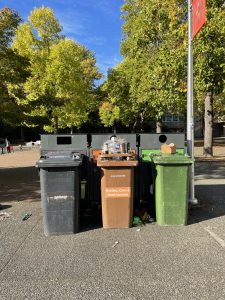
Overflowing bins found outside library entrance near the fountain.
Perhaps our most important discovery was that the waste management policies at UVic are inadvertently causing the litter issue on campus and are unnecessarily increasing landfill rates. Throughout the campus there are waste sorting stations equipped with some combination of various waste type bins. Outdoor stations are usually only equipped with a non-recyclable landfill bin, a compost bin, and a plastic/paper/metal/container bin. By collaborating with our classmates and interviewing random individuals, we were able to discern that a lack of accessible waste bins is increasing bin traffic which is discouraging proper sorting behaviours on campus. People are more likely to throw their waste in whichever bin is most convenient when they feel crowed or pressured. The sorting stations are also maintained by UVic as part of their policy towards waste reduction; however, we came across the fountain station overflowing with garbage and recycling. Some of the waste became litter while others became mixed. Interviewees also noted that the sorting stations unintentionally display unclear directions, leading people to sort their waste incorrectly. Most people were surprised to learn that sorting things incorrectly or disposing of dirty containers can turn the content of a bin into landfill.
How has COVID-19 shifted behaviours?
Nowadays, face masks can be found littered in most areas. Although masks may not be the most prominent item littered (13 out of the 388 items), they appear frequently enough to spark concern over the potential global implications. Despite being valuable indoors, disposable masks don’t often get a second thought while outside and so if they fall off an ear or out of a pocket it most frequently goes unnoticed. In addition, fear over the possible transmission of the virus has also impacted good samaritan behaviours by dissuading people from picking up unknown litter or touching bins that require the lid to be lifted.
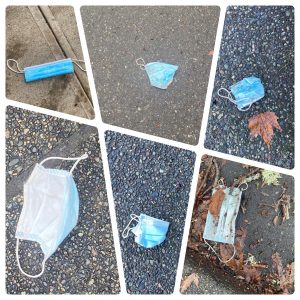
Various masks found littered along the grounds of UVic’s campus.
What can be changed?
Inefficient waste management strategies, and Covid related influences are creating planet harming disposal behaviours at UVic. Landfill rates could be lowered if mindfulness and proper sorting takes priority. To encourage meaningful waste practices, the Sort-It-Out program should re-evaluate their policies and add waste and recycle bins to reduce congestion in busy locations as well as to prevent bins from overflowing. Installing clearer signs with better detailed instructions would also help to inform individuals of proper waste disposal acts. Through these changes and with the cooperation of individuals from within the community, we can be more conscientious of our impact on the planet by shifting our behaviours to a more sustainable practice.
Sources:
Face Mask Littering. Narrated by Olivia Fraser, Winchester Journalism, 7 Oct. 2020, www.youtube.com/watch?v=WFqA3-rgLCk.
Littering. Created by Domics, 2 Feb. 2013, www.youtube.com/watch?v=CHIWmCuGSJo.
Why won’t you pick up your trash, www.memesmonkey.com/topic/littering.


0 Comments