
Can looking at patterns of why people throw away what they do help universities improve their sorting stations and change what kinds of products they sell, to work towards a more eco-friendly campus? According to the University of Victoria’s waste reduction hub, their primary goal regarding waste disposal is to “increase the waste diversion rate to 82% by Dec. 31, 2021”.
Our first study was guided by several questions. We wanted to look at whether or not people at the University of Victoria are correctly disposing of their waste – which was further broken down into trash, compost and recycling. Also, we wanted to look at if any waste was related to the current COVID-19 pandemic, and if these waste items could explain current waste disposal trends. As a team we collected the trash from CARSA, the university’s gym and climbing centre, while other teams gathered trash from other spots around campus.
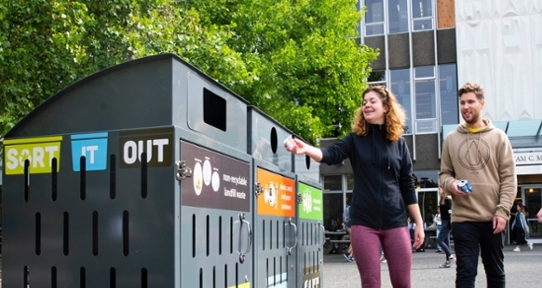
Sort-It-Out Stations are used for sorting trash on campus
After analyzing the data we found some interesting patterns. The first being an enormous 89.5% of all compostable items collected across the UVic campus (like banana peels, used paper straws etc) were sorted into the wrong bins, most often the landfill bin. This isn’t a pattern found in just the overall average of the data set either. All groups that found compostable items within their specific trash location also found that those compostable items were often incorrectly sorted. From both the campus-wide data and our own research at CARSA, we concluded that UVic does not compost properly. This does not reflect UVic’s waste reduction goals and made us wonder why the university’s waste management was not working well.
Our initial hypothesis was that this was caused by an equal mix of lack of knowledge surrounding UVic’s compost guidelines and lack of accessible compost bins. In wanting to explore this issue further we constructed a second study to understand attitudes towards waste on campus, called an ethnographic study.

There are many steps in dealing with trash in a environmentally friendly way
How do university students deal with their trash and how do they feel about it?
In our second study, we looked at people’s feelings towards UVic’s waste management system as well as their own competency. We interviewed students and non-students alike around the campus and had them complete self-report questionnaires, with questions from class discussions. After analyzing the data we found that our hypothesis was only partially correct. It is not a lack of understanding but a lack of accessibility. Most interview participants expressed that bin availability directly affects their sorting and that there are simply not enough compost bins. UVic’s campus population confidently understands composting guidelines however our study has found that convenient disposal superseded correct disposal. The lack of compost bins directly correlates to the amount of biodegradable waste that ends up in the landfill. This is not a very sustainable practice and waste diversion from landfills is an important part of climate action. It’s also an important goal UVic has set for themselves in order to make the campus more sustainable by the end of this month. Becoming more environmentally conscious and reducing landfill waste is very achievable, but needs to start with identifying where current practices are lacking and followed up by the implementation of real changes to identified problems.
What happens to your compost in a large American city and why it’s so important to climate action
What’s next?
Our two studies show that there could be definite improvements that could make our campus more sustainable. We suggest that increasing the number of bins available to the public, particularly compost bins, would be a good place to start. Also, first-year orientation could include some sort of education session, which could help increase confidence in people’s sorting skills and they would be able to use this knowledge throughout their university career. According to a UNESCO study, 91% of students report agreeing that “their place of study should actively incorporate and promote sustainable development”, so it would be beneficial not only to help our environment but could also improve students’ perception of their university.
UVic needs to address this issue if they wish to promote a more environmentally sustainable campus, so what can you do to help? Visit UVic’s Sustainability services page to educate yourself further on sustainability practices at university. You could also email wastenot@uvic.com and express your concern for the lack of accessible compost bins around campus.


0 Comments