


Garbology Methodologies:
Our garbology project at UVic started with a simple question: why do people throw away what they do? Like so many questions often do, once we started to talk about it in class this initial query lead to others: are people sorting waste correctly? How much properly deposited recycling avoids the landfill? Our team, Old Hat, focused on coffee cups deposited in the orange bin (plastics, metals, and paper). To answer these questions, we collected the contents of the orange bins on two separate occasions, documenting everything we found. Following this, we conducted surveys with students, staff, and faculty members to help understand what guides their recycling practices. Our collected trash assemblage helped further articulate what is being deposited in which conditions into the orange bin while the surveys our group conducted, along with the gathered class survey data helped us better understand the waste disposal behaviors of people who frequent the UVic campus.
Results: Point of contamination
Through comparison between our material culture findings (or collected trash) and our ethnographic survey findings, we were given a glimpse into the contradictory nature of how the UVic population views their recycling practices versus the reality of how much of their recycled coffee material actually skips the landfill. Our results showed that while our class average of ethnographic survey participants said that they were 76% certain that they practiced proper recycling procedures, our material data told a different story. Although initially we found 74% of our material culture items to be properly recycled, after taking into account the paper items (coffee sleeves/cups) that were ruined and deemed unrecyclable due to the contamination of coffee (which we found in all six of our sample bags) the percentage of recyclable items in our material culture assemblage dropped by 24% to a total of 50% properly recycled items.

This table shows the percentage of correctly sorted objects and percentage of objects that will not be recycled due to contamination.
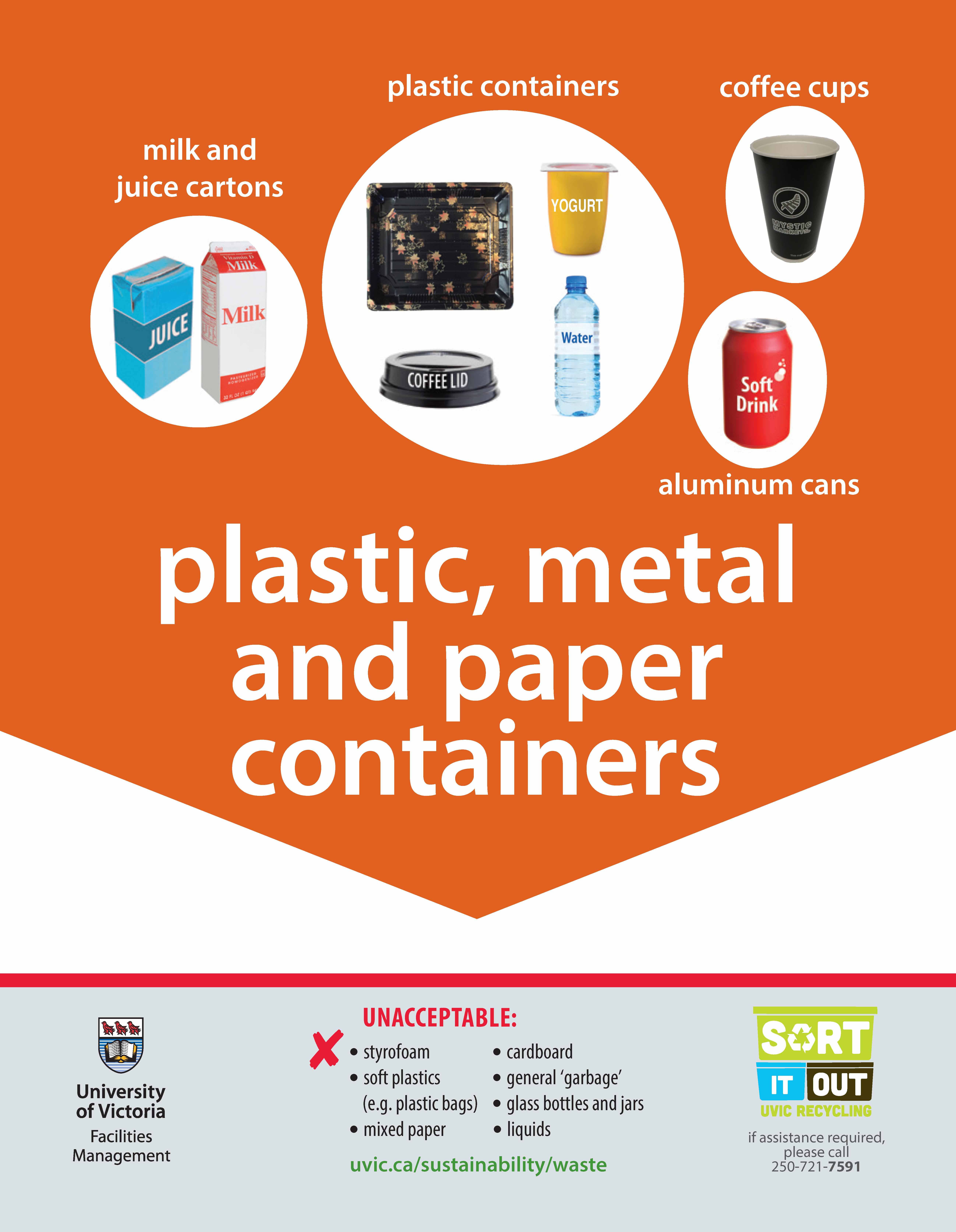
Container bin sign. Sign shows what should be deposited in the bin with large images. Unaccepted objects are written at the bottom with a small font. Sign says liquids are not accepted, but it does not specify leftover coffee must be deposited to compost bins.
Our results showed that UVic’s Sort-It-Out stations are an example of greenwashing. Greenwashing could be explained as promoting something or some practice as environmentally friendly, but in reality, they are not. Sort-It-Out stations were installed in 2019 for helping UVic reach its 2021 waste diversion goal which aims for 82% of waste being diverted. UVic hasn’t announced if the 2021 goal was reached but based on our data diversion rate in orange bins at Clearihue A Wing (our sample location) are far less than 82% (in comparison to the 50% of diverted waste we recorded as a team). Reasons for such low rates were due to unclear labeling of what items shouldn’t go into the bins, and not having enough compost bins to pour leftover coffee before disposing of cups in orange bins. UVic promotes the use of Sort-It-Out stations as a step towards a sustainable future, but because they are not effective their attempt becomes greenwashing.
Rathje’s Syndromes
While looking for psychological influences/phenomena that would help explain the discrepancy we found between our material culture findings and ethnographic survey data, we turned to the archaeologist who is responsible for creating the study of garbology in the first place. William Rathje also found a significant discrepancy when conducting research in urban households between an individual’s self-report on how much they consumed or recycled versus what he and his team found in their weekly household waste. Rathje created what he called “syndromes” to help explain this discrepancy. What he found was that while individuals often overestimated the amount that they recycled personally, they often recycled about as much as they said their neighbors did.
How to Slow the Landfill Flow
Our group also pinpointed the signage on bins as a major factor in guiding the UVic population’s recycling practices. What we currently see on bin signage is about 80% of the bin’s sign dedicated to displaying what should be going into the bin with the type of materials that shouldn’t be deposited displayed in a fine print found at the bottom of the sign. Since we chose to focus on the orange bin, which is where the majority of coffee related waste goes, we think that the soiling of paper recyclables, such as coffee cups and sleeves, can be reduced by a redesigning of the bin’s signage to emphasize that liquid coffee DOES NOT go into the Containers bin.
Solutions
The Nulla Project is a grassroots organization based in Victoria that provides a reusable coffee cup service. Customers pay a $5 deposit to partnered cafes to get a reusable coffee cup. Cups can later be returned for a $5 discount or a refund. Implementing such a practice in UVic will reduce the use of single-use coffee cups, getting over the recycling problem by creating less waste.

0 Comments