
Composting on Campus: How bad is it?
Our study
How well do you compost? How confident are you in your trash-sorting abilities? These are just some of the questions we set out to answer in our project. Each day, thousands of individuals dispose of their garbage on campus. Our first research question was what percentage of material in landfill bins on campus could have been composted. To answer this, we sorted through the contents of landfill bins at two spots, inside the Clearihue building and outside the Human Social and Development building. We chose these locations as the first is near faculty offices and the other is in a highly trafficked pedestrian area. We also surveyed eight people on campus to find out what they think of UVic’s recycling program and to gain insight of their trash sorting behaviours.
The Garbage
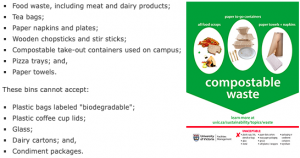
University of Victoria. This is a current copy of compostable material on campus. When not available, these compostable waste materials end up in the landfill bins.
First, look to the right to see what is compostable. In the high traffic area, 43% of the landfill waste there could have been composted. At Clearihue, only 16% of its contents were compostable but if you look closely at the chart below, our material count is skewed by 146 staples. Once the staples are removed from the sample, 53% of the landfill waste was compostable!
Staples are usually made of zinc and steel but other supplies, such as binder clips, are also made of this composite. We found UVic only provides recycling bins for aluminum and tin on campus. However, UVic’s recycled metals go to Schnitzer steel, a processing plant that works with zinc and steel. We think that UVic should incorporate zinc and steel products into their Sort-it-Out program to lessen the strain on landfill bins.
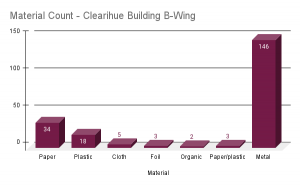
Our tabulated data counts for the Clearihue location, which houses faculty offices such as those of the Gender Studies department. Graph created by the “garbage disposal unit” group.
The Surveys
One of the most striking things we learnt was that people might be overconfident in their trash-sorting abilities. 88% of our surveyees placed themselves as a six or higher on a scale of one to ten for how well they sort their trash on campus. When asked how knowledgeable they felt about composting guidelines, 88% answered either adequate or very adequate. This doesn’t match up with the poor composting we found in our garbage analysis. Also, 50% of our surveyees did not know the soiled recyclables rule and 63% said there was a shortage of compost bins at UVic. This does add up with what we found in the landfill bins, as unsoiled paper products, such as napkins and paper plates, made up a sizeable percentage of our sample.
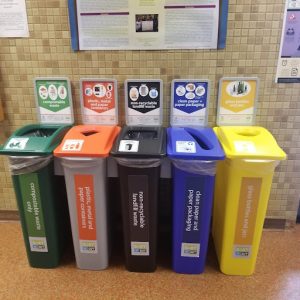
These were the waste management bins available at our second sorting location in the Clearihue building. This sort-it-out station has each type of bin available. Photo taken by Meaghan Bergman.
Recommendations
Composting
Our surveys indicated that students and faculty do not think there are enough composting bins available on campus. A simple solution that the UVic waste management team could introduce is to increase the availability of green bins. Many of the surveyed students also mentioned that they are not confident on how to properly recycle coffees cups on campus. Providing infographics of the step by step process both at sort-it-out stations and cafes could help. The attached video was created by the waste management team in 2017 and may have been successful for a short period of time but our survey shows students are still confused about the process. We recommend similar steps to be taken in educating people about recycling rules when it comes to soiled paper products such as plates and napkins.
Ariff, Nadia. October, 2017. Waste Reduction Video Series. https://www.uvic.ca/sustainability/involved/sustainability-fund/projects/csf011waste-vids/index.php
Office Supplies
The high percentage of staples found in our sample made us question what practices UVic employs to reduce office supply waste. There is only one location on campus to recycle pens and pencils but it is on the basement floor of the SUB. A solution to reduce office supply waste at UVic would be to introduce “upcycling stations”. At these places faculty could place their old, but still usable items, into designated slots where they could be reused by other faculty members, staff, or students. This would mean supplies are not being thrown out when they could be used by others.
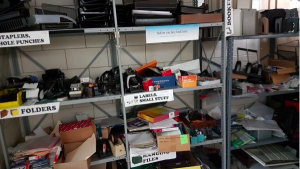
Clean River Recycling Solutions. Introducing an “Upcycle Station” at UVic would be beneficial in reducing office supply waste.


0 Comments