
![]() Does Age Matter? Understanding the Generational Differences Through Trash
Does Age Matter? Understanding the Generational Differences Through Trash
Does age matter when it comes to throwing away trash? We questioned whether or not there was any kind of significant generational differences when it came to disposal practices. This was our primary research question, our main motivator. We’d like to believe that the younger generations care more about the planet than the older generations given their incentive. After all, arguably the most recognized face of action against climate change is that of the courageous 18 year old, Greta Thunberg. At the very least, young people aren’t exactly excited about whatever the future might hold.
Discussion
Now there are things we could talk about, or ask about, when discussing disposal practices between generations. For example, do young people throw away more trash than the older generations? Or do they consume more? Perhaps it helps that the consumer economy promote consumption rates? Or maybe age doesn’t actually matter, rather, it’s the era of the world and the economy of the time – the zeitgeist. What is the current zeitgeist, anyway? If that survey from before is any indication, the feeling is that of doom and gloom, with a dash of hope. Despite the hopefulness, global mental health is at an all time low. It doesn’t help that the world is still reeling from 2020. These years revealed the world’s true colours.
Now before this spirals into an existential crisis, let’s go back to trash. Specifically, trash at the University of Victoria. Trash that had been accumulated at precise locations and had been collected at a specific time. Now as you can imagine, that description isn’t exactly a confidence inducing fact, when the entire premise is to try and collect garbage data on intergenerational waste disposal practices. Nonetheless, we had hoped to see some pattern emerge from our data. If we had begun analyzing our material culture and our data turned up inconclusive, what do we do then? The idea of joining forces with the rest of the class was initiated. That’s exactly what happened during the survey portion of our class. The surveys didn’t ask about the volume of trash in a ‘x’ amount of time. It also didn’t ask about the nature of the trash people threw out. It did, however, ask about familiarity with recycling practices. That question is a window into waste disposal behaviour.
Our Data
To compare and contrast our methods of analysis that brought us to the result of inclusivity, let’s take a look at the benefits and disadvantages to gathering and surveying.
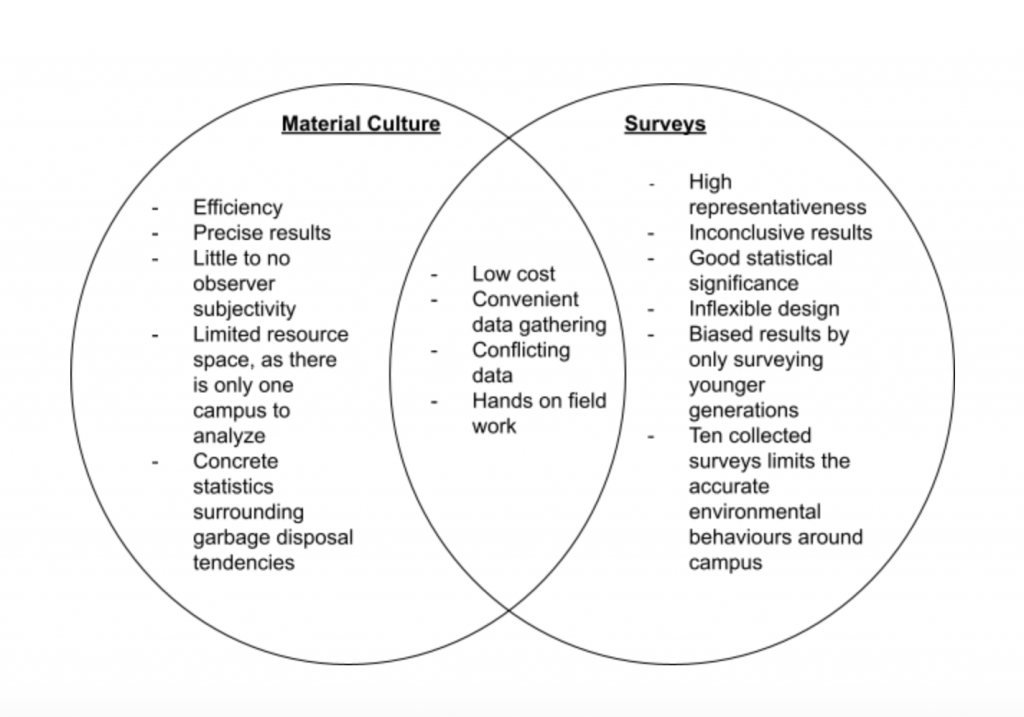
Venn Diagram depicting the advantages and disadvantages to both analysis methods practices. December 2nd, 2021.
I’ll save you from further reading. Our results were inconclusive. The results of ours, and the class, gave us no further indication of whether or not there was any generational differences written in trash disposals. The reason for this was because most of the volunteers that were surveyed were from a younger generation! Of course this shouldn’t be surprising since the survey was specific to UVic.
Results
Now, even if our conclusions were more conclusive than inconclusive, would it matter? We ask that not in the nihilistic sense, but because the survey was done on one university campus, in this part of the world, in this western culture. We would even be hard pressed to say this is representative of British Columbia, let alone entire generations.
To summarize, while the data was inconclusive, we would like to imagine that the seemingly impending doom of our planet is somewhat of a motivator for those who feel it coming. That the young people are more environmentally conscious because their lives depend on it.
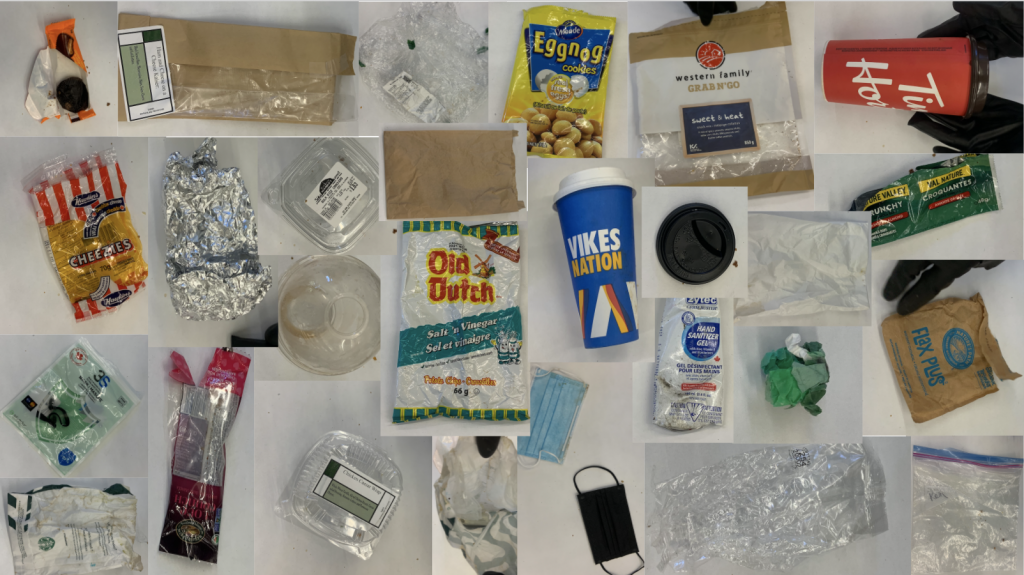
Student trash collected from the David Turpin Building. September 23rd, 2021.

0 Comments