EDCI335 Blog Post 4

Insomnia

  1. In what way are they likely to respond to the video on their own, e.g., make notes, do an activity, or think about the topic (learner-generated)?

If not prompted, I think students would be most likely to think about the topic or perhaps make notes. I think it would be fun to form an activity surrounding learners’ personal circadian rhythms (learners hypothesize and discuss what they believe the average circadian rhythm looks like, maybe?).

  1. What activity could you suggest that they do after they have watched the video (designed)? What type of knowledge or skill would that activity help develop? What medium or technology would students use to do the activity?

I think this TedEd video, coupled with a brief lesson about healthy sleep habits, would be a great introduction to the Bedtime Routine activity outlined in Pod 3s learning blueprint. I have created a template that (hopefully) learners will be able to edit on a computer or tablet to create an ideal bedtime routine using positive sleep habits and relaxing activities. After completing their bedtime routines, learners can break off into groups to offer feedback and problem-solve for things that may disrupt their new routines (sports practice, late shift, etc.).

  1. How could the video have been designed to generate more or better activity from viewers or students?

I believe providing questions that are answered either after a 30 second pause or at the end of the video would be a good way to form more activity from learners. I also think it would be great to embed a QR code that could have a quiz or series of polls for learners to interact with. It could even be cool to have a link to a game in which learners have to ensure the character’s room is best equipped for sleep (such as removing screens, closing blinds, taking an Advil for any pain, etc.)

  1. How will you address any potential barriers for your learners in the use of this video to ensure an inclusive design?

One of the biggest barriers I noticed is that the video is not well-equipped for those with impaired vision. Although the animation is an accompaniment to the voiceover, I think it is a good contribution to the lesson. If in person, I would provide tactile models of the room for learners to interact with, but in a technology-mediated setting, I would likely provide described video and share colourful and bold versions of the images with those who need it. Overall I think the biggest barrier in general is ensuring students are engaged with the content in the video. Fortunately, it is already short in length (5min), but as stated above I would love to add questions or a quiz to the video.

Reference:

Kwartler, D. (2018). What Causes Insomnia?. YouTube. https://youtu.be/j5Sl8LyI7k8?si=_7yJGQ4Q7Jth-WMe

EDCI335 Blog Post 3

How can you adjust your planned learning activities to meet the needs of your learners if an unexpected event occurs?

Considering our topic is on sleep habits and educating others on the symptoms of insomnia, I feel as though our learning activities translate well to online environments. Our initial learning activity calls for small group discussions detailing each person’s bedtime routine, along with reflections of how this may improve or impede sleep. This may do better in a technology-mediated environment to remove barriers of getting to campus/class, allows for discussions to be recorded and transcribed for better accessibility and to allow students to catch up with older course material and discussions. No extra training is needed, this is just an activity to break the ice and allow students to reflect on how their current sleep habits may affect their quality of sleep. 

The only difficulty of our main learning activity being switched to online is creating an edit-able template for the sleeping journals to ensure learners will not need access to a printer. It would be beneficial to be able to meet online in small groups or as a class to discuss the findings and experiences of the learners, but it is not necessary in the event of an unexpected event. Based on our own experiences in this course, I think it would be great to offer access to a platform like MatterMost where learners are able to ask the course community questions and just share their thoughts

Similarly to the sleeping journal activity, the learning activity in which learners create their ideal bedtime routine can be easily moved to an online learning environment by creating an edit-able template that students can fill out from the comfort of their own home. I would prefer to introduce these activities in a synchronous fashion (i.e. providing these learning activities on a zoom call or having a weekly zoom check-in) so I, as the educator, can better understand where the learners are at, if they are fully grasping the concepts provided, and to answer any questions/provide and feedback learners may require.

Blog Post 2: Direct Instruction

Direct Instruction (DI) is one of the most common teaching methods and has been recognized in education for decades. As defined by the Education Hub (2019), DI is a “systematic approach to teaching in which the teacher is very explicit about what students are to learn, the language of instruction clear, and allows teachers the opportunity to monitor their students while teaching, and to provide constructive feedback.” This is most often recognized by the following characteristics highlighted by Adams & Carnine (2003):

Meeting students at their skill level, and emphasizing mastery of the basics

Teachers make all decisions regarding lesson plans, resources, etc.

Consistent and active questions with learners (TellAsk [Merrell, 2018])

Positive reinforcement

From a layperson’s perspective, DI may look like a boring lecture or maybe watching a movie, followed by panic when the educator calls on them to answer a question. However, DI can be incredibly beneficial with certain subjects such as spelling and reading (Renard, 2023).

Based on my general research and discussions with my Pod, I believe DI does not really align with our topic. Although we aim to meet learners at their skill level, our topic and blueprint encourages a lot of Doing (Merrell, 2018) with a lot of room for mistakes, group conversations, and teamwork. Ideally for our topic learners will pursue external resources and real-life experiences on their own, or get creative (see Learning Activities) during lesson plans. However, a majority of resources made available for students comes from the educators, which is aligned with DI. Overall, I believe Direct Instruction aligns at a base level, but our blueprint has further implemented several methods to best cater to the learners’ skills and needs.

References

Adams, G., & Carnine, D. (2003). Direct instruction. Handbook of learning disabilities, 403-416.

The Education Hub. (2019). A brief introduction to direct instruction. https://www.theeducationhub.org.nz/wp-content/uploads/2019/08/Direct-Instruction.pdf

Renard, L. (2023, March 24). Direct instruction – A practical guide to effective teaching. BookWidgets. https://www.bookwidgets.com/blog/2019/03/direct-instruction-a-practical-guide-to-effective-teaching

Blog Post 1: Best Learning Experience

Prompt: Share a story about your best learning experience (could be a formal course or something more personal). Why did you enjoy it?

In elementary school, I went to an alternative learning program once a week. Although our learning was still somewhat classroom-based, Vicky– an incredibly eccentric, slightly scatterbrained, most caring teacher– would create lessons somewhat on the spot based on what the 15-or-so of us were interested in that week/month. We once spent a Friday researching the history of the Illuminati while Vicky handed out supplies tailored to each kid in the class to have us share our learning based on our individual strengths (drawing utensils, dictionaries, whiteboards, abacuses, research-specific books, bins of scrap fabric and paper!!). Fridays were the most exciting time of the week for years.

Looking back on those experiences, I would say Vicky used a combination of cognitivist and constructivist perspectives when creating lessons. She is a pretty hands-on, ‘let’s take this apart to see how it works’ kind of individual, which is how she led our lessons. She took the time to understand how each student learned, through observation and conversation, and would then tailor our learning specifically to each of us. Oftentimes, rather than leading with a lesson, we would begin with experiments or hypotheses, inviting us to create our own understanding and meaning, usually followed by a group discussion.

My best example of this was our survival unit, which lasted a month and was by far the most fun. We had been divided into teams, and were given access to survival guides and a list of items we as a team were allowed to use. Vicky had drawn several ‘islands’ on paper and laid them across the classroom, putting each team on one. There was a series of tasks, scenarios, natural disasters, and challenges we had to go through, such as surviving a severe storm with nothing but a tarp and the wilderness surrounding you (each island had its own climate, vegetation, etc), regrouping after a bear stole the food cache the team was saving for winter, and the best competition: building a model of the boats that would sail the teams to freedom and victory… if it floated the longest. I am pretty sure my team lost and accepted our hypothetical lives on our island were doomed. For each decision we made, we had to explain to the rest of the class how and why we did it, mapping out the best course of action. Looking back on it, the general setup was kind of like DnD without the dice, but either way it was an awesome experience and I still use a ton of those survival skills when camping or spending time outdoors.

Vicky is now retired, but gifted me a bucket of cool rocks before she left, bless her.

Hello and Welcome!

Hi friends! My name is Frankie and I am heading into my final year here at UVic in the Gender Studies program. I grew up on the unceded territory of the Squamish and Tsleil-Waututh nations and have spent much of my life surrounded by educators. My main area of academic focus is intersectional autism studies– as an AuDHD individual myself, I am incredibly passionate about making autism education accessible for everyone!!

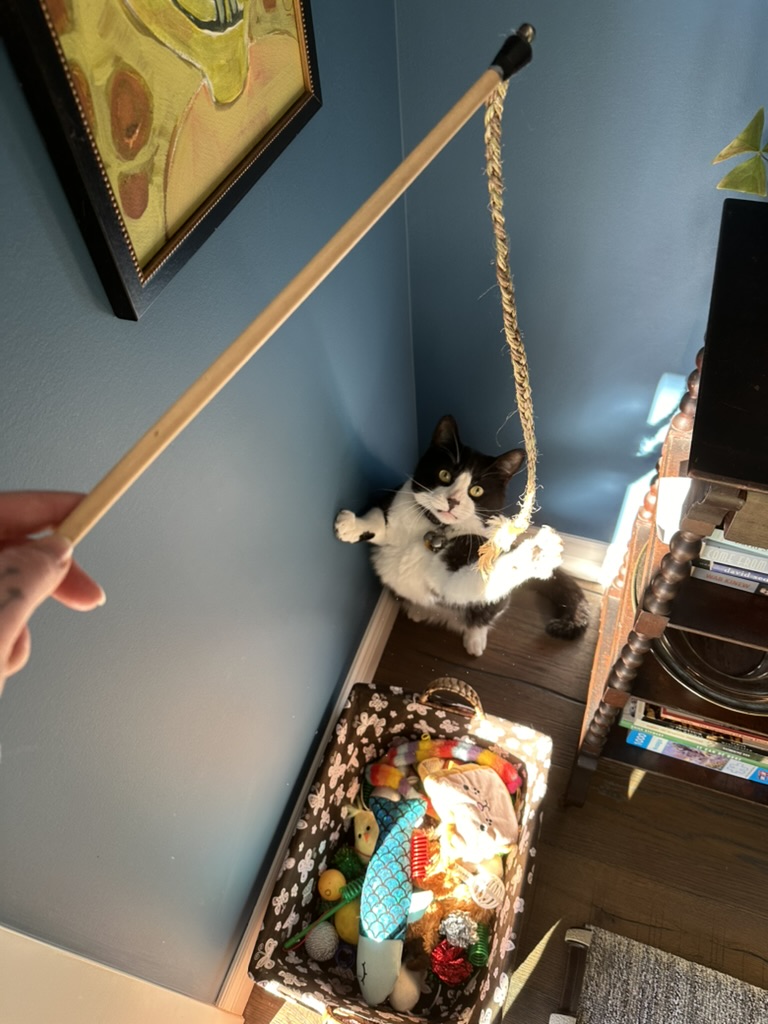
When I am not locked in on my research and coursework, you can usually find me petting random cats or doing arts and crafts! I do have 2 kitties, Thunder and Oreo, who live at home with my family, although I would much prefer if they were out in Vic with me :). I look forward to being a part of this wonderful community and learning from all of you!

Thunder^

Oreo^