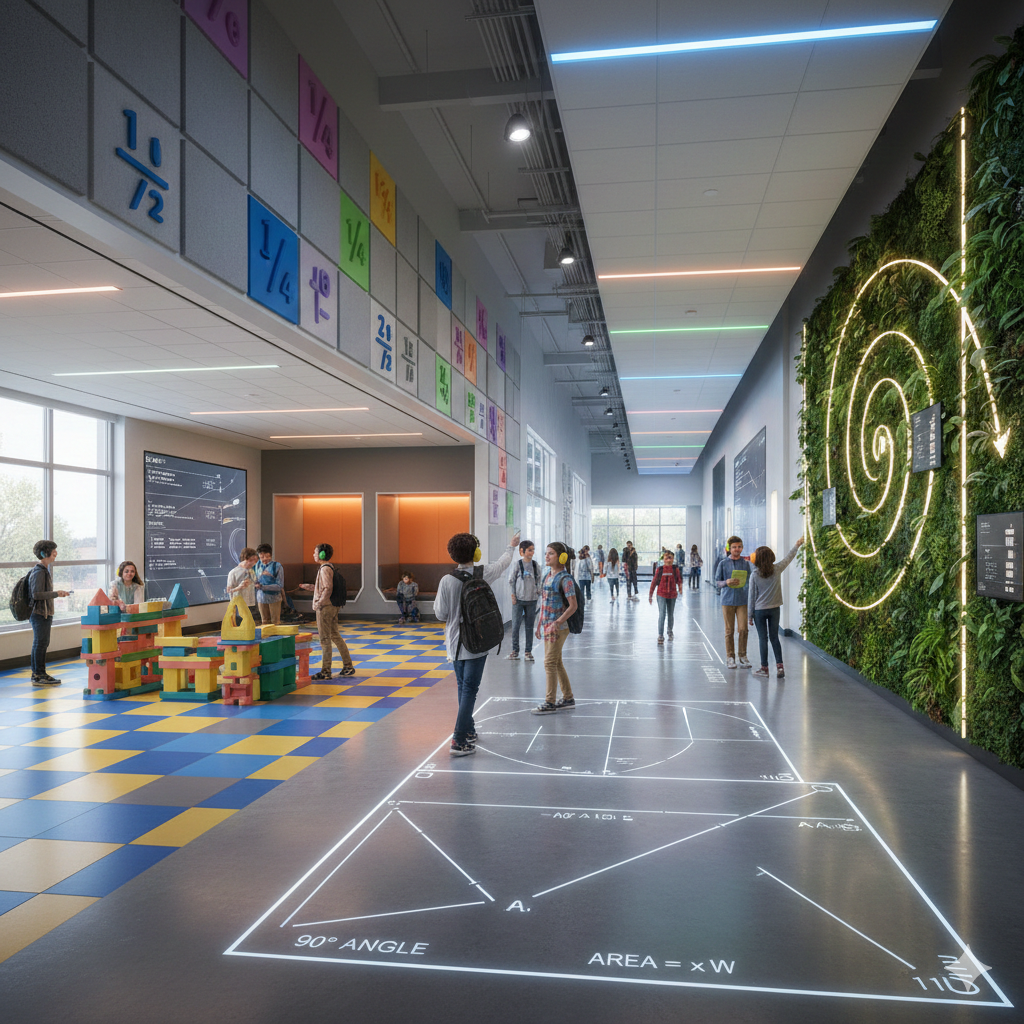
The Living Textbook (The Hallway)
Traditional hallways are often sensory minefields—high-echo, fluorescent-lit, and chaotic. Reimagining them as a math tool does two things: it provides “incidental learning” and gives purpose to transition times.
- Kinesthetic Geometry: Use floor patterns to teach angles and area. A 90° corner isn’t just a wall; it’s a labeled vertex. Floor tiles can represent a giant coordinate plane, allowing students to “walk the slope” of an equation.
- Fibonacci Spirals in Nature: Integrate “living walls” (vertical gardens) where the plant growth patterns illustrate the golden ratio and sequences.
- Acoustic Math: Use textured wall panels that dampen sound (reducing sensory overload) while visually demonstrating fractions or wave patterns.