Category: Uncategorized

  • Spring has sprung

    Alexander McLauchlan

    “Our findings also suggest that community gardens, particularly in newer suburban developments, reflect a shift in the utopian visions of postsuburban planning away from a consumerist lifestyle to a newer one that enables access to nature and sustained social connections among residents.” [1]

    I: At Satinflower Gardens

    I’m struck by the vastness. Just thirty or so minutes out from Victoria proper, Satinflower Gardens emerges from a right-hand turn in Metchosin. The acres of growing space give way to a view unlike anything you’d find in town; hills and farmland and greenery unchallenged. 

    We introduce ourselves, and before long Kristen is showing us the seed library. The names are great: Forbes (fifty best seeds under fifty!), camas (common, greater, lesser, and death), Blue-Eyed Mary, Mountain Sneezeweed, Checkermallows. And beyond the fun nomenclature, it isn’t difficult to understand how people fall in love with this work. Something is growing alongside the plants—a genuine belief in nature’s power to restore our oft-fractured social makeup. The development projects just down the road from here are almost farcical when juxtaposed with Satinflower. It’s like watching two worlds operating on different speeds.

                Chewing on some Nodding onion and contemplating its softness, we stand around a pond, trying to make out any signs of Pacific Forest Frogs. What a dream it’d be to wake up to their cries instead of an excavator making room for some long-delayed bike lane, as is the case just outside my house. Carelessly, I stumble backwards and step on some prunella vulgaris—common name Heal-all—and feel like a murderer. This transgression won’t leave the back of my mind when surveying.

    II: At UVic Family Housing

    Let’s see. There are 181 units in total. Getting to the apartment-style arrangements is beyond us at the moment, so we can just start with the townhouses. Jess and I move counter-clockwise, beginning with the hundreds, two-hundreds, and so on. I had forgotten how much fun this was. Assuming someone is a) home, and b) up to talking, it’s a thrill to watch their face light up when we explain the project. Up to ten raised garden beds (fenced, to stop deer and raccoons), designed to alleviate both the cost and the monotony of options on campus. It doesn’t hurt that a lot of residents are already gardeners, and we get no outright refusals. A law student in continuing education beams at me as he moves aside to reveal a series of potted plants sitting in his back patio. Sometimes, I make a fool of myself: Upon asking one resident if he’d support the initiative, I’m asked to turn around and bask in the aura of his three tomato plants. “There’s your answer.” 

    Understandably, not everyone wants to give out a last name, and understandably, not everyone feels comfortable speaking about a survey at all. But it’s still fun to shoot the shit. There are people from Germany, and Taiwan, and Hong Kong, and Jamaica, and Iran, and the Netherlands, and they’ve almost all got stories to share about gardening. A pattern begins to emerge around the two-thousands: I ring the doorbell, and the curtain is pulled back just enough for some elementary-aged eyes to peek back at us. The door is opened just a crack, and a small voice asks something to the effect of “who are you.” A parent arrives, gives us a smile, and asks what’s up. 

    And it’s not just casual interest. One resident sounds exhausted when she explains to me that, in the five years she’s been here, she has not once been able to secure her own plot at the CCG. Another tells me he had a plot for a while, but was discouraged by the effort required to keep it going when he would have rather done the work just outside his doorstep. These are the problems we’re here to fix.

    Stopping for a smoke at the development’s outskirts, I’m struck by just how communal the place already feels: Playgrounds, a basketball court, common areas; I hadn’t spent a lot of time here, but always assumed the ambiance would be similar to cluster housing used by students. This is different, people make their lives in family housing. What’s the harm in some new gardens? Turning up the path, southwards and towards the last batch of townhouses, a cat emerges from the forest and brushes up against my calf. Wind hits the leaves like chimes, and sunlight rips across the grass as clouds break. Spring has arrived.


    [1] Toda and Lowe, “Gardens in a postsuburban region: Community garden governance and ethos in Orange County,” 2021
  • Hello World!

    This is Food for Thought, a project that was born from the Students in Community: Engaging Meaningfully for Climate Action and Resilience program.

    We are a group of undergrads (mostly English majors) who recognize that often in the Humanities, there is a disconnect between writing or learning about something and seeing the actual impact within our communities. We frequently don’t get hands-on experience during our research, and Food for Thought has become a way to get involved with our communities – starting right here at UVic.

    Our Goals?

    Eventually, we’d love to see a few things happen on UVic’s campus. 

    Establish a learning garden behind the McPherson Library:

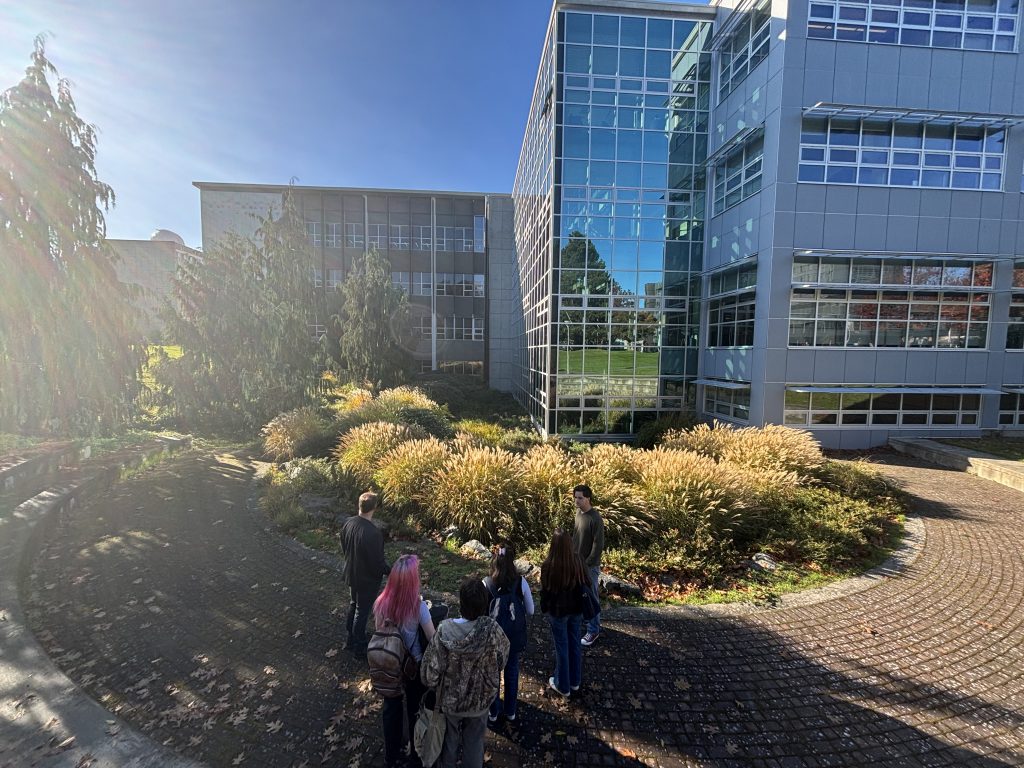
    • You know that weird swamp/grass/gravel amphitheatre area behind the McPherson Library that you can vaguely see from the Ring Road? Turns out that none of the plants in there are native species. Even more, they’re not actually doing anything there. These plants are not providing nourishment for the students, they’re not acting as a rain garden that could assist in positive climate action, and they’re not even aesthetically inspiring. 
    • We hope to slowly take out the plants in that area that aren’t doing much and, with the help of Satinflower Nurseries, replace them with native species. This process will have two benefits: the plants we put in can also be used to create paper and inks in the Farallon Book Arts Lab. There’s already been a bit of experimenting with this process by professors and librarians in the UVIC Campus Community Garden, and by expanding what we grow, we expand the learning opportunities for students on campus! The other benefit is that this amphitheatre area will actually become more of an outdoor classroom space/ learning garden. Classes from all departments and fields of study will be able to use the space as a way to get hands-on knowledge – whether it’s helping replace the plants, learning about their traditional uses, or just enjoying fresh air and sunlight while learning (instead of a windowless prison – shoutout to the ELL basement.)
      1. Create edible gardens for students on campus:
        • Imagine taking your flavourless food from Cove and adding fresh dill, parsley, or chives on top. It might actually make spending that $18 worth it. Or being able to make an entire salad with ingredients found outside your dorm. Or making a fresh cup of tea for your midnight study session with the mint you picked yourself. 
        • Food insecurity on campus is a real issue. By putting garden beds on campus, students gain the ability to eat fresh, free food. It plays into the idea of resistance gardening: the belief that growing your own food is a political, community-building, self-sufficient act that fosters resilience and challenges systemic inequalities. We also just think you should be able to eat fresh food without questioning if that money should have been saved for something else. This part of the project also involves setting up garden beds for family housing to alleviate pressure on the Campus Community Gardens and enable them to offer plots to even more people.

      Ultimately, the goal is to create hope for environmental sustainability on campus through food and learning. There have been A LOT of bureaucratic hoops to jump through, and starting is slow. Currently, we’re working on securing funding and preparing for future students to continue the project. It’s not something that will just happen overnight (although Guerrilla gardening has jokingly been floated more than a few times), but we’ve already managed to build and install a bed for someone in family housing (read about that process here)!

      This blog will (hopefully) continue to be a place where we document the experience and our progress. It’s often the case in Humanities and projects like these, where documentation gets left to the wayside in preference to the shiny, beautiful end product. But that isn’t where the learning happens. This is a case of many hands make light work – all of us are undergrads who have a lot on our plates. But little by little, we can carve out spaces on this campus built for us that encourage others to feel hope for the future. 

      If you want to get involved, email saross@uvic.ca.

    1. First Fruits

      Today — December 17, 2025 — we assembled and installed our first two garden planters for students living in Family Housing. With a skeleton crew of Stephen, Jack, and Kate, along with Stephen’s trusty little red truck, we took our 7.5’x2′ beds through rain, wind, and even a bit of sun to get the ball rolling with concrete work to help students improve their access to nutritious and rewarding food.

      Here’s one of the beds, sitting in its new home. Soil and plants will be added when the winter rains subside and the students in the unit have settled on the final location of the bed.

      Here Jack and Kate show off another of the beds inside a patio enclosure. The beds are made with 1×8 cedar boards to provide natural pest deterrence and to last a long time in the west coast weather.

      Kate and Jack show off the size of the planters (and gang signs, maybe?).

      Huge appreciation for the Emerging Learning Fund, the Community-Engaged Learning office, and the Campus Community Gardens for helping make this a reality!

      If you live in Family Housing and would like us to build you a planter so you can grow some of your own food, just email saross@uvic. ca and we’ll make it happen. #food4thought

    2. HUMA 180 Practicum Blog Post: Isabella Douglas

      HUMA 180 Practicum Blog Post: Isabella Douglas

      “We acknowledge and respect the Lək̓ʷəŋən (Songhees and Xʷsepsəm/Esquimalt) Peoples on whose territory the university stands, and the Lək̓ʷəŋən and W̱SÁNEĆ Peoples whose historical relationships with the land continue to this day.”[1] This is what we hear constantly as students or faculty at the University of Victoria, but what does it mean not only in the context of the Indigenous peoples’ histories but also in relation to the history of this institution? The question is all the more pressing since the history of the Lək̓ʷəŋən peoples predates the university by so much it is in effect an independent story. 

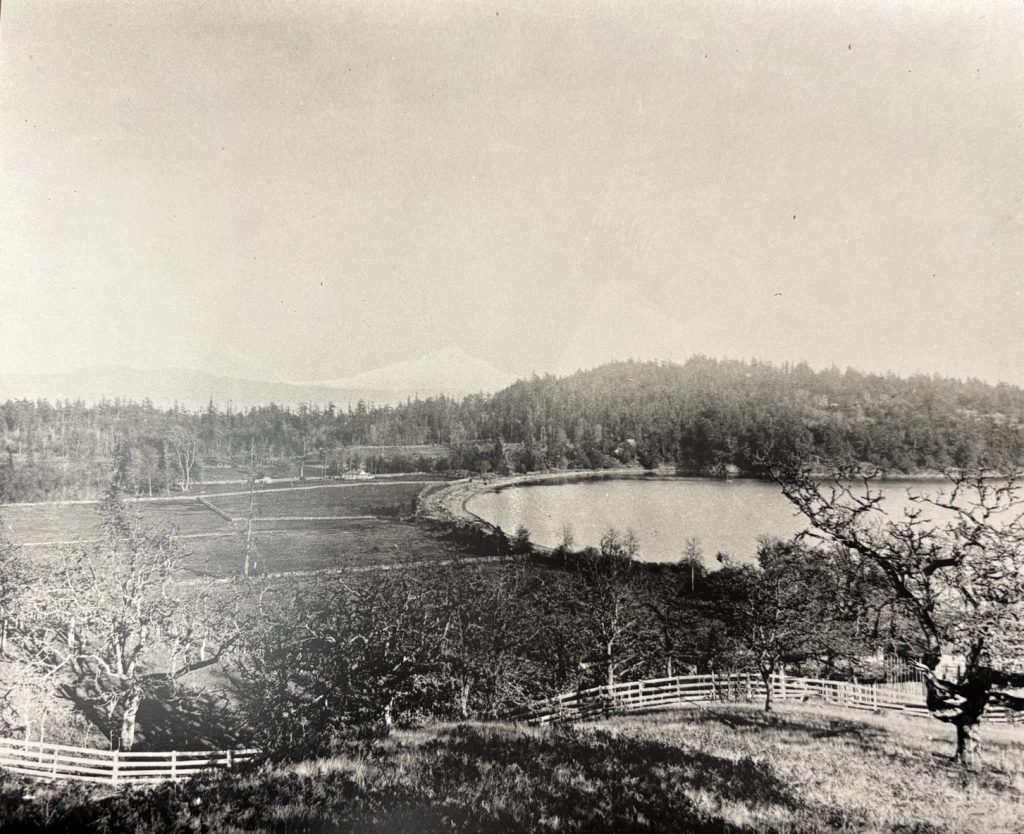
      Beginning in the early 19th century, the Lək̓ʷəŋən peoples were composed of many smaller groups. They each occupied certain areas around southern Vancouver Island; however, for the purposes of this post we will focus on the Chekonein peoples. They lived around Cadboro Bay, up to Cordova Bay, and around the university campus, with 24 different burial and village sites throughout this area. There was a village and burial site at Cadboro Bay, called Sungyaka, meaning snow patches. It was an important winter village used for fishing and hunting. The Chekonein peoples relied on the fish, the shellfish, the waterfowl and seal. The bay later became known as Cadboro Bay after James Douglas’ ship, which he used to survey sites for Fort Victoria in 1842. [2]

      Cadboro Bay in 1870 – Found in the University of Victoria’s Special Collections and Archives

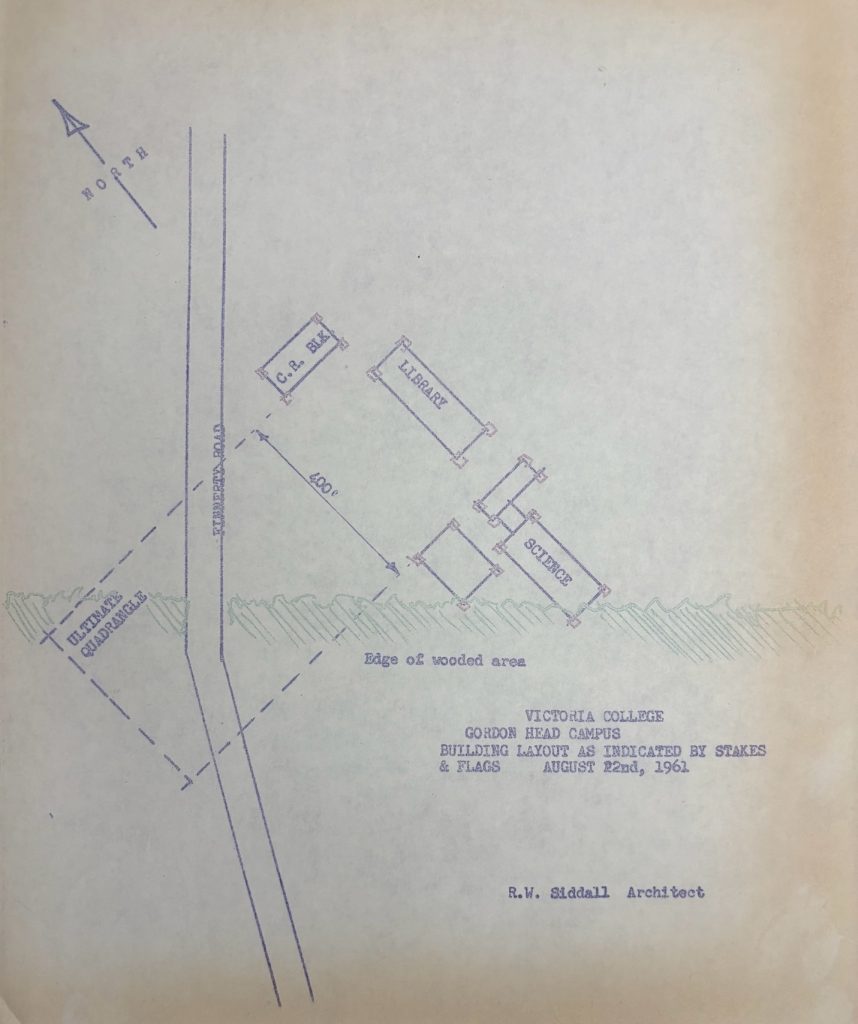
      Only a couple of years later, the Chekonein peoples relocated to Victoria Harbour to be closer to Fort Victoria’s trading post. Unfortunately, due to the ever-growing settler population, the Chekonein peoples were forced to relocate many more times. In 1911 the Lək̓ʷəŋən peoples were paid a nominal sum and forced to move onto a reserve. Over the last 200 years the village and burial sites have been mostly destroyed, and the Indigenous populations were decimated by the intentional spread of smallpox, leaving little archaeological evidence remaining. Nevertheless, there are clear indicators that the Chekonein peoples had a smaller village on campus where the Elliott building parking lot is today.[3]It was used as a base to hunt and gather things like deer and camas roots, which were found on the southeast side of what is now campus.[4] As settlers took over the land that would become UVic’s campus, it changed hands in parcels and was at one point co-occupied by the Hudson’s Bay Company and the Canadian military, who used it as a training camp during the Second World War. The land was finally purchased for the university between 1959-1961, initially housing just one portion of Clearihue, the Elliott building, and the McPherson Library. 

      Original Gordon Head Campus layout – Found in the University of Victoria’s Special Collections and Archives

      The construction of the university in the early sixties was organized by Victoria College, which had been working in junction with UBC since 1920, meaning that if you earned a degree from the college, you would have a diploma from UBC. When the Gordon Head campus was opened in 1963, it was the first independent university on Vancouver Island, and the original Lansdowne campus where Victoria College was, is where Camosun College is today.[5]

                  In the end, knowing the overarching history of this land and the university, provides a more active and personal acknowledgement when recognizing the Lək̓ʷəŋən peoples’ connection to this place. It allows us to fully respect the history of the Indigenous peoples who have been on this land for time immemorial and reminds us to make a conscious effort toward reconciliation. Additionally, it allows us to build a connection with the university and recognize the increasing respect the University shows toward local Indigenous populations, cultures, and histories. The Food4Learning project’s goal is to create a learning garden behind the library that can act as a space not only to learn about the past but also about how this land was used before a colonial presence was established. Ideally this garden would grow plants with historical and educational significance, including many that were traditionally used by the Lək̓ʷəŋən peoples. The objective would be to create a modern-day connection to Lək̓ʷəŋən peoples’ past while also finding easy everyday ways to take small steps toward climate action.

      Sources

      “Cadboro Bay.” InteractiveResource. University of Victoria, B.C., Canada. Accessed November 13, 2025. https://bcgenesis.uvic.ca/cadboro_bay.html.

      UVic.Ca. “Culture & Protocol – VP Indigenous – University of Victoria.” Accessed November 13, 2025. https://www.uvic.ca/ovpi/ways-of-knowing/culture-and-protocol/index.php.

      University if Victoria (B.C). University of Victoria (B.C) fonds. Special Collections and University Archives, University of Victoria Libraries, Victoria, British Columbia.

      University if Victoria (B.C). Gordon Head Exhibit Project. Special Collections and University Archives, University of Victoria Libraries, Victoria, British Columbia. 


      [1] “Culture & Protocol – VP Indigenous – University of Victoria,” UVic.Ca, accessed November 13, 2025, https://www.uvic.ca/ovpi/ways-of-knowing/culture-and-protocol/index.php.

      [2] “Cadboro Bay,” InteractiveResource, University of Victoria, B.C., Canada, accessed November 13, 2025, https://bcgenesis.uvic.ca/cadboro_bay.html.

      [3]1995-034, box ¼, folder 1.12, Gordon Head Exhibit Project. Special Collections and University Archives, University of Victoria Libraries, Victoria, British Columbia.

      [4] 1995-034, box ¼, folder 1.11, Gordon Head Exhibit Project. Special Collections and University Archives, University of Victoria Libraries, Victoria, British Columbia. 

      [5]1984-021, box ¾, folder 3.1, University of Victoria (B.C) fonds. Special Collections and University Archives, University of Victoria Libraries, Victoria, British Columbia.