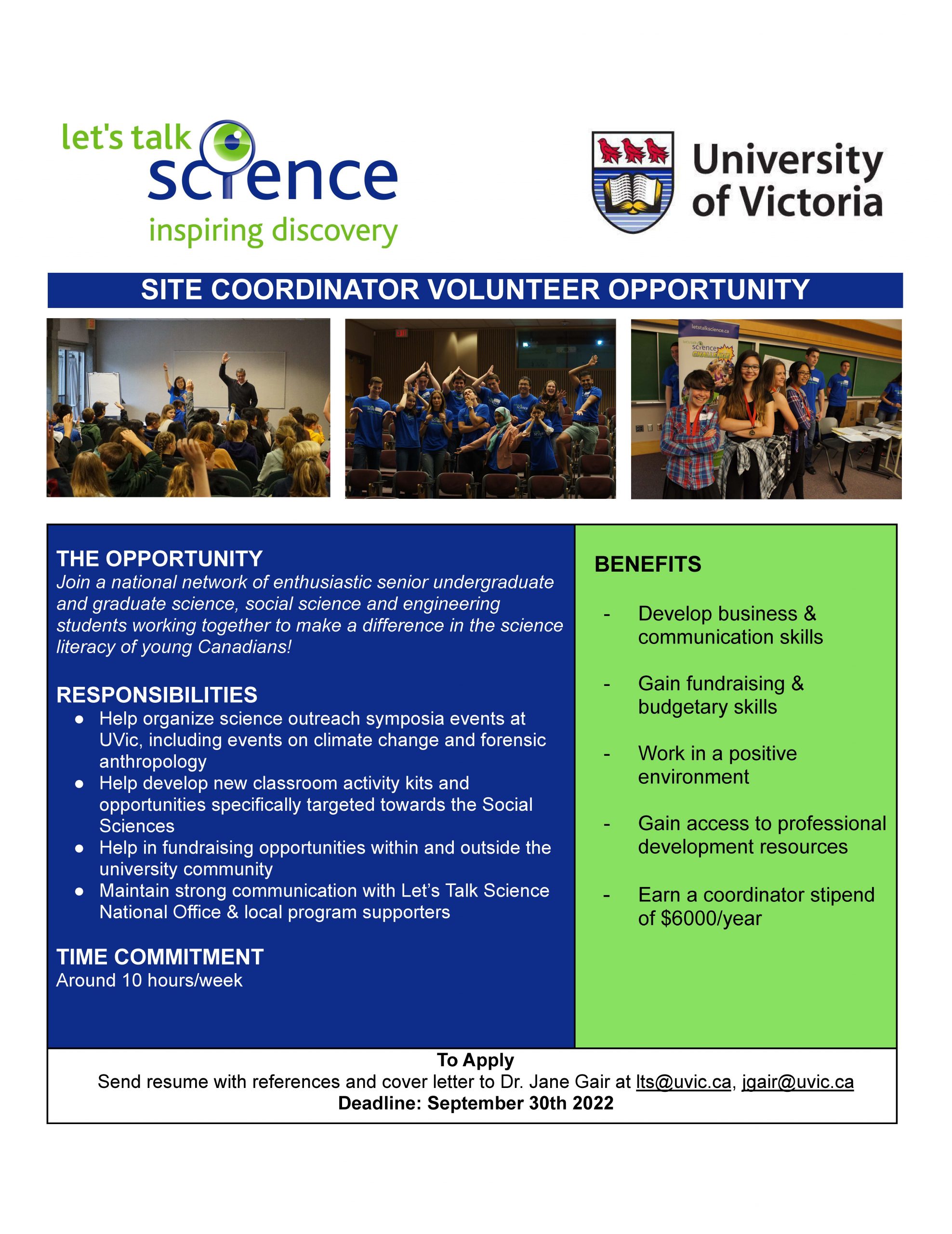
Canadian Association for Girls in Science (CAGIS) is recruiting volunteers in Victoria!

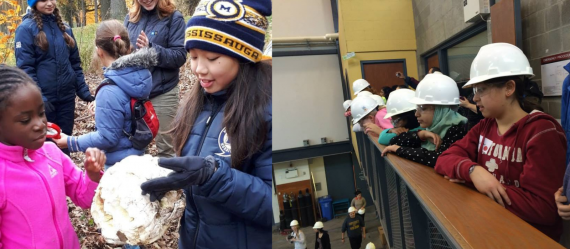
CAGIS is an award winning not-for-profit organization that supports interest in Science, Technology, Trades, Engineering, and Mathematics (STEM) among girls and gender nonconforming youth with local clubs that visit labs, workshops, and field sites to meet mentors and do fun, hands-on activities.

Volunteers help to plan, organize and assist at these local events, and act as role models and mentors to the youth participants.

Learn more and apply here to volunteer:  https://girlsinscience.ca/volunteer/

Please contact the local club at Victoria@GirlsInScience.ca with any questions, or check out our website for more details.

Canadian Association for Girls in Science (CAGIS)

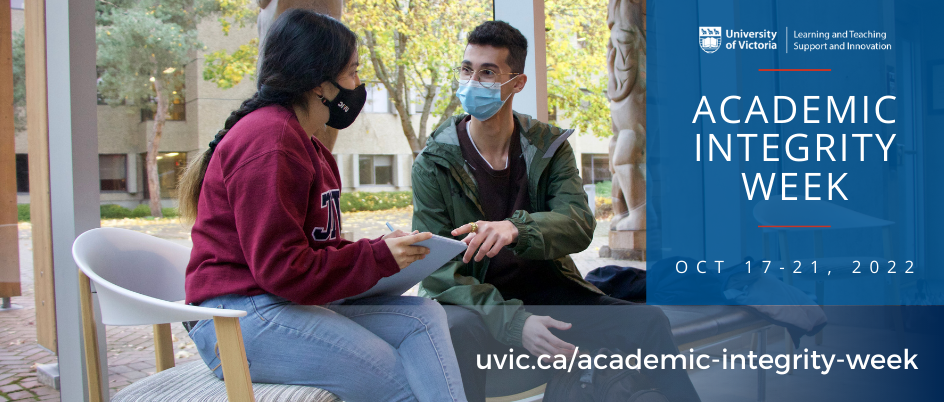
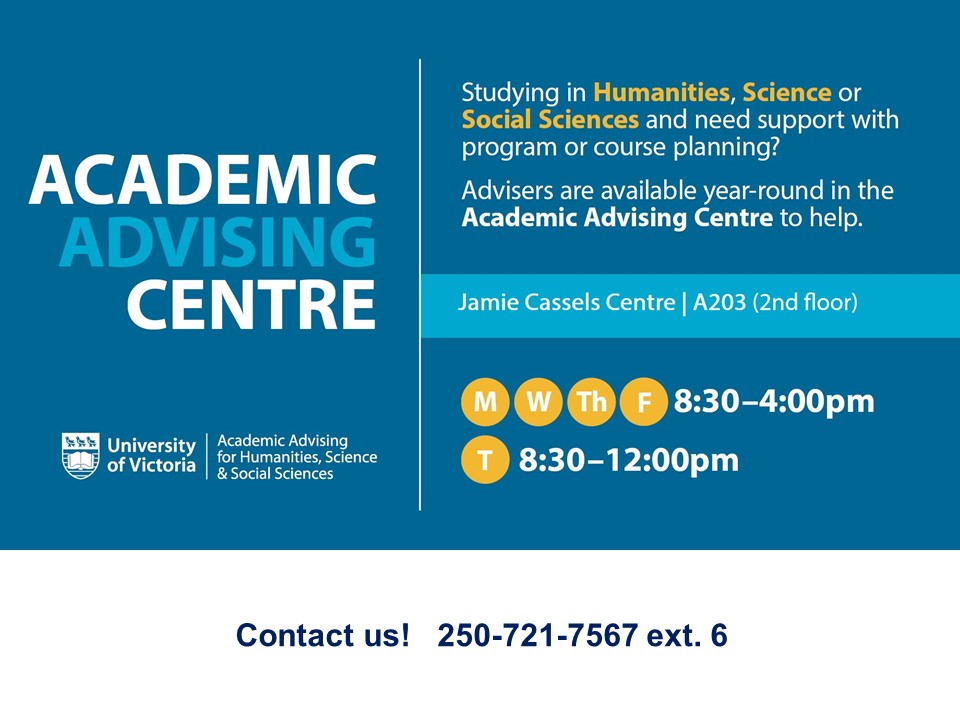
Academic Integrity Week – Oct 17-21, 2022

Join us for a week of events and initiatives involving students, instructors and staff, showcasing how UVic ensures academic integrity to protect your intellectual property. Events will include awareness building and prevention strategies.  Find a list of events for students here:
https://www.uvic.ca/learningandteaching/about/home/eventsworkshops/academic-integrity-week/index.php


What is Academic Integrity?

Academic integrity is foundational to scholarship within the post-secondary environment. It refers to a standard of commitment and behavior in accordance with the values of honesty, trust, fairness, respect, responsibility, and courage in learning, teaching and research (ICAI, 2014). As such, academic integrity is central to the mission of the university in developing new knowledge and in creating a strong academic environment that strengthens students’ intellectual and moral development. Beginning in first year, students are mentored into integrous processes to recognize and attribute the contributions of others as well as ways to assure the integrity of their own intellectual work.

Seminar – Juewen Liu – Monday October 17, 11:30am

The Chemistry Seminar Program brings visitors from across Canada and beyond to present seminars in their area of expertise.  The seminars are open to everyone, including undergrad students.

Monday October 17
11:30 am
David Turpin Building A110

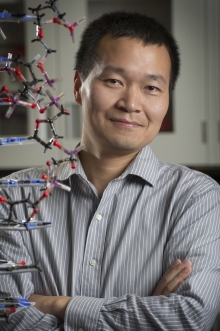
Juewen Liu
University of Waterloo
http://www.science.uwaterloo.ca/~liujw/index.html

“DNA adsorption on gold nanoparticles, graphene oxide and metal oxides”

Understanding and control of DNA adsorption on surfaces and nanoparticles is critical for biosensor development. This seminar covers detailed studies on three types of important nanomaterials. DNA adsorbs on gold nanoparticles via very strong base coordination. Such strong adsorption led to kinetic controlled processes. DNA as an interesting block copolymer with many negative charges has interesting self-assembly properties as a function of ionic strength, pH and temperature, all of which have been used to promote DNA adsorption to gold. Such understanding has led to not only better conjugation methods but also better biosensors. DNA adsorbed on graphene oxide via hydrogen bonding along with pi-pi stacking, while they adsorb to metal oxides via phosphate backbone binding along with some base interactions. Some literature reported sensors are reviewed and some sensing mechanisms were found to be incorrect due to a lack of attention to fundamental DNA adsorption mechanisms.

Seminar – Oleksandr Voznyy – Thursday October 13, 11:30 am

The Chemistry Seminar Program brings visitors from across Canada and beyond to present seminars in their area of expertise.  The seminars are open to everyone, including undergrad students.

Thursday October 13
11:30 am
David Turpin Building A110

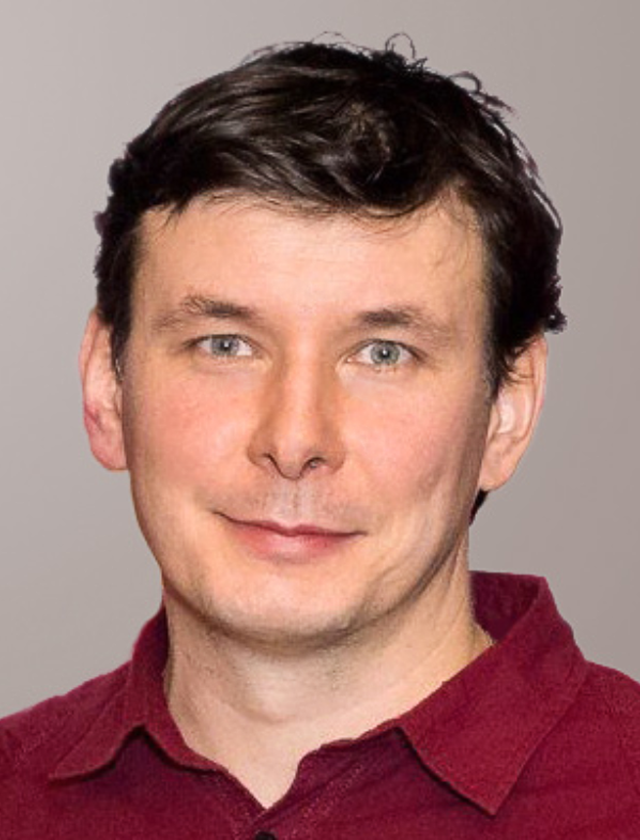
Oleksandr Voznyy
University of Toronto, Scarborough
http://www.mapageweb.umontreal.ca/waldronk/Files/Home.html

“Applications of machine learning for studying phase stability in energy materials”

There is a growing demand for design and discovery of new materials that can replace their costly counterparts without the loss of performance. Focusing on clean energy applications, our experimental efforts show that in catalysis, batteries and photovoltaics, even minor changes to the material composition (using alloying or doping) may bring substantial benefits to materials’ performance.  However, it is becoming increasingly evident that traditional trial and error methods are simply too inefficient, given the vastness of the chemical combinatorial space, where human intuition is often inadequate to capture the trends in materials properties.  We find that having one tool that could predict formation energies and bandgaps for arbitrary materials, provided the accuracy is adequate, could help address a host of problems in a vast range of clean energy applications.  In this talk I will present our efforts in developing such a tool and the advances we’ve made in improving the accuracy of such predictions (in particular, formation energies). I will also demonstrate how this simple tool can be used for predicting battery cathode voltages, solid electrolytes ionic conductivity, solar cells phase stability, and catalysts’ stability in acid.


3M National Student Fellowship

The 3M National Student Fellowship honours up to ten full-time undergraduate students at Canadian institutions who have demonstrated outstanding leadership and innovation through seeing current needs in higher education or society and implementing change in their lives and at their university. These students embrace a vision of quality education that enhances their academic experience and beyond.

Fellowship recipients receive $1000 (to be spent at their discretion) and are invited to join other award winners at the annual conference of the Society for Teaching and Learning in Higher Education (STLHE). They will also participate in a 3M National Student Fellowship Program summit. Awardees will receive a contribution towards their cost of travel to and accommodation during the conference.

Application deadline is November 30.

For more information visit https://onlineacademiccommunity.uvic.ca/LearnAnywhere/3m/.


Seminar – Karen Waldron – Sept 26, 11:30 am

The Chemistry Seminar Program brings visitors from across Canada and beyond to present seminars in their area of expertise.  The seminars are open to everyone, including undergrad students.

Monday, September 26
11:30 a.m.
David Turpin Building A110 and Zoom (see link below)

Karen Waldron
University of Montreal
http://www.mapageweb.umontreal.ca/waldronk/Files/Home.html
“Crosslinked proteolytic enzymes for microscale proteomics applications”

Proteolytic enzymes are routinely used to cleave the potentially thousands of proteins in a biological sample into smaller, more manageable peptide fragments. This facilitates their separation and identification by nano-HPLC, capillary electrophoresis (CE) and/or mass spectrometry (MS). This process, called peptide mapping, is one of the steps used in the workflow for identifying, quantifying, characterizing or probing the function of proteins in the vast field of proteomics, specifically “bottom-up” proteomics. Insoluble proteolytic enzymes (i.e., trypsin, chymotrypsin, pepsin, Lys-C, Asp-N, etc.) offer several benefits such as limited autolysis, reusability and rapid digestion because high enzyme-to-substrate ratios can be used. The added advantage of adaptability to microreactor formats and microfluidic platforms comes from using glutaraldehyde (GA) to crosslink enzymes and render them insoluble instead of immobilizing them on solid-phase supports. In 2004 we reported a multi-step GA-crosslinking procedure for trypsin and compared its specific activity and peptide maps to trypsin immobilized onto GA-functionalized glass beads. The procedure was later adapted for chymotrypsin to digest nanomolar concentrations of fluorescently labelled protein substrate with peptide mapping by CE laser-induced fluorescence (LIF) detection. A GA-chymotrypsin microreactor was fabricated in a capillary column by programing reagent delivery in a CE instrument. Despite the ease in making GA-crosslinked trypsin and chymotrypsin “particles”, their re-use for multiple digestions has been problematic. Our successes and setbacks will be discussed, as well as our efforts to improve the robustness of the crosslinked enzymes using a Design-of-Experiments (DOE) approach to investigate the experimental parameters in our multi-step crosslinking method.

This seminar will be live streamed on Zoom.
https://uvic.zoom.us/j/83657240884?pwd=3pDZp5892dS4gsAKoaplX1t2j9kgbh.1
Meeting ID: 836 5724 0884
Password: 379943

View the full list of seminars at https://events.uvic.ca/chemistry/.