Tag Archives: Information

Steel the Show: Understanding the Potential for Steel Reuse in Canada


by Ariya Kosavisutte
The construction industry is one of the largest generators of waste globally. Canada alone produces over four million tons of construction, renovation, and demolition waste (CRD) every year. As an industry, we are beginning to recognize that a traditional linear model, where resources are used and discarded at the end of its life, is simply unsustainable. This is driving a shift towards a circular economy approach which takes on a regenerative framework that focuses on extending material life and minimizing waste through reuse and recovery. Within construction, this implies focusing on strategies that divert waste from landfills by reclaiming building materials and reintegrating them into new construction.

Within the circular economy framework, there are several waste management strategies. The two most common ones are reuse and recycling. While these terms are often conflated, they have different implications. In the waste management hierarchy, reuse is placed above recycling as it entails using materials or objects in their original, or close to original form, whereas recycling involves remanufacturing materials into new secondary products. From an environmental perspective, recycling consumes more energy (e.g., steel is melted in an electric furnace), making reuse a more preferrable approach. In fact, studies find that reusing steel can reduce greenhouse gas emissions by 75%. 

Rationale for Steel. Among the various materials used in building construction, steel presents itself as an ideal candidate for reuse. Steel is a strong, durable material with high structural integrity. It is also an engineered component that is amenable to disassembly, lending itself to reuse. Apart from the environmental benefits of reusing steel as previously mentioned, reused steel can also help reduce material costs for projects, with its price being 50-75% the cost of new steel. 

Continue reading

Introducing Better Ways to Build in Canada  

As part of the Best Practices in Building Systems project, we are thrilled to launch the Better Ways to Build in Canada podcast. At their core, housing systems are about people: the people shaping technologies, policies, and ways of working that affect how we live. As a component of the BPiBS project, the podcast explores the role of relational humility, reciprocity, and building relationships in these systems. Each episode, host Elisabeth Girgis speaks with an expert or changemaker with decades of experience in building systems, standards, and policy. They explore what drives their work, how they got there, and what is needed now to move from big ideas to real action in meeting Canada’s housing needs.    

The podcast kicks off with Dr. Phalguni Mukhopadhyaya, Professor of Civil Engineering at the University of Victoria and a leading researcher in building envelope design, who shares how empathy, emotional intelligence and design thinking are just as essential as technical skills. Since then, Elisabeth has spoken with leading science communicator Rhonda Moore on rebuilding trust in science, with architect and researcher Susane Havelka on self-built housing in Northern Canada, and with builder Rod Nadeau on lessons we can learn from tradespeople — and why affordability and sustainability goals go hand in hand.  It is part of this collaborative initiative led by BC Housing and the University of Victoria, supported by the government of Canada’s Housing Infrastructure and Communities Canada, Research and Knowledge Initiative.  

We invite you to listen, follow the show, comment, share, or answer one of the surveys in the show notes. Stay tuned for more episodes that will share fascinating insights from experts advancing change in housing and building systems, including guests such as CHBA’s Senior Director of Net-Zero Housing, Sonja Winkelmann and mechanical engineer Martin Roy.  

When we build with care, we all thrive.  

Listen Now on Spotify Listen also on IHeart Radio

Listen to selected Episodes:

Building a Sustainable Future: Energy and Thermal Systems in BC Homes

The Challenge: Energy and Emissions in BC’s Buildings

Buildings have a significant impact on the environment in British Columbia (BC), accounting for around 25% of the province’s energy use and about 19% of its greenhouse gas emissions. Most of this comes from heating, cooling, and hot water systems. Recent weather events, like the heat wave in 2021, have shown us how outdated building designs can make us vulnerable to climate change.

BC, like other parts of Canada, faces the important challenge of making homes both affordable and able to withstand climate-related issues. The good news is that there are effective solutions available. These include heat pumps, solar panels, better insulation, and smart energy controls. These technologies can help lower energy costs, cut down on emissions, and make our homes more comfortable throughout the year. The current focus is on expanding the use of these solutions, especially in older buildings that were not designed with energy efficiency or climate resilience in mind.

Building’s Energy and Thermal Systems

Energy and thermal systems form the heart of every building. They include the technologies and design features that regulate temperature, air quality, water heating, and overall comfort, while managing how energy is used.

Continue reading

Whole-System Thinking in Sustainable Building Design

When we think of sustainable buildings, the conversation often begins and ends with energy efficiency and the integration of renewable energy systems, such as solar panels on the roof or high-performance insulation in the walls. A building is more than just the sum of its individual components, thinking in isolation. 

True sustainability can be achieved by designing buildings as unified systems. Energy, water, structure, exterior, and health don’t exist in isolation. A key focus should be on how energy, water, structure, and health systems integrate to create sustainable, resilient, and people-centred design. Usually, these individual building components interact in ways that are often unexpected. A truly sustainable building conserves resources while ensuring a healthy condition for its occupants. More holistic thinking is needed in the design and operation of buildings, moving away from isolated component-based design toward viewing them as a single unit.  

A unified building design encompasses five thematic areas and their interdependencies, which will be discussed in more detail below. 

Continue reading

Learning to Drive Change and Best Practices in Housing

When BC Housing asked me to speak about change leadership, I faced a familiar challenge: how do you measure progress when the path forward isn’t predictable? Construction professionals know this tension well : balancing immediate needs with the long-term, and working across sectors that don’t always speak the same language.

This week’s conversation at the MBAR roundtable (Mobilizing Building Adaptation and Resilience (MBAR) | BC Housing) ranged widely in approach: structured results pyramid, community consensus and personal sense-making. Each has its value. I chose to speak about why we in the BPiBS project are putting energy into learning KPIs.

Traditional KPIs have long served me well. When I first led a project and program management office, they gave clarity and accountability. Activities led to outputs, outputs to outcomes, outcomes to impact. That chain works for well-bounded projects. But the housing system is not a tidy chain. It is a shifting landscape.

The reality is: change is not easy. It means balancing priorities, stepping outside comfort zones, and moving forward even when the way isn’t clear. In my own work, this has meant championing the environment as a building code objective, drawing attention to under-representation in design, and supporting reconciliation through First Nations’ self-determination in asset decisions. None of these were in a plan, but each became possible by paying attention in the quiet moments, asking what would truly move the work, and trusting the skills and support around me.

BPiBS exists to mobilize best practice knowledge. The project is not a regulatory effort. It does not force actors to collaborate. Instead, it helps knowledge move across domains so the simplest path forward becomes more visible—even when it isn’t the easiest.

Continue reading

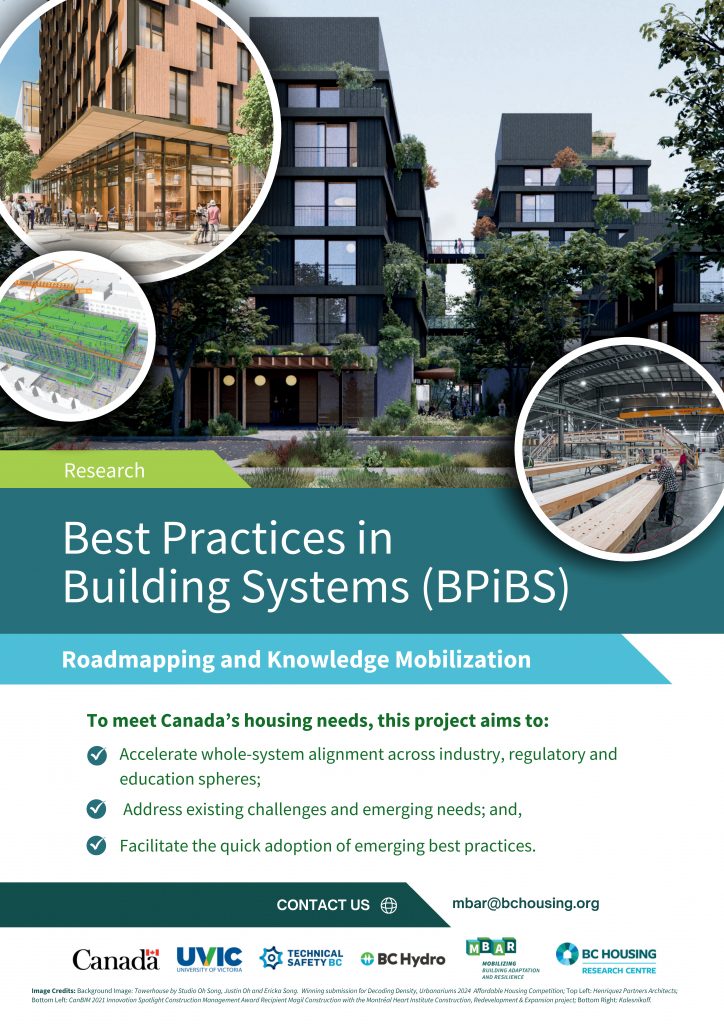
A Primer on BPiBS

Canada’s housing system is complex: it is shaped by regulatory, economic, social, and technological forces, all of which are interdependent on one another. There are numerous, diverse actors in this system, from builders, engineers and designers to planners, researchers and non-profit organizations. How can these actors more closely align to address the country’s pressing housing needs? And how can we ensure that emerging best practices in building—such as modular construction and mass timber—are adopted quickly and widely?  

The Best Practices in Building Systems (BPiBS) project is developing a data-driven roadmap that will support strategic coordination across these diverse spheres, while also facilitating the rapid adoption of emerging best practices in building. The roadmap will provide opportunities for scenario testing and ongoing inquiry related to building housing that is inclusive, accessible, sustainable, and resilient. BPiBS is an interdisciplinary, collaborative project led by BC Housing’s Research Centre, with the University of Victoria serving as a key research partner.  

BPiBS is designed to be responsive and dynamic, with a deep commitment to listening: the roadmap will be informed by engagement sessions and workshops with a diverse range of housing and building stakeholders. The project is also developing a database to organize insights about current challenges, future needs, and emerging opportunities in building systems, which will be incorporated into the roadmap. These insights will encompass a wide range of themes in building systems, including health and lifestyle elements, building exteriors and grounds, building forms and structures, water and waste systems, and energy and thermal systems. 

The roadmap’s design will continue to evolve as insights about building systems are collected. Follow our updates here to learn more about the project’s progress and the BPiBS team.