When we think of sustainable buildings, the conversation often begins and ends with energy efficiency and the integration of renewable energy systems, such as solar panels on the roof or high-performance insulation in the walls. A building is more than just the sum of its individual components, thinking in isolation.
True sustainability can be achieved by designing buildings as unified systems. Energy, water, structure, exterior, and health don’t exist in isolation. A key focus should be on how energy, water, structure, and health systems integrate to create sustainable, resilient, and people-centred design. Usually, these individual building components interact in ways that are often unexpected. A truly sustainable building conserves resources while ensuring a healthy condition for its occupants. More holistic thinking is needed in the design and operation of buildings, moving away from isolated component-based design toward viewing them as a single unit.
A unified building design encompasses five thematic areas and their interdependencies, which will be discussed in more detail below.
When BC Housing asked me to speak about change leadership, I faced a familiar challenge: how do you measure progress when the path forward isn’t predictable? Construction professionals know this tension well : balancing immediate needs with the long-term, and working across sectors that don’t always speak the same language.
This week’s conversation at the MBAR roundtable (Mobilizing Building Adaptation and Resilience (MBAR) | BC Housing) ranged widely in approach: structured results pyramid, community consensus and personal sense-making. Each has its value. I chose to speak about why we in the BPiBS project are putting energy into learning KPIs.
Traditional KPIs have long served me well. When I first led a project and program management office, they gave clarity and accountability. Activities led to outputs, outputs to outcomes, outcomes to impact. That chain works for well-bounded projects. But the housing system is not a tidy chain. It is a shifting landscape.
The reality is: change is not easy. It means balancing priorities, stepping outside comfort zones, and moving forward even when the way isn’t clear. In my own work, this has meant championing the environment as a building code objective, drawing attention to under-representation in design, and supporting reconciliation through First Nations’ self-determination in asset decisions. None of these were in a plan, but each became possible by paying attention in the quiet moments, asking what would truly move the work, and trusting the skills and support around me.
BPiBS exists to mobilize best practice knowledge. The project is not a regulatory effort. It does not force actors to collaborate. Instead, it helps knowledge move across domains so the simplest path forward becomes more visible—even when it isn’t the easiest.
BPiBS project members recently had the privilege of attending the BeaCon Annual Conference 2025, held August 19–21 in Edmonton. The program was rich with community-driven innovation, breakout sessions and hands-on activities centered on startups, entrepreneurship and relational leadership. It was both inspiring and strategically valuable as an opportunity to introduce our BPiBS work on the KIND and CIV database development approach, especially at the current state of the project implementation.
A key focus for our team was connecting with technical and startup initiatives that resonate with our tech development of the graph database and CIV tool…
Last week of July, our team had the privilege of joining the international CSCE/ISARC/MOC 2025 conference in Montréal—a gathering of about 500 interested in both technical excellence and a widening circle of innovation. Our formal presentation, Advancing Knowledge Mobilization through Road Mapping, focused on the knowledge repository model and emerging logic for structuring a robust, responsive database.
The surrounding conversations, questions, and side sessions reminded us of the plurality within the building system. Discernment to move data to knowledge comes from how we work and learn as much as the database we are building.
A heartfelt thanks to Dr. Thomas Froese (photo) who carried our project forward in the presentation room. Dr. Froese walked through an overview of the project, the logic of the knowledge model and our shift toward emergent, rather than rigid, roadmapping – a direct challenge to the often-reductive impulse in systems change. Rigid roadmapping, while effective in stable contexts, can become a structural barrier in complex systems change.
On Tuesday evening last week, while on my way to a community event, my phone rang. It was an automated call from the local government’s emergency operations centre. Living on the west coast of Vancouver Island, I’m signed up for tsunami and earthquake alerts, which typically arrive on Friday mornings as part of a routine test. But this was a Tuesday—and it wasn’t a test.
The message said a Tsunami Advisory had been issued. The threat level was unknown, and we were advised to stay alert for further information. I paused to check updates from news outlets, email, and social media where I learned that an 8.8-magnitude earthquake had struck off Russia’s Kamchatka Peninsula. Having been through a similar situation before, I mentally reviewed my emergency checklist, confirmed the location of our emergency kit, and contacted loved ones to ensure they too had received the alert. Despite the uncertainty, I felt at ease.
The Best Practices in Building Systems (BPiBS) project team was delighted to participate in the 3rd Annual Community Energy Co-operative Canada (CECC) AGM and Community Energy Forum held at Royal Roads University from July 31 to August 2, 2025. The event gathered experts, community leaders, researchers and policymakers to discuss innovative pathways and practical solutions for community-owned renewable energy systems.
On July 17, 2025, members of the BPiBS project team attended an important public event “Beyond the Carbon Tax: Charting a New Course for Climate Action in BC” hosted at the IESVic (University of Victoria). Organized by IPAC Victoria in partnership with Accelerating Community Energy Transformation (ACET), the evening drew a full audience for a timely and urgent discussion on the evolving direction of climate action in British Columbia.
You might not expect a housing strategy to start with philosophy—but when you’re trying to solve complex problems across many sectors, disciplines, and timelines, it turns out ideas matter. A lot.
As someone who works at the intersection of systems, policy, and implementation, I spend a lot of time asking: How do good ideas spread? What makes change stick? Why do some solutions scale while others stall out, even when they work? These aren’t just technical questions—they’re questions about how people think, relate, and act in systems that are always shifting.
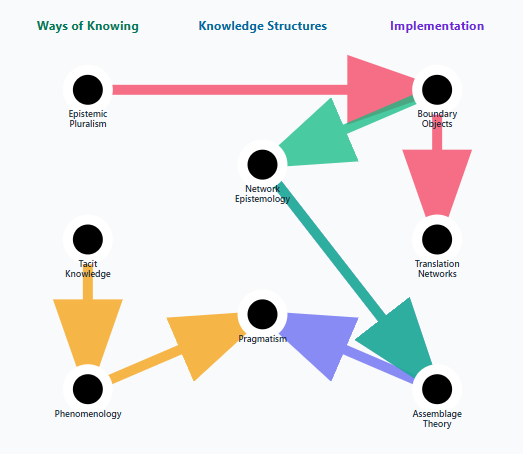
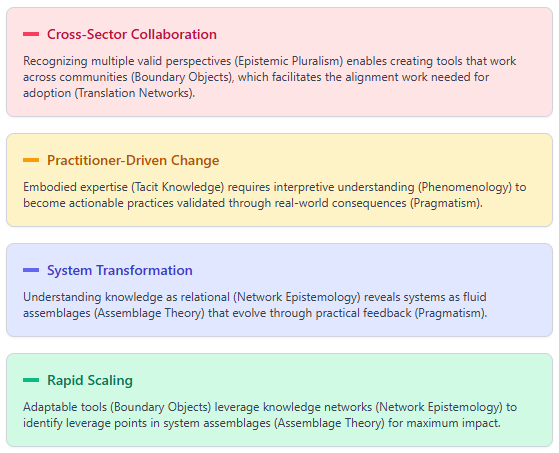
To explore that, I’ve pulled together this interactive map. It brings to life the hidden logic behind our work: how knowledge is created, how decisions are made, and how we might accelerate what works—without forcing what doesn’t. Some of these ideas come from philosophy or cognitive science. Others are rooted in everyday practice—listening to builders, planners, residents, and policymakers as they navigate real-world constraints and opportunities. This isn’t about academic theory for its own sake. It’s about sharpening the tools we use to coordinate across silos, tailor solutions to context, and recognize those key moments when the system is ready to shift. It’s the kind of behind-the-scenes sensemaking that makes strategies more adaptable, partnerships more fruitful, and outcomes more aligned.
These concepts relate as constellations : structures that help us navigate complexity while staying grounded in purpose. They illuminate paths toward alignment, but they also acknowledge the tension and quiet grief that often accompany meaningful shifts in direction. In my experience leading multi-stakeholder initiatives, the real work of transformation isn’t just technical; it’s relational. It requires us to move with both decisiveness and care, recognizing that growth often involves loss: of familiar processes or tools, of timelines that no longer fit, or of the unspoken comfort of the status quo. By examining the concepts at play, we can guide adaptation thoughtfully, without losing what makes individual contributions matter.
If you’re working at how to better connect insight to action, or how to build structures that are both rigorous and responsive—this may help.
Canada’s housing system is complex: it is shaped by regulatory, economic, social, and technological forces, all of which are interdependent on one another. There are numerous, diverse actors in this system, from builders, engineers and designers to planners, researchers and non-profit organizations. How can these actors more closely align to address the country’s pressing housing needs? And how can we ensure that emerging best practices in building—such as modular construction and mass timber—are adopted quickly and widely?
The Best Practices in Building Systems (BPiBS) project is developing a data-driven roadmap that will support strategic coordination across these diverse spheres, while also facilitating the rapid adoption of emerging best practices in building. The roadmap will provide opportunities for scenario testing and ongoing inquiry related to building housing that is inclusive, accessible, sustainable, and resilient. BPiBS is an interdisciplinary, collaborative project led by BC Housing’s Research Centre, with the University of Victoria serving as a key research partner.
BPiBS is designed to be responsive and dynamic, with a deep commitment to listening: the roadmap will be informed by engagement sessions and workshops with a diverse range of housing and building stakeholders. The project is also developing a database to organize insights about current challenges, future needs, and emerging opportunities in building systems, which will be incorporated into the roadmap. These insights will encompass a wide range of themes in building systems, including health and lifestyle elements, building exteriors and grounds, building forms and structures, water and waste systems, and energy and thermal systems.
The roadmap’s design will continue to evolve as insights about building systems are collected. Follow our updates here to learn more about the project’s progress and the BPiBS team.
BPiBS project team was excited to take part in the CHBA Home Building Week in Canada 2025, a national gathering of industry leaders, policymakers, innovators, and researchers focused on the future of housing in Canada. Our participation reinforced and deepened the strategic direction of the BPiBS initiative, which aims to accelerate whole-system alignment across the housing sector. The themes explored, such as Net Zero innovation, modular pathways, code reform, municipal benchmarking, equity, and Indigenous partnerships directly correspond with BPiBS’s interdisciplinary and iterative approach to knowledge mobilization.