
Introducing KIND: Knowledge Integration Networks for New Directions and Designs
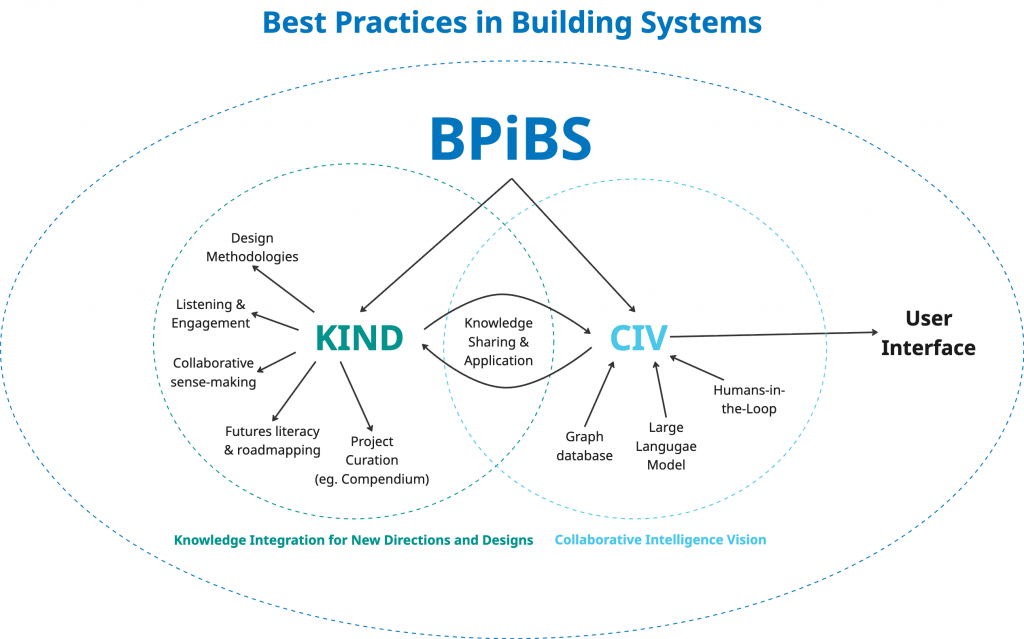
Born out of the BPiBS project, KIND is the living, human-centered knowledge field that gathers, nurtures, and evolves the knowledge, relationships, and practices across the housing and building systems. It’s the space where people come together, through listening, learning, and other forms of engagement, to share lived experiences and insights, and to build futures literacy, including hearing from the edge of dominant systems. KIND supports learning as the foundation for change, helping knowledge evolve in response to real-world needs, strengthening cross-sector connections, and enabling practical action toward more resilient housing systems.
CIV, in turn, is the digital tool integrated alongside KIND, designed to help improve how human wisdom is shared and applied. It’s the digital compass that helps navigate all the knowledge gathered, transforming information into intelligence, through discernment, to deliver useful, practical outputs. While KIND keeps the human-knowledge ecosystem alive, CIV ensures that those connections and insights are organized, accessible, and implementation-ready to fuel change in housing systems. Its architecture enables navigation across multiple layers of data, from discrete relationships and insights to synthesized system-level views, supporting both in-depth analysis and broad contextual understanding.
In essence, KIND is the living, breathing heart of the initiative, and CIV is the control board that helps distil and apply what KIND nurtures.
The Broader Purpose
KIND connects participatory and computational methods. It links approaches such as foresight, listening sessions, design thinking, and collaborative facilitation with data-informed tools like vector databases, knowledge graphs, systems mapping, and complexity-based analysis.
This combination supports sensemaking, pattern recognition, and context-aware decision making. It is designed not to predict fixed futures, but to enhance our ability to navigate complexity and engage with change in meaningful and adaptive ways.
BPiBS has highlighted the need for new ways of imagining, designing, providing, building, maintaining, and renewing housing systems. KIND offers a space for co-designing those ways together, supporting housing systems that are more affordable, adequate, high-quality, and environmentally sustainable.
This project is funded in part by the Government of Canada through the Research and Knowledge Initiative (RKI), delivered and supported by Housing, Infrastructure and Communities Canada to advance housing and infrastructure projects across the country.
Our team works across the unceded territories of many Indigenous Peoples, including the Algonquin Anishinaabe (Ottawa), Mississaugas of the Credit, Haudenosaunee, and Huron-Wendat (Toronto), Musqueam, Squamish, and Tsleil-Waututh (Vancouver), kʷikʷəƛ̓əm (Coquitlam), lək̓ʷəŋən and W̱SÁNEĆ Peoples (Victoria), and the Tla-o-qui-aht and Nuu-chah-nulth Nations (Tofino).
We recognize that land acknowledgment is not the work itself, but a reminder of our ongoing responsibilities—relational, material, and ethical—to the peoples and places that continue to steward these lands.
We commit to unsettling extractive habits in our work and to walking, with humility, toward deeper accountability.