
By Madelaine Prince
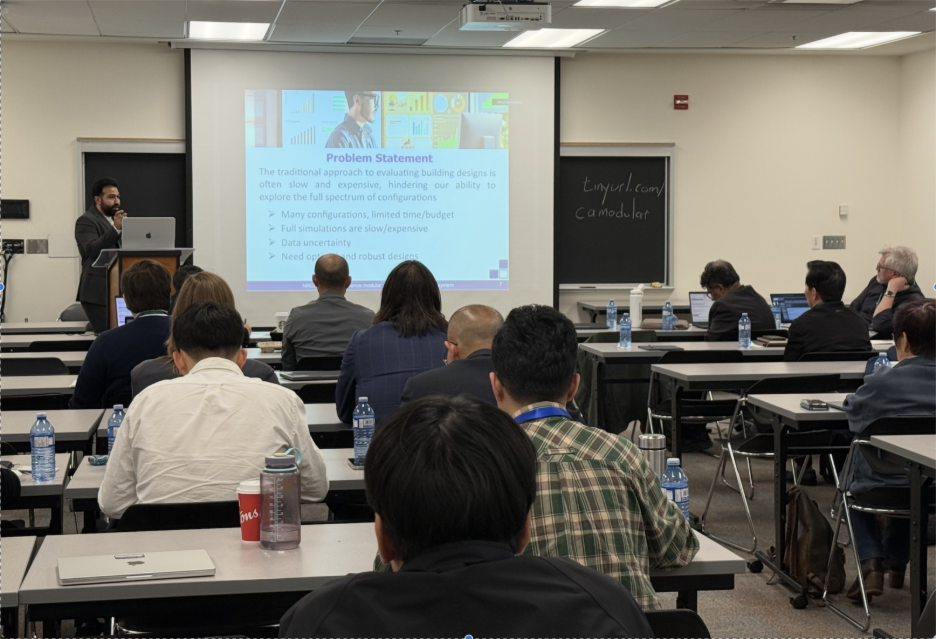
In late September, members of the BPiBS team participated in the High-Performance, Energy-Efficient, and Carbon-Neutral Modular Buildings Workshop hosted at the University of British Columbia (UBC). The initiative brings together experts across structural engineering, materials science, building science, mechanical and electrical engineering, and climate resilience to develop modular technologies that are faster to construct, lower in emissions, and more affordable, advancing both Canada’s housing and sustainability goals.
The workshop is part of an $8.27 million national research initiative led by UBC’s Department of Civil Engineering, in partnership with the University of Victoria (UVic) and the University of New Brunswick (UNB). Supported by Natural Resources Canada (NRCan), the National Research Council (NRC), and a broad network of industry collaborators, the project is driving innovation in high-performance, low-carbon modular building systems to accelerate sustainable housing solutions across Canada.
The research program is organized around four interconnected themes that bridge science, engineering, and practice:
- Theme 1: Development of high-performance, energy-efficient modular structural and non-structural components and systems.
- Theme 2: Quantification of energy use and greenhouse gas (GHG) emissions in modular buildings.
- Theme 3: Operational monitoring and optimization of energy performance and carbon emissions.
- Theme 4: Design, implementation, and knowledge mobilization for high-performance modular construction.
From the UVic Department of Civil Engineering, Dr. Thomas Froese and Dr. Phalguni Mukhopadhyaya, both BPiBS project leads, are contributing to the initiative. Specifically, Dr. Froese is supervising research to develop a tool to optimize the energy efficiency, cost, and GHG emissions of building systems, conducted by PhD student Abdulrahman Sati. Dr. Mukhopadhyaya is supervising research on super insulations in modular constructions, conducted by PhD student Meysam Khatibi.
For the BPiBS team, the workshop offered valuable insights into the opportunities for modular building in Canada and how these connect with broader system transformation efforts across the country’s building sector. A key takeaway was the need for stronger cross-sector collaboration and shared understanding between disciplines. Developing common language, improving coordination, and investing in the “soft skills” that enable effective collaboration were identified as some of the most challenging, but also most essential, factors for advancing successful project outcomes. These reflections closely align with and validate patterns emerging from BPiBS’s ongoing research, which similarly emphasizes the importance of integration, communication, and collective capacity-building across the home building ecosystem.
The project will culminate in a full-scale prototype modular building and a comprehensive design guide, resources that will help builders, policymakers, and communities adopt sustainable modular solutions more widely across Canada.