
How our “ontology & topology” help connect the dots.
With a live example from a Knowledge Mobilization guide. by Alex Dekin
What is the BPiBS Database?
Think of the database as a living knowledge map for housing systems. Instead of keeping documents, topics and insights in folders and spreadsheets, we capture them as nodes (information entities) and draw relationships between them. This makes it possible to see patterns and to ask better questions while looking for information related to housing domain. We’re building an interlinked database for BPiBS that treats housing information like a map of things and connections. The “ontology” sets the rules (what kinds of topics exist and how they relate). The “topology” shows the actual pattern of links across topics, stakeholders and references.
Two simple ideas: Ontology & Topology
Ontology (the rules) — the structure of our map. It defines the types of nodes, their properties (like name, description, source), and which relationships are best to use between them. For example, a Guideline can be PART_OF a Reference, and Information_Elements or References can be ASSOCIATED_WITH Topics. This keeps entries consistent and queryable.
Topology (the shape) — the actual web of connections we build in practice. It shows where clusters form (e.g., “Reference” domain organizes related research initiatives, guides and reports), how the spine of the topic ontology – the Topic Tree, provides a structure for navigation and where cross-links braid topics together with audiences and activities.
The Topic Tree: our organizing spine
Our Topic Tree organizes content across Building, Delivery, Digital, Environmental and Social systems:
Building Systems: Concern the physical forms, structures, and exteriors that shape how buildings interact with their environment and occupants, emphasizing resilience, adaptability and cultural responsiveness.
Delivery Systems: Encompass the processes, supply chains, governance mechanisms, and institutional pathways through which housing is financed, regulated, and built, ensuring that innovation and best practices move effectively from concept to implementation.
Digital Systems: Focus on data, automation, and AI-enabled tools that enhance decision-making, coordination, and transparency across the housing lifecycle, supporting smarter, interoperable and more responsive systems.
Environmental Systems: Address the ecological and energy dynamics of buildings, including carbon management, water and waste cycles, and climate resilience, ensuring housing contributes to sustainable and regenerative environments.
Social Systems: Integrate the human, cultural, and community dimensions of housing, emphasizing inclusivity, health, equity and relationships that make built environments livable, just and connected.
Example entries include:
- Planning and Design Phases (Delivery Systems)
- Integration of Housing Policy with Urban Planning (Social Systems)
- Building Envelope and Insulation (Building Systems)
- Biophilic Design and Connection to Nature (Environmental Systems)
- Digital Codes and Automated Permitting (Digital Systems)
- Off-Site and Industrialized Construction (Delivery Systems)
- AI and Data Analytics (Digital Systems)
These aren’t just listed headings, in the Database they’re clickable nodes that other pieces of evidence can connect to.
A concrete example: connecting a Knowledge Mobilization guide
To show how this works, we recently added the document Resource Guide: Knowledge Mobilization Activities (University of Waterloo, Water Institute https://uwaterloo.ca/water-institute/sites/default/files/uploads/documents/c018883_water-network-knowledge-mobilization_final-ua.pdf).
In our Database:
- The Guide appears labelled as a Reference and Information_Element, with properties like name, description, and a URI (the source link).
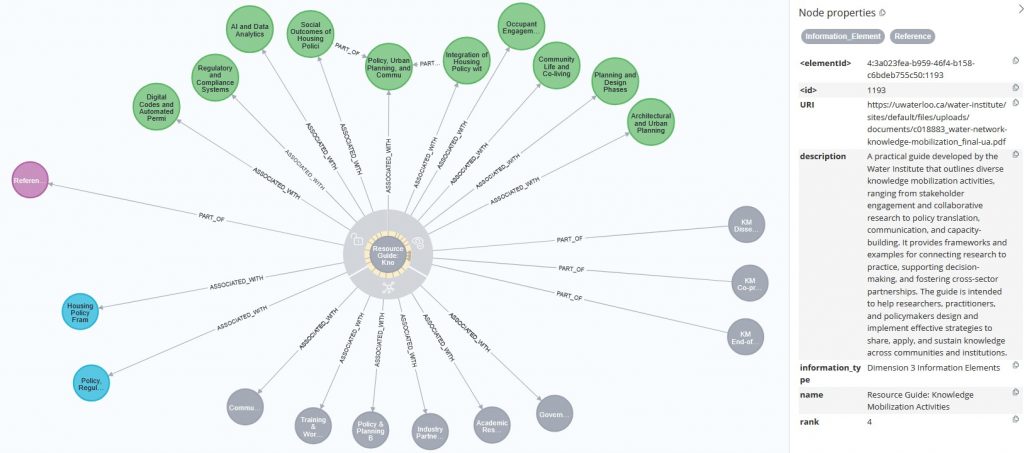
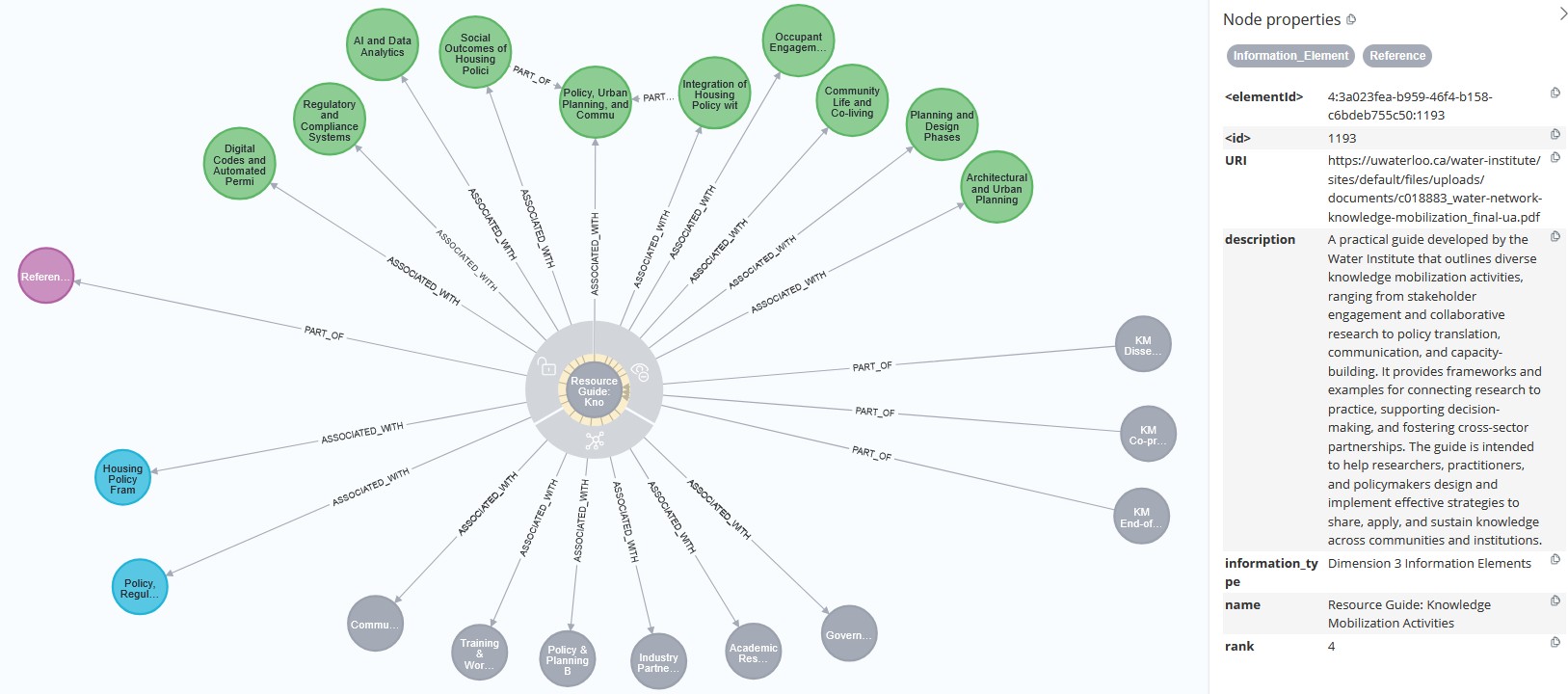
- The Guide includes three Knowledge Mobilization (KM) Guideline nodes that are PART_OF the Guide:
- KM Co-producing Research
- KM End-of-Grant
- KM Disseminating Research Outputs
- The Guide is ASSOCIATED_WITH multiple Topic Tree items (e.g., Planning and Design Phases; Architectural and Urban Planning; Integration of Housing Policy with Urban Planning; Occupant Engagement; Community Life and Co-living; Digital Codes and Automated Permitting; Regulatory and Compliance Systems; AI and Data Analytics).
- It also links to stakeholder groups (e.g., Policy & Planning Bodies; Government Agencies; Industry Partners; Academic & Research Institutions; Community Groups; Training & Workforce Development Bodies).
Aligned with the planed CIV tool integration, these links can let us ask focused questions like:
- “Show KM options for Digital Codes & Automated Permitting targeting municipal policymakers.”
- “What co-production activities connect to Integration of Housing Policy with Urban Planning?”
The example visualization (below) shows the Guide in the center, KM activities to the right, connected Topics above, Stakeholder groups below, and the broader References domain to the left. It’s a snapshot of how a single document becomes interoperable with everything else in the database:
Why do we think this matters
Housing systems are inherently complex, with technical, social, environmental, digital, and delivery dimensions constantly overlapping. By structuring knowledge in the way we do with the BPiBS database, we not only preserve provenance, so it’s always clear where information comes from, but also make it easier to compare across domains and spot connections that might otherwise remain hidden. Most importantly, this approach helps turn evidence into action: for example, identifying which knowledge mobilization activities are best suited to a given topic or stakeholder group. In short, the database doesn’t just store information, it makes it usable, comparable, and actionable for real-world housing challenges.