
By Madelaine Prince
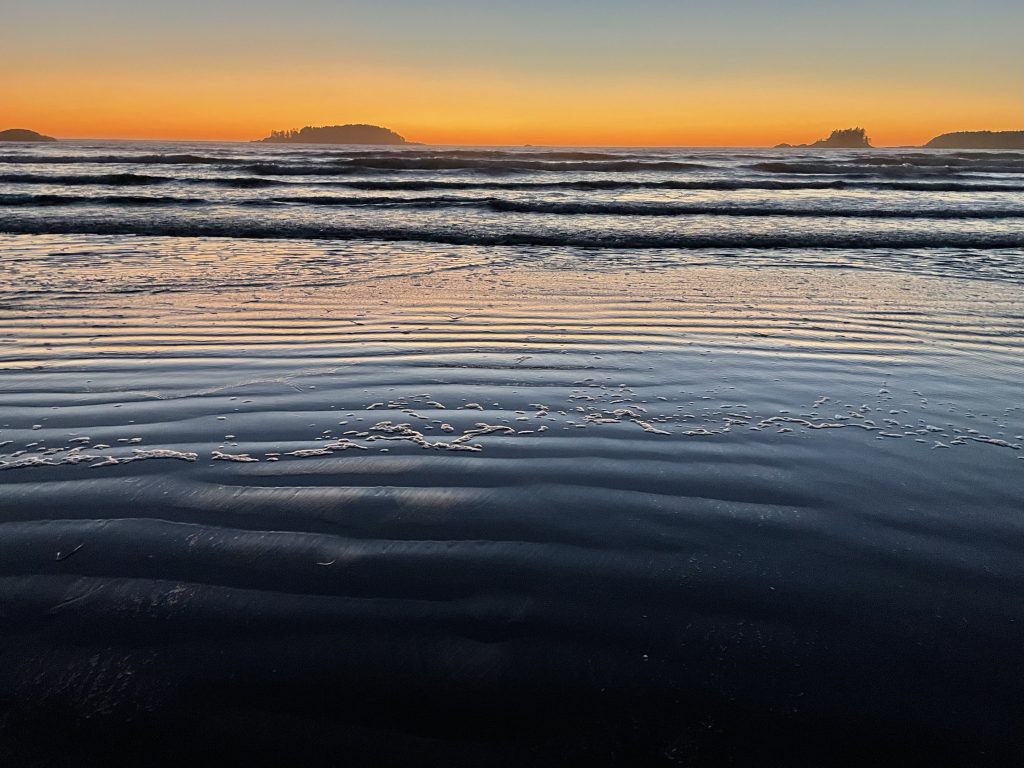
On Tuesday evening last week, while on my way to a community event, my phone rang. It was an automated call from the local government’s emergency operations centre. Living on the west coast of Vancouver Island, I’m signed up for tsunami and earthquake alerts, which typically arrive on Friday mornings as part of a routine test. But this was a Tuesday—and it wasn’t a test.
The message said a Tsunami Advisory had been issued. The threat level was unknown, and we were advised to stay alert for further information. I paused to check updates from news outlets, email, and social media where I learned that an 8.8-magnitude earthquake had struck off Russia’s Kamchatka Peninsula. Having been through a similar situation before, I mentally reviewed my emergency checklist, confirmed the location of our emergency kit, and contacted loved ones to ensure they too had received the alert. Despite the uncertainty, I felt at ease.
But it wasn’t always this way…
Back in January 2018, on a stormy night around 2 a.m., I was jolted awake by sirens. At first, I assumed they were ambulances, but a simultaneous phone call from a friend confirmed otherwise. A major earthquake off the coast of Alaska had triggered a Tsunami Warning. The sirens were signaling to evacuate to higher ground. I panicked. I had no plan, no emergency kit, and very little awareness of the tsunami risks in our region. In a scramble, I grabbed a few essentials—granola bars, a water bottle, some band-aids, a blanket—and frantically drove to my friend’s house above the hazard zone.
At the time, I was managing the local harbour authority, a vital hub for our coastal community. I was new in the role and had received no tsunami preparedness training. Frankly, I hadn’t even imagined anything like this, let alone prepared for it. All the emergency guidance I read online urged people to stay away from harbours and marinas, but we had no protocols in place. That night, as I tried to comprehend what was unfolding, I was grappling with the responsibility I held—for the harbour, the fishers, and the community—and the stark realization that we were unprepared. It was deeply unsettling.
Fortunately, the alert was downgraded and eventually cancelled later that morning. Although a tsunami did reach the region, the waves were minor. In the weeks and months that followed, I began actively learning about tsunami risk and emergency preparedness. I attended training, volunteered at community education sessions, and read as much as I could. I assembled grab-and-go kits for my home and car, and mapped response plans for different scenarios, considering variables such as season, time of day, and location. These steps gave me peace of mind.
Years later, while taking a futures thinking course, I revisited that experience with a fresh perspective. During a class on scenarios, our instructor posed a provocative question:
What if all communication systems went down—no internet, no phones, no radio, no TV? What would you do?
We were encouraged to take a minute to imagine ourselves in the situation and reflect on how we might feel, think, and act. As I sat with the question, my mind returned to that night in 2018 and the helplessness I had felt. Though the scenario didn’t seem unrealistic—especially given our growing dependence on technological systems and the vulnerability that creates—I was struck by the realization that I had no idea what I would do since I had never seriously imagined it before.
Then a classmate shared her story. She had been living in Cairo during the 2011 Egyptian revolution, when all telecommunications were abruptly shut down. She described the fear and uncertainty, but also the rapid adaptation: people revived landline networks, exchanged information in person, and found creative ways to organize and support each other. Her story opened our eyes to how communities can adapt when systems fail.
Hearing her experience shifted my mindset—from uncertainty to possibility. It helped me imagine how I might respond in a similar situation. That simple scenario planning exercise didn’t just build confidence; it made me realize that, perhaps unconsciously, I had already been cultivating resilience by imagining tsunami scenarios and planning responses. Scenario planning wasn’t just theoretical. It was a tool to learn from lived experience, sharpen adaptive skills, and prepare for plausible futures. Perhaps most importantly, it reminded me that resilience is relational. It’s not built in isolation, but nurtured through storytelling, shared knowledge, collective imagination, and care.
So, when last Tuesday’s tsunami alert came through, my response was completely different from 2018. I felt calm. I knew where to find reliable information and how to interpret it. I had the confidence to take informed action. I knew where my emergency kit was and what it contained. I was even able to reach out to friends and family to help them make sense of the information and offer support. That sense of preparedness came from imagining and planning for different scenarios—small steps that, over time, built resilience. In the end, the tsunami caused only minor waves along Vancouver Island’s beaches, and the advisory was cancelled early Wednesday.
Just a day later, on Thursday, a wildfire broke out on central Vancouver Island. It has since grown into what is now known as the Wesley Ridge fire. More than 500 people have been evacuated, with 387 properties under evacuation order and another 250 on alert. Over 200 personnel, supported by seven helicopters, have been working tirelessly to contain the fire, which is covering over 500 hectares. Thankfully, no homes have been lost, though conditions remain dangerously dry. Driving past the area this weekend after a hike, I found myself reflecting on how we build—not just our homes and infrastructure, but our capacity to respond.
While I was getting ready for work this morning, I heard an interview on the radio with the chief of a nearby volunteer fire department involved in the response. He spoke about how hard the crews were working, but more importantly, he emphasized that their ability to respond came from years of preparation. He shared that the teams had been training and planning for this kind of event for over a decade—using scenario-based exercises to build readiness.
His words echoed a question our research team has been exploring: what does it mean to be resilient in the face of complexity? These concepts are woven throughout the BPiBS initiative. Through this research collaboration, we’re applying futures thinking, scenario planning, and relational approaches to help Canada’s housing systems become more adaptive, sustainable, and equitable amid disruption—from climate events to economic shifts to technological transformation. Tools like scenario planning help us anticipate what’s ahead, respond with intention, and design systems that are not only more resilient, but also more inclusive and just.
Tuesday’s tsunami alert and the Wesley Ridge fire are powerful reminders: resilience doesn’t begin when the alert comes. It’s built over time, through the knowledge we share, the scenarios we prepare for, and the futures we imagine.
Photo credit: Madelaine Prince