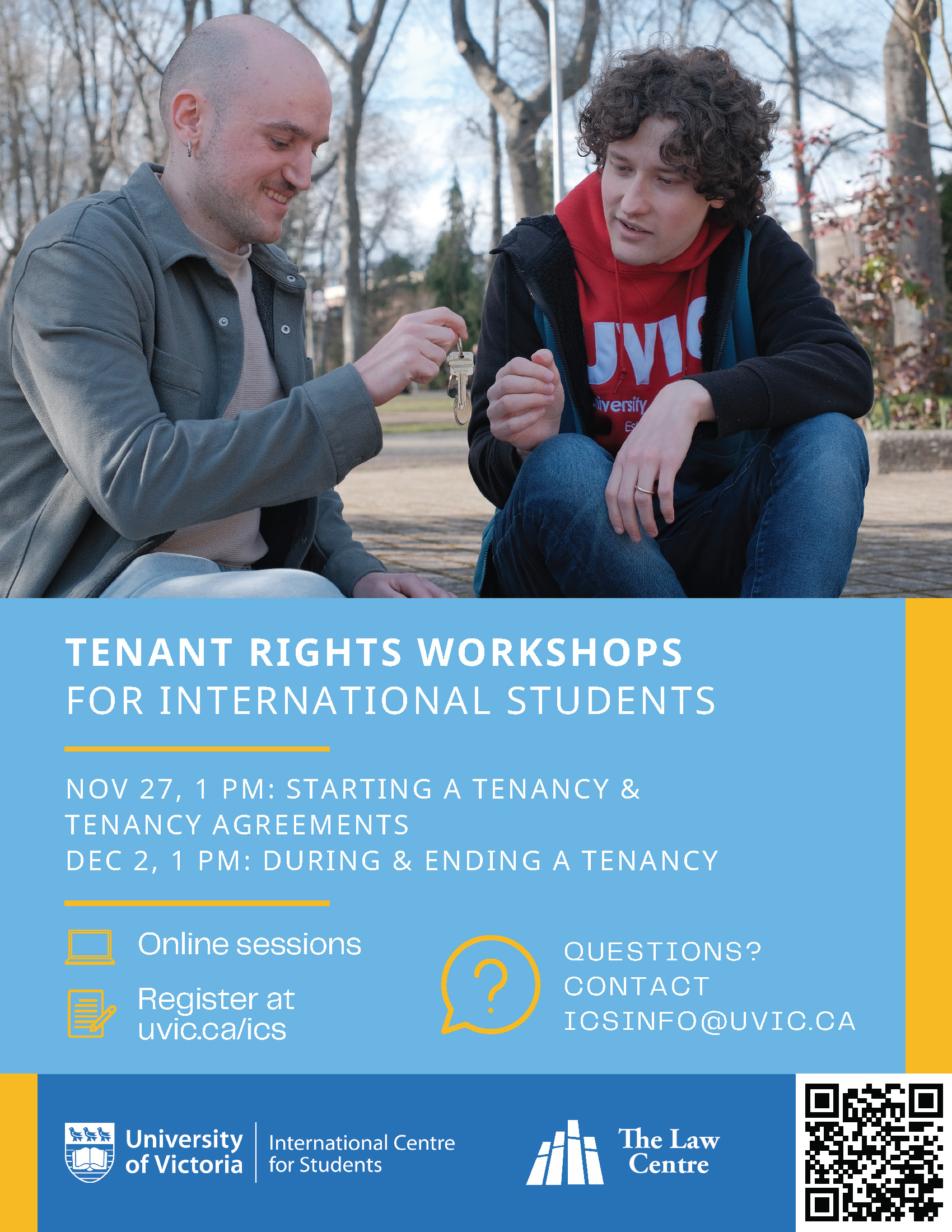
Co-hosted by the International Centre for Students and The Law Centre
In these two sessions, law students from The Law Centre will explore important information about tenant rights for international students. The sessions will cover the full range of experiences a student renter may have in BC, from starting a tenancy to ending one. They will provide useful information on tenancy agreements, the Residential Tenancy Act, and resolving housing disputes. Whether you are currently renting or planning to live off campus in the future, prepare yourself by learning more about your rights and responsibilities.
Session 1: Starting a Tenancy and Tenancy Agreements
Masters and PhD Opportunities in Modelling, Ecology, and Evolution of Microbes for Better Climate Predictions
The Ecosystems and Global Change Group (www.ecosystemchange.com) at Trent University jointly led by Prof Andrew Tanentzap (Canada Research Chair in Climate Change and Northern Ecosystems) and Dr Erik Emilson (Research Scientist, Canadian Forest Service sector of Natural Resources Canada, https://glfc-wet.github.io) is recruiting up to 3 funded positions for Autumn 2026 at the intersect of ecosystem ecology, microbiology, and computational modelling.
What we can offer: Our research training environment features some of the most advanced environmental research infrastructure in Canada, including access to a Fourier transform – ion cyclotron resonance mass spectrometer, a long-read and single-cell sequencing facility, radioisotope and stable isotope labs, and eddy covariance systems, with extensive support for field research (ATVs, snowmobiles, autonomous surface vessel). As our team partners with government scientists, you will have a unique opportunity to influence environmental policy and make connections outside of academia to bolster your career.
All postgraduate students are guaranteed at least $28k/year, considerably more than minimum stipends at Trent. Peterborough is one of the most affordable and desirable places to live in Ontario, offering the best of urban (70 mins to Toronto) and rural living all under 30 minutes to the heart of the Kawarthas that boasts endless lakes and forests to explore. Our group supports flexible working arrangements and supports applicants from diverse backgrounds as we strive to build a more equitable, diverse, and inclusive workplace. International applicants will be supported in applying for a Study Permit.
We are currently looking for students to work in two main areas:
1) PhD in Modelling microbe-molecule interactions for climate change
Human-driven land use change is one of the largest perturbations to the global carbon cycle, so is an essential lever to limit climate change. However, predictions of how land use impacts climate remain highly uncertain, precluding climate change mitigation and adaptation. A major shortcoming of state-of-the-art Earth system models used to predict climate change is that they assume: i) carbon exists in a handful of uniform pools and ii) microorganisms, which cause most carbon exchange between the atmosphere and both the land and oceans, interact identically with these pools.
In this PhD, you will develop mathematical models to predict consumer-resource dynamics based on the interactions between microbial decomposers and their organic substrates. The models will be used to predict fluxes of greenhouse gases from natural ecosystems. Data will come from existing studies and lab-based experiments. As the successful candidate, you will hold a Masters in mathematical biology, microbial ecology, or a related field. You will have skills in process-based modelling and some experience with lab work and publishing in peer-reviewed journals.
2) Masters or PhD in Environmental microbial ecology and evolution
Mobile genetic elements, including viruses, can have large impacts on the metabolism of their hosts in ways that ultimately alter biogeochemical cycles, but they remain mostly hidden from traditional sequencing approaches. A Masters project will develop molecular methods to improve the concentration and detection of mobile genetic elements in environmental samples with leading-edge single-cell encapsulation devices. A PhD will expand this research to exploit environmental archives (sediments, permafrost soils) and track what types of genes are being exchanged over evolutionary timescales that correspond with periods of large-scale climatic change.
The successful candidate will have undertaken an undergraduate thesis project (for MSc applicants) or Masters (for PhD applicants) in microbiology, molecular ecology, or a related field. You will have experience with molecular biology techniques (DNA extraction, sequencing library preparation) and bioinformatics. PhD applicants will be expected to have demonstrated some evidence of publishing or being about to publish in peer-reviewed journals.
We are also continuously interested in working with applicants motivated to develop their own research project in the areas described above and on our websites. Reach out with your ideas!
How to apply: Please email Andrew Tanentzap (atanentzap@trentu.ca) with a CV and brief cover letter describing what you hope to get out of working with us, how your research interests are a good fit to our group, and how your past experiences make you suitable for this position. Positions will remain open until filled. Only those applicants that are short-listed will be contacted. Applicants that are encouraged to enrol will be required to apply to Trent’s Environmental & Life Sciences (ENLS) Graduate Program (https://www.trentu.ca/els/). The absolute deadline to apply to ENLS for Sept 2026 entry is the 1 Feb 2026. Therefore, early contact is required to ensure that you have enough time to prepare a competitive application.
Crossroads aims to bring together the diverse disciplines in health sciences research, providing a platform for health practitioners, students, and researchers to present their work. In particular, we’re welcoming abstract submissions from undergraduate students or first-time conference attendees who would like the opportunity to present at a student-led, mutually supportive event. We’re holding our 22nd event at Dalhousie University’s Student Union in Halifax, Nova Scotia, from March 13th-14th, 2026.
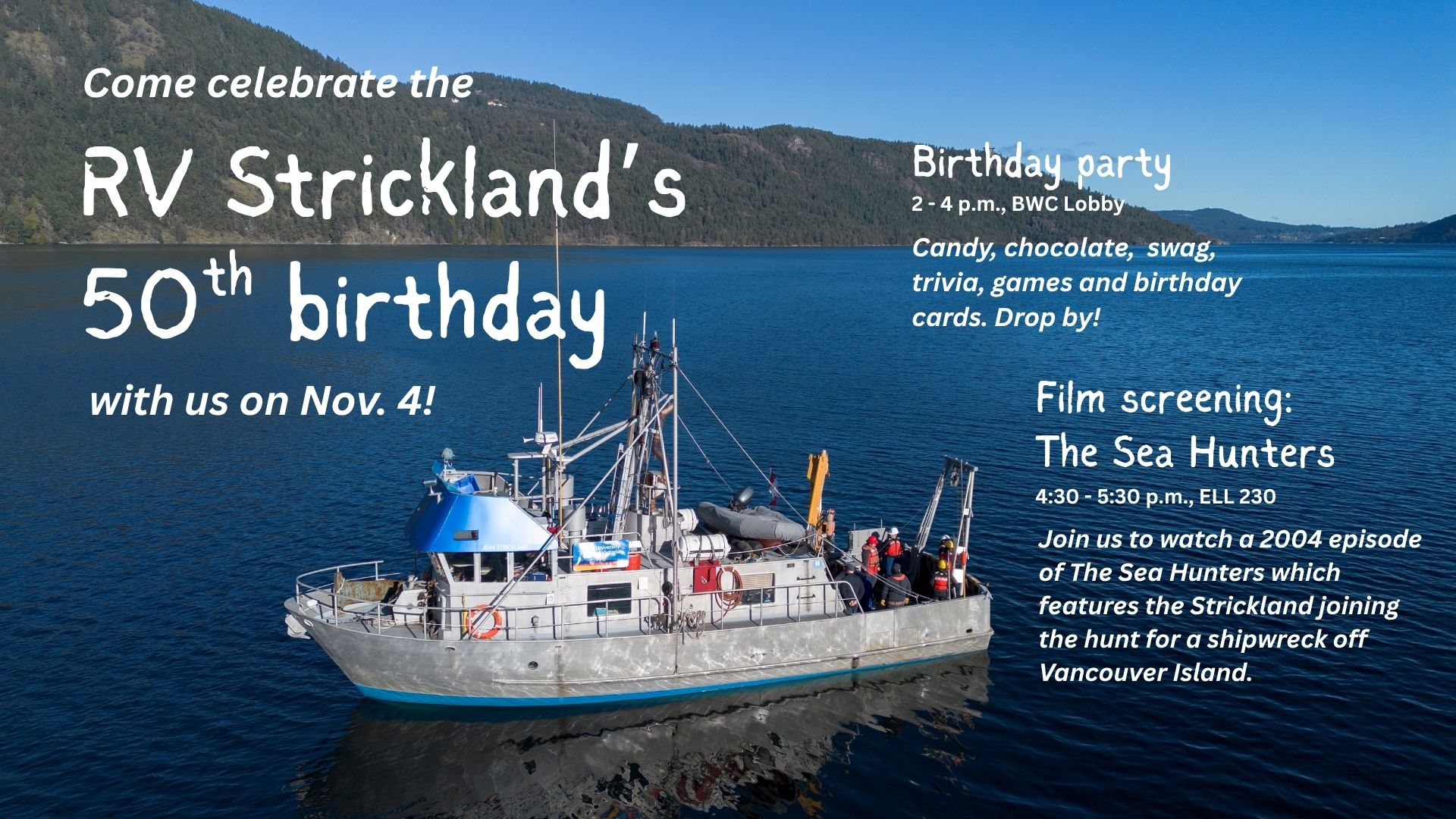
We’ll be tabling with candy, chocolate, trivia, games and birthday cards. Drop by anytime!
Film screening: The Sea Hunters
Nov. 4, 4:30 – 5:30 p.m., ELL 230
Join us to watch a 2004 episode of The Sea Hunters, which features the Strickland (and Captain Ken!) joining the hunt for a shipwreck off Vancouver Island. (We found the episode on a videocassette in our storage room, and thought students might be interested in watching!).
Join Ocean of Data Challenge Kickoff, featuring Ocean Tracking Network. Hosted by DeepSense, COVE, and ShiftKey Labs, this exciting challenge offers a unique opportunity to collaborate and develop innovative ideas! The free event kicks off on Thursday, October 16th, at 6 pm ADT with an introduction to the challenge, expert presentations, and a Q&A session to help fuel your creativity. Participants must submit video entries by 11:59 pm ADT on Monday, November 3rd. Judges will review submissions over the following week, and winners will be announced on Wednesday, November 12th.
Dive into the challenge, innovate with your unique approach, and develop bold solutions to advance the ocean sector! Oh, and in case you missed it, win cash prizes!
Who should participate?
Great ideas often emerge from diverse perspectives, so we encourage students from all disciplines to participate – whether that be computer science, engineering, biology, sustainability, business, or any other program! Participants must be current students (full-time or part-time) or recent graduates (within the past 12 months) of a post-secondary institution in Canada. You can choose to work solo or collaborate with a team of up to five members.
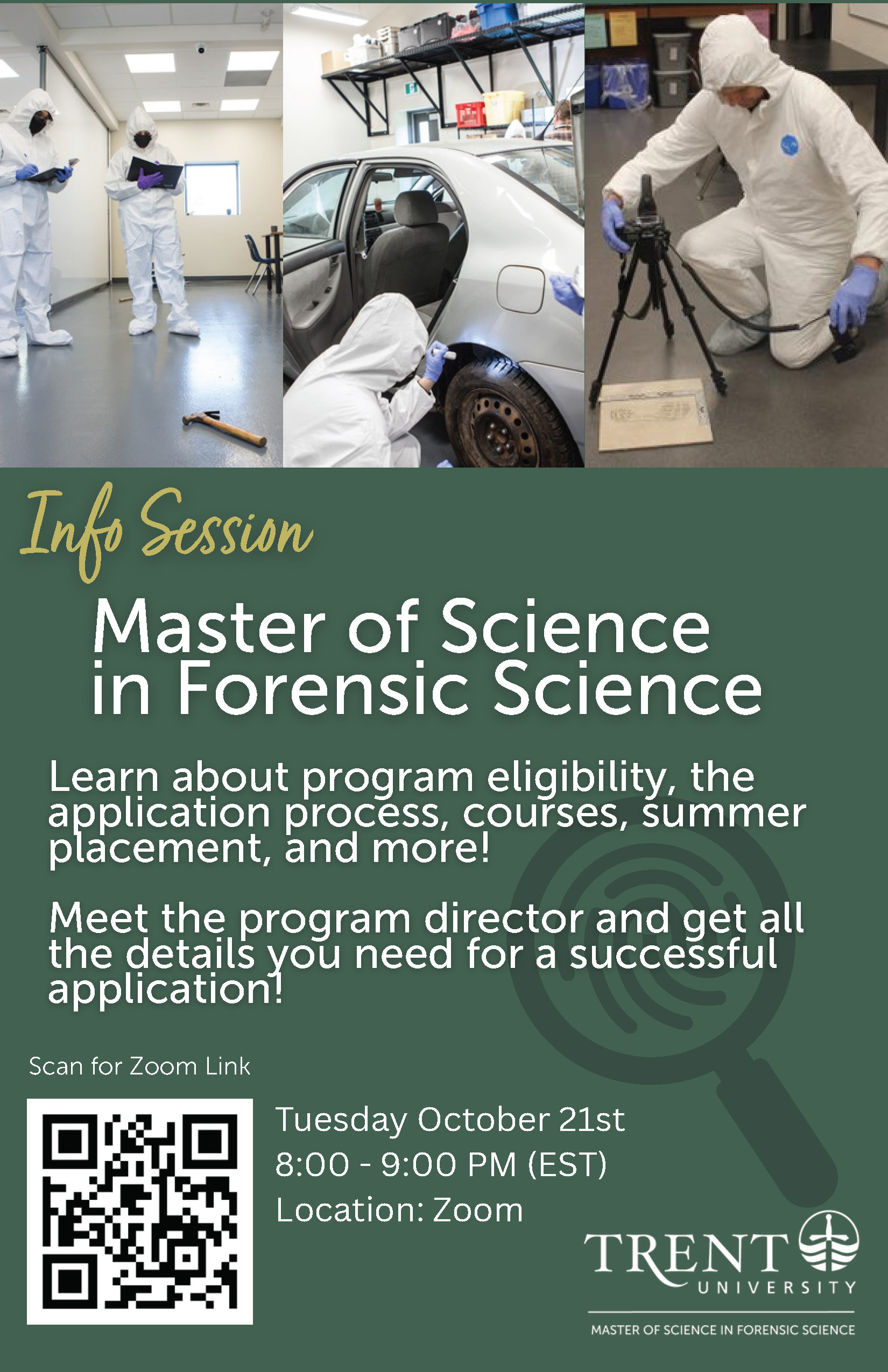
We are excited to invite you to our upcoming Zoom session dedicated to those interested in pursuing graduate studies in Forensic Science. This will be an information session for the September 2026 intake in the MScFS program. If you’ve been considering advancing your education, better preparing yourself for the job market, or both, this is the perfect opportunity to learn more about our MSc. Forensic Science program at Trent University. We are currently accepting applications; our early application deadline is November 1, 2025.
The field of sustainability is dynamic, interdisciplinary, and more critical than ever. But how do you turn your passion for environmental and social responsibility into a tangible career path?
This online panel discussion connects you directly with a diverse group of professionals who are actively shaping the future of sustainability in our community and beyond. From hands-on conservation and scientific consulting to climate journalism and public policy, our panelists will share their unique career journeys, insights, and advice for students looking to enter the field. This is your opportunity to ask questions, learn about different sectors, and see the many ways your degree can make a difference.
At this event, you will:
Learn about the diverse career paths available within the broad field of sustainability.
Hear directly from leaders working in non-profit, corporate, academic, and government sectors.
Ask your own questions and hear panelists’ perspectives on curated topics submitted by students.
Discover resources and gain practical advice for launching your own career.
Meet the Panelists:
Cara Gibson – Executive Director, Swan Lake Nature Sanctuary
Erika Grebeldinger – Marine Biologist, WSP
Sean Holman – Associate Professor & Wayne Crookes Professor of Environmental and Climate Journalism, UVic
Kara Shaw – Program Lead, Transformative Climate Action Certificate, UVic Continuing Studies
Kenneth Porter – Manager, BC Public Service
Event Details:
Date: Wednesday, October 22, 2025
Time: 4:30 PM – 6:00 PM PDT
Audience: Open to all UVic undergraduate and graduate students.